


doi: 10.1002/anie.201307387.
Epub 2013 Nov 20.
Therapeutic targeting of oncogenic K-Ras by a covalent catalytic site inhibitor
Affiliations
- PMID: 24259466
- PMCID: PMC3914205
- DOI: 10.1002/anie.201307387
Item in Clipboard
Therapeutic targeting of oncogenic K-Ras by a covalent catalytic site inhibitor
Angew Chem Int Ed Engl.
.
Abstract
We report the synthesis of a GDP analogue, SML-8-73-1, and a prodrug derivative, SML-10-70-1, which are selective, direct-acting covalent inhibitors of the K-Ras G12C mutant relative to wild-type Ras. Biochemical and biophysical measurements suggest that modification of K-Ras with SML-8-73-1 renders the protein in an inactive state. These first-in-class covalent K-Ras inhibitors demonstrate that irreversible targeting of the K-Ras guanine-nucleotide binding site is potentially a viable therapeutic strategy for inhibition of Ras signaling.
Keywords: K-Ras; cancer; covalent inhibitors; drug design.
Copyright © 2014 WILEY-VCH Verlag GmbH & Co. KGaA, Weinheim.
Figures
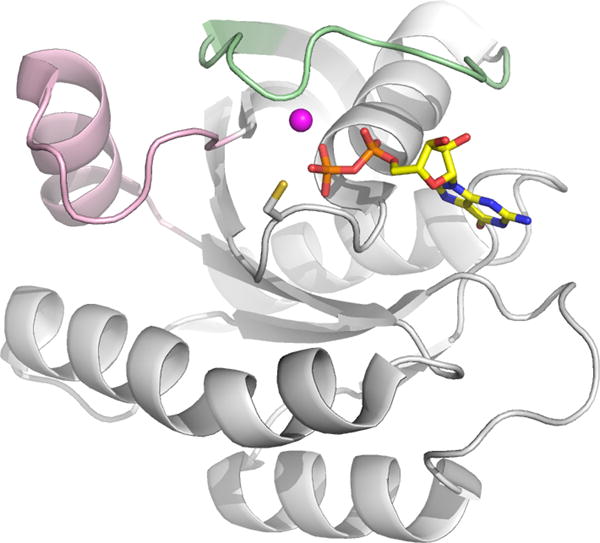
Model of K-Ras G12C bound to GDP (sticks). Cysteine 12 is located in the P-loop opposite the catalytic magnesium (magenta ball) and switches 1 (green) and 2 (pink). Model based on PDB: 4EPR.
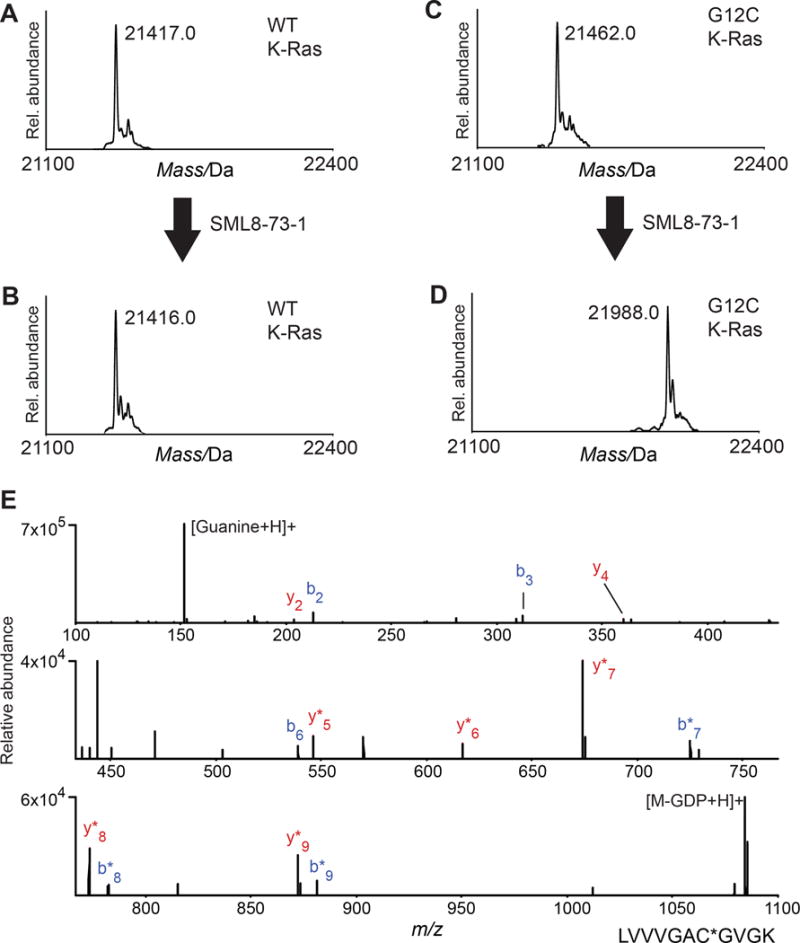
SML-8-73-1 reacts quantitatively with K-Ras G12C, but does not label WT K-Ras. Deconvoluted electrospray mass spectra obtained for (A,B) WT K-Ras and (C,D) K-Ras G12C (A,C) before and (B,D) after incubation with 2.5 mM SML-8-73-1. A mass increase of 526 Da (compound-HCl) was observed only after treatment of K-Ras G12C, indicating covalent labeling of the protein. (E) HCD MS/MS spectrum of SML-8-73-1 modified K-Ras G12C peptide (residues 6–16). Ions of type b and y are shown in blue and red, respectively, and localize the modification to C12. GDP, guanosine diphosphate; *, loss of GDP.
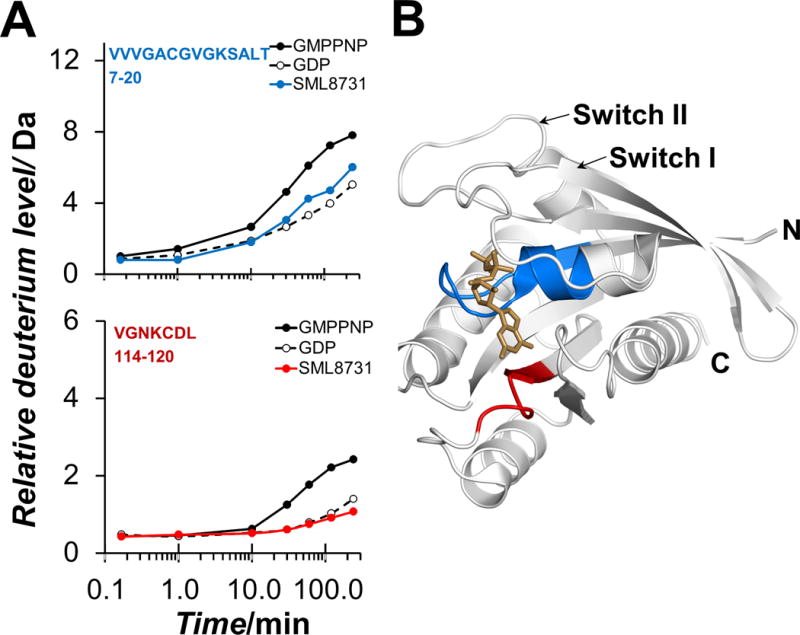
Summary of differences in deuterium exchange in K-Ras G12C bound to GMPPNP, GDP, and SML-8-73-1. Hydrogen deuterium exchange suggests that SML-8-73-1 places K-Ras G12C in the inactive state. (A) Relative deuterium uptake curves for two key peptides (top: residues 7–20, VVVGACGVGKSALT; bottom: residues 114–120, VGNKCDL) showing differences in deuterium incorporation. These are representative data: each data point is the average of duplicate mass determinations from one of three triplicates of the entire experimental measurement (see supporting information). (B) Location of the two regions from panel A, on PDB file 4Q21. GDP is shown in brown, residues 7–20 in blue, and residues 114–120 in red.
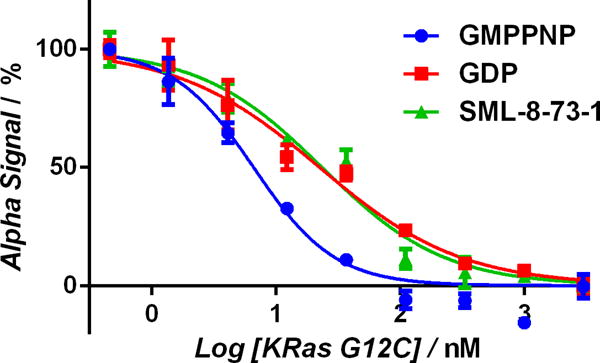
Alpha assay confirms that modification with SML-8-73-1 renders K-Ras G12C biochemically inactive. Untagged GMPPNP-loaded K-Ras G12C was incubated with a 10 fold molar excess GDP (red), SML-8-73-1 (green) or buffer (blue). Under these conditions K-Ras G12C becomes completely labelled by SML-8-73-1 or loaded with GDP or GMPPNP. These K-Ras G12C preparations were then added at the indicated concentrations to compete for binding with Alpha-tagged K-Ras G12C (donor):Raf-RBD (acceptor) complexes which had been pre-formed. SML-8-73-1-bound K-Ras G12C (green) resembles GDP-bound K-Ras G12C (red) with respect to affinity for Raf-RBD.
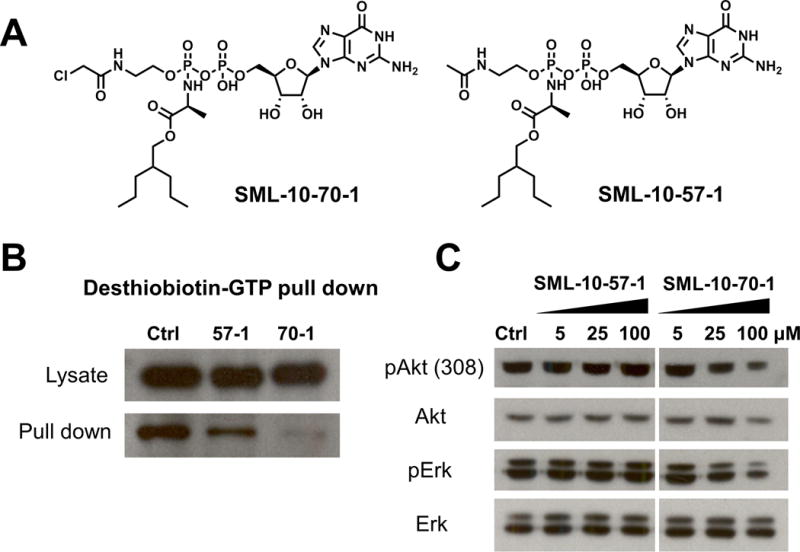
The caged analogue SML-10-70-1 is cell permeable and disrupts Ras signaling. (A) Chemical structrues of caged SML-10-70-1 and the non-reactive negative control, SML-10-57-1. (B) Treatment of H358 cells with SML-10-70-1 at 100 μM prior to probing with desthiobiotin-GTP decreases the amount of K-Ras which can be pulled down with streptavidin as compared to cells treated with non-reactive control suggeting that SML-10-70-1 penetrates into cells and accesses the active site of K-Ras-G12C. (C) Treatment of H358 cells with SML-10-70-1 decreases levels of pErk and pAkt as compared to treatment with negative control (SML-10-57-1) suggesting a compound-dependent effect on K-Ras signaling.
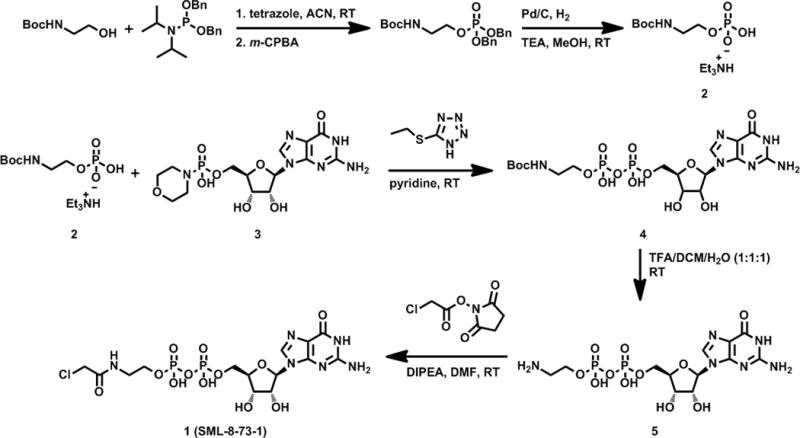
Synthesis of SML-8-73-1.
References
-
- Barbacid M. Annu Rev Biochem. 1987;56:779–827. - PubMed
-
- Milburn MV, Tong L, deVos AM, Brunger A, Yamaizumi Z, Nishimura S, Kim S-H. Science. 1990;247:939–945. - PubMed
-
- Kim S-H, Privé GG, Milburn MV. In: Handbook of Experimental Pharmacology, Vol. 108/I: GTPases in Biology. Dickey BF, Birnbaumer L, editors. Springer-Verlag; Berlin Heidelberg: 1993. pp. 177–194.
-
- Vetter IR, Wittinghofer A. Science. 2001;294:1299–1304. - PubMed
-
- Scheffzek K, Ahmadian MR, Kabsch W, Wiesmüller L, Lautwein A, Schmitz F, Wittinghofer A. Science. 1997;277:333–338. - PubMed
Publication types
MeSH terms
Substances
Grants and funding
LinkOut - more resources
Full Text Sources
Other Literature Sources
Miscellaneous
