


Is increased red cell distribution width an indicating marker of nonalcoholic steatohepatitis and fibrotic stage?
- PMID: 24259972
- PMCID: PMC3831223
- DOI: 10.3748/wjg.v19.i42.7412
Is increased red cell distribution width an indicating marker of nonalcoholic steatohepatitis and fibrotic stage?
Abstract
Aim: To evaluate the red cell distribution width (RDW) as an indicator of the presence of non-alcoholic steatohepatitis (NASH) and its association with fibrotic scores.
Methods: A retrospective study was carried out that included sixty-two biopsy proven NASH, 32 simple steatosis patients and 30 healthy controls. The correlation between the clinical and histopathological features of NASH patients and RDW values was evaluated. Liver fibrosis scores were measured using a 0 to 4 point scale and were divided in to two groups; fibrosis scores 0-1 were termed mild and fibrosis scores 2-4 were termed advanced fibrosis. RDW values were compared between NASH, simple steatosis and healthy controls. Univariate and multivariate analyses were performed to evaluate the independent predicting factors for the presence of liver fibrosis caused by NASH.
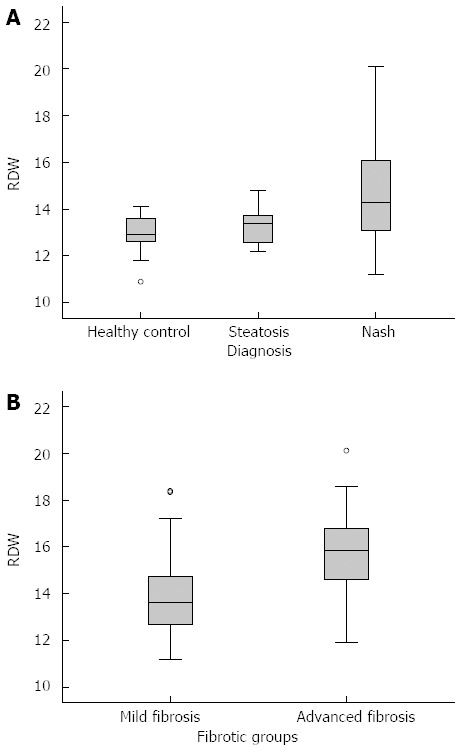
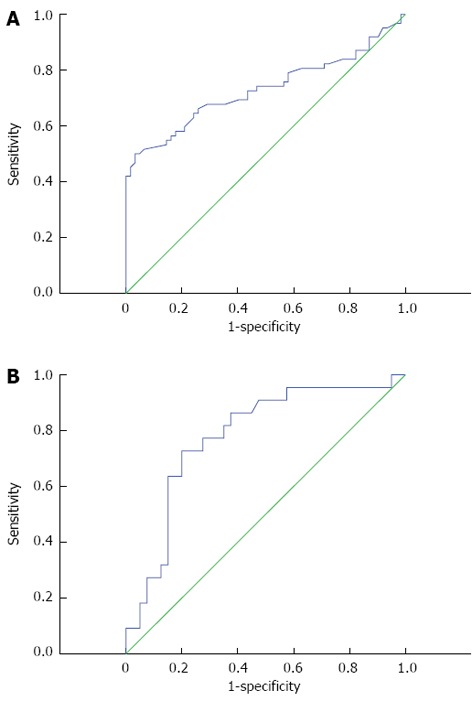
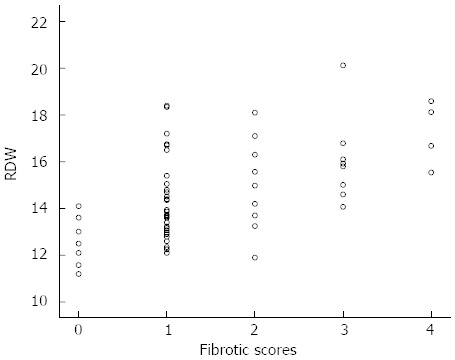
Results: Patients with NASH had higher RDW values compared with simple steatosis and healthy control groups [14.28% ± 0.25% vs 13.37% ± 0.12%, 12.96% ± 0.14% (P < 0.01), respectively]. Patients with advanced fibrosis had higher RDW values than the mild fibrosis group (15.86% ± 0.4% vs 13.63% ± 0.67%, P < 0.01, respectively). RDW also correlated with fibrotic scores (r = 0.579 and P < 0.01). The variables that were significant in the univariate analysis were evaluated in multivariate logistic regression analysis, and RDW was an independent predicting factor of NASH (OR = 1.75, 95%CI: 1.129-2.711, P < 0.05).
Conclusion: RDW a new non-invasive marker that can be used to demonstrate the presence of NASH and indicate advanced fibrotic scores.
Keywords: Liver biopsy; Liver fibrosis; Non-alcoholic steatohepatitis; Non-invasive marker; Red cell distribution width; Simple steatosis.
Figures
Comment in
-
Is increased red cell distribution width an indicating marker of nonalcoholic steatohepatitis and fibrotic stage?World J Gastroenterol. 2014 Sep 21;20(35):12711-2. doi: 10.3748/wjg.v20.i35.12711. World J Gastroenterol. 2014. PMID: 25253983 Free PMC article.
-
Red cell distribution width and nonalcoholic steatohepatitis.World J Gastroenterol. 2014 Nov 21;20(43):16387-8. doi: 10.3748/wjg.v20.i43.16387. World J Gastroenterol. 2014. PMID: 25473202 Free PMC article.
References
-
- Brunt EM. Nonalcoholic steatohepatitis: pathologic features and differential diagnosis. Semin Diagn Pathol. 2005;22:330–338. - PubMed
-
- Browning JD, Szczepaniak LS, Dobbins R, Nuremberg P, Horton JD, Cohen JC, Grundy SM, Hobbs HH. Prevalence of hepatic steatosis in an urban population in the United States: impact of ethnicity. Hepatology. 2004;40:1387–1395. - PubMed
-
- Clark JM. The epidemiology of nonalcoholic fatty liver disease in adults. J Clin Gastroenterol. 2006;40 Suppl 1:S5–10. - PubMed
-
- Lazo M, Clark JM. The epidemiology of nonalcoholic fatty liver disease: a global perspective. Semin Liver Dis. 2008;28:339–350. - PubMed
MeSH terms
LinkOut - more resources
Full Text Sources
Other Literature Sources
Medical
