


Serum Markers of Inflammation and Endothelial Function are Elevated by Hormonal Contraceptive Use but not by Exercise-Associated Menstrual Disorders in Physically Active Young Women
- PMID: 24259996
- PMCID: PMC3827565
Serum Markers of Inflammation and Endothelial Function are Elevated by Hormonal Contraceptive Use but not by Exercise-Associated Menstrual Disorders in Physically Active Young Women
Abstract
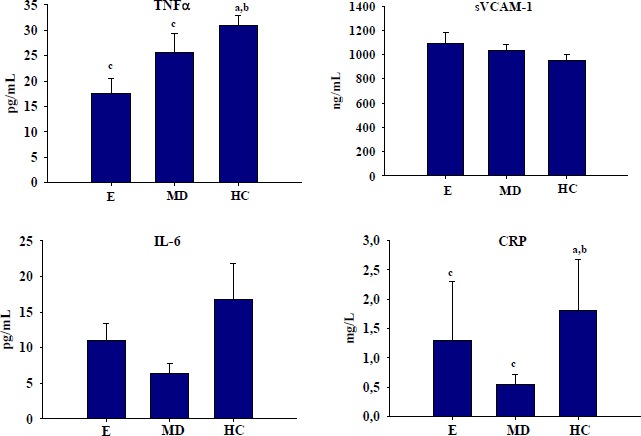
The purpose of the study was to determine the effects of exercise-associated menstrual disorders and hormonal contraceptives (HC) on systemic inflammatory markers and endothelial function in female athletes. Thirty-nine active women (≥5 h of aerobic exercise per wk), aged 18-33 y, participated in this cross-sectional study comparing women with menstrual disorders (MD, n = 10; 0-9 cycles·y(-1)), eumenorrheic women (E, n = 13; 10-13 cycles·y(-1)), and HC users (HC, n = 16; 12 cycles·y(-1)). Fasting serum samples were collected during the early follicular phase (d2-5) for the menstruating women. Tumor necrosis factor-α (TNFα), interleukin-6 (IL-6), C-reactive protein (CRP), soluble vascular adhesion molecule-1 (sVCAM-1), total cholesterol (TC), high- and low density lipoprotein-cholesterol (HDL-C, LDL-C), triglycerides (TG), reproductive hormones, and cortisol were measured in serum. Estradiol, progesterone, and cortisol were not statistically different between MD and E groups; cortisol was significantly greater in the HC versus E group (p = 0.002). TC (p = 0.005), LDL-C (p = 0.03), and CRP (p = 0.05) were increased in the HC versus MD and E groups. TNF-α was significantly higher in the HC (p=0.001) compared with the E group. There were no significant group differences in the concentrations of sVCAM-1 or IL-6. TNF-α and cortisol were positively correlated (r=0.31, p = 0. 058), as were sVCAM-1 and estradiol (r = 0.41, p = 0.010). In conclusion, HC use, but not exercise- associated menstrual disorders, is associated with increased TNFα and LDL-C. Key PointsSerum lipids and markers of inflammation were not altered by exercise-associated oligomenorrhea or amenorrhea.Hormonal contraceptive users had elevated total and LDL cholesterol compared with regularly menstruating non-HC users.C-reactive protein and tumor necrosis factor-α, but not soluble vascular adhesion molecule-1, were increased in hormonal contraceptive users.The long-term effect of these changes on cardiovascular disease is unknown.
Keywords: Cytokines; female reproductive disorders; soluble vascular adhesion molecule.
Figures
References
-
- Ainsworth B.E., Haskell W.L., Whitt M.C., Irwin M.L., Swartz A.M., Strath S.J., O’Brien W.L., Bassett D.R., Jr., Schmitz K.H., Emplaincourt P.O., Jacobs D.R., Jr., Leon A.S. (2000) Compendium of physical activities: an update of activity codes and MET intensities. Medicine and Science in Sports and Exercise 32, 498-504 - PubMed
-
- Cary N.S.I.I. (1999) Statistical analyses system. Version 8.2. Cary, NC: SAS Institute Inc.
-
- Cybulsky M.I., Gimbrone M.A., Jr. (1991) Endothelial expression of a mononuclear leukocyte adhesion molecule during atherogenesis. Science 251, 788-791 - PubMed
-
- Dreon D.M., Slavin J.L., Phinney S.D. (2003) Oral contraceptive use and increased plasma concentration of C-reactive protein. Life Science 73, 1245-1252 - PubMed
-
- Dubey R.K., Imthurn B., Zacharia L.C., Jackson E.K. (2004) Hormone replacement therapy and cardiovascular disease: what went wrong and where do we go from here? Hypertension 44, 789-795 - PubMed
LinkOut - more resources
Full Text Sources
Research Materials
Miscellaneous