Review
. 2014 Jan-Feb;6(1):73-85.
doi: 10.4161/mabs.27240.

Drugs derived from phage display: from candidate identification to clinical practice

Review

Drugs derived from phage display: from candidate identification to clinical practice

Andrew E Nixon et al. MAbs. 2014 Jan-Feb.

Abstract

Phage display, one of today’s fundamental drug discovery technologies, allows identification of a broad range of biological drugs, including peptides, antibodies and other proteins, with the ability to tailor critical characteristics such as potency, specificity and cross-species binding. Further, unlike in vivo technologies, generating phage display-derived antibodies is not restricted by immunological tolerance. Although more than 20 phage display-derived antibody and peptides are currently in late-stage clinical trials or approved, there is little literature addressing the specific challenges and successes in the clinical development of phage-derived drugs. This review uses case studies, from candidate identification through clinical development, to illustrate the utility of phage display as a drug discovery tool, and offers a perspective for future developments of phage display technology.


Figures
None
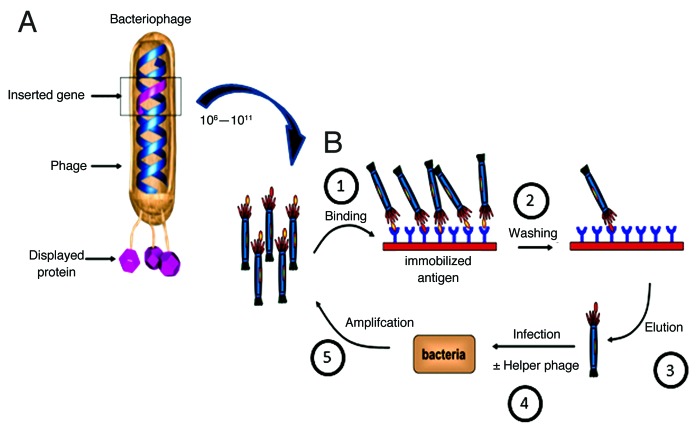
Figure 1. Phage display and selection. (A) A bacteriophage highlighting the genotype-phenotype coupling that is fundamental to phage display technology. The gene of interest (pink) is cloned into the gene 3 protein (g3p) of phage DNA, which results in the display of the pink protein product (antibody, peptide) on the surface of the phage as a polypeptide fusion. (B) Overview of phage display selection process. (1) A phage library containing 10^6-10^11 clones is incubated with immobilized antigen. (2) Unbound phage are removed by washing. (3) Bound phage are eluted. (4) E.coli are infected with eluted phage with or without helper phage to amplify eluted candidates. (5) Cells are plated onto selective plates and amplified. Process is reiterated 2–3 times resulting in enriched population of antibody/peptide fragments for the antigen of interest. Additional site directed mutagenesis or depletion approaches can be used to further tune desired antibody properties. Adapted and reproduced with permission from Buckler D, Schofield D, Sexton DJ, Lowe D and Vaughan TJ. Selection and screening of antibody phage display libraries. In: Wood CR, ed. Antibody Drug Discovery.©2012 World Scientific Publishing Co.
None
Figure 2. Depletion strategy for selecting specific bioactive epitopes. In this strategy, a library of candidates is applied to immobilized antigen in the presence of a competitor that binds at the active site of interest. The competitor will prevent the binding of displayed candidates with similar binding characteristics, while allowing undesired candidates to bind. Unbound candidates in solution can be collected and applied to immobilized antigen, this time without the competitor. Such a strategy can facilitate the discovery of therapeutic candidates with exquisite specificity that would not be feasible using in vivo methods.

References

    1. Drews J. Drug discovery: a historical perspective. Science. 2000;287:1960–4. doi: 10.1126/science.287.5460.1960. - DOI - PubMed
    1. Bradbury AR, Sidhu S, Dübel S, McCafferty J. Beyond natural antibodies: the power of in vitro display technologies. Nat Biotechnol. 2011;29:245–54. doi: 10.1038/nbt.1791. - DOI - PMC - PubMed
    1. Buckler DR, Schofield D, Sexton DJ, Lowe D, Vaughan TJ. Selection and Screening of Antibody Phage Display Libraries. In: Wood CR, ed. Antibody Drug Discovery. London: Imperial College Press, 2012.
    1. Markland W, Ley AC, Ladner RC. Iterative optimization of high-affinity protease inhibitors using phage display. 2. Plasma kallikrein and thrombin. Biochemistry. 1996;35:8058–67. doi: 10.1021/bi952629y. - DOI - PubMed
    1. Markland W, Ley AC, Lee SW, Ladner RC. Iterative optimization of high-affinity proteases inhibitors using phage display. 1. Plasmin. Biochemistry. 1996;35:8045–57. doi: 10.1021/bi9526286. - DOI - PubMed

MeSH terms

Substances
