. 2014 Apr;30(4):631-8.
doi: 10.1007/s00381-013-2315-1. Epub 2013 Nov 22.

Diffusion tensor imaging of deep gray matter in children treated for brain malignancies

Affiliations

Diffusion tensor imaging of deep gray matter in children treated for brain malignancies

Alena Horská et al. Childs Nerv Syst. 2014 Apr.

Abstract

Purpose: Previous DTI studies reported microstructural changes in white matter of patients receiving treatment for brain malignancies. The primary aim of this prospective pilot longitudinal study was to examine if DTI can detect microstructural changes in deep gray matter (as evaluated by the apparent diffusion coefficient, ADC) between pediatric patients treated with cranial radiation therapy and typically developing healthy children. The relationship between ADC and neurobehavioral performance was also examined.

Methods: ADC was measured at 1.5 T in the caudate, putamen, globus pallidus, thalamus, and hippocampus in nine patients (mean age 11.8 years) and nine age-matched healthy controls. The study was designed with four visits: baseline, 6-month, 15-month, and 27-month follow-ups.

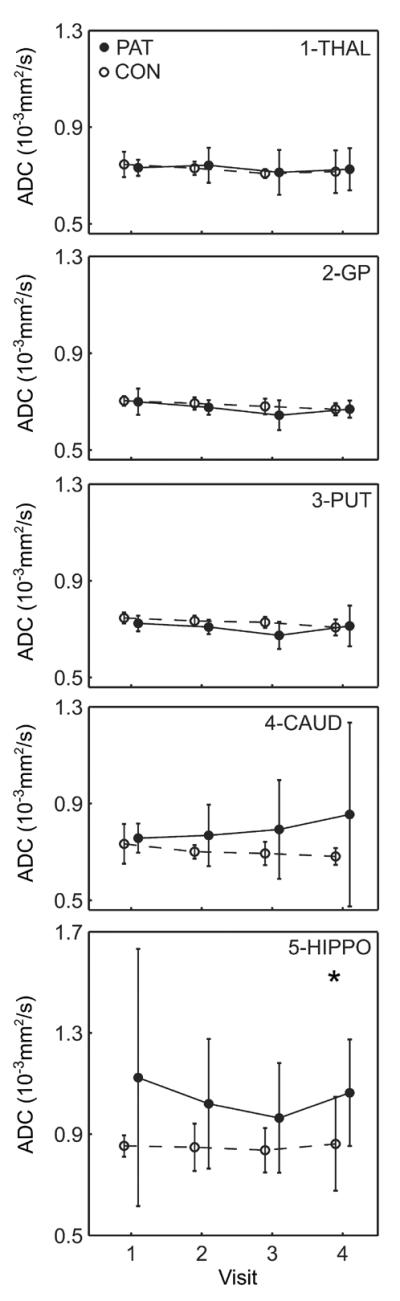
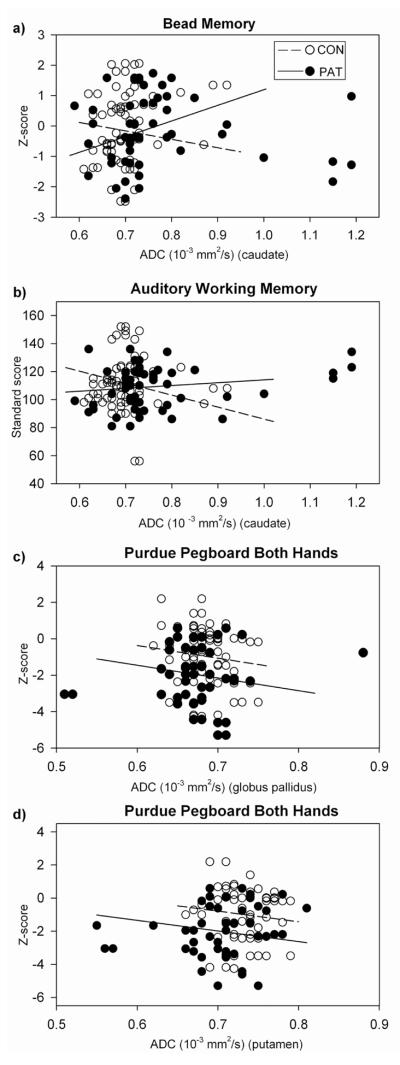
Results: Patients had 24 % higher overall mean ADC in the hippocampus compared with controls (p = 0.003). Post hoc analyses revealed significantly elevated ADC at baseline (p = 0.003) and at the 27-month follow-up (p = 0.006). Nevertheless, patients performed normally on a verbal memory test considered to be a hippocampus-related function. Relative to controls, patients' performance on the tests of the visual-spatial working memory decreased over time (group by visit, p = 0.036). Both patients and controls showed a decline in motor speed with increasing ADC in the globus pallidus and putamen.

Conclusions: Childhood brain malignancies and their treatment may affect gray matter microstructure as measured by water diffusion. Significant findings in the hippocampus but not other regions suggest that differences in tissue sensitivity to disease- and treatment-related injury among gray matter regions may exist. ADC in basal ganglia may be associated with motor performance.


Figures
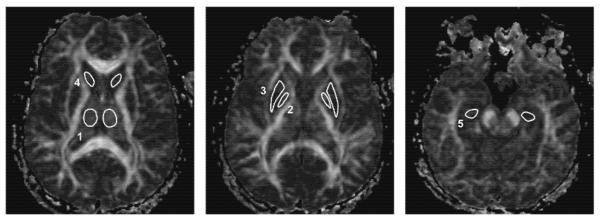
Figure 1
Figure 1
Five regions of interest drawn on the FA map of a 12 year-old healthy control. Regions 1 (thalamus) and 4 (caudate head) are shown on the left image, regions 2 (globus pallidus) and 3 (putamen) are shown on the center image, and region 5 (hippocampal head) is shown on the right image.
Figure 2
Figure 2
Comparison of mean ADC values in the thalamus (THAL), globus pallidus (GP), putamen (PUT), caudate (CAUD), and hippocampus (HIPPO) between patients and healthy controls at the four visits. The error bars represent standard deviations. Significant group differences between patients and healthy children (hippocampus, main LME analysis: p<0.01) are marked by an asterisk.
Figure 3
Figure 3
Relationship between neuropsychological performance and ADC in subcortical gray matter. Data from all subjects at all visits are presented in the figure. The regression lines represent changes in neuropsychological test scores with ADC averaged across the four visits in patients and controls. The regression lines were calculated from all significant factors that comprised the final models of the respective LME analyses comparing both groups. Compared with least squares regression lines, LME regression lines take into account the variability of the data. In all LME analyses, the p values including the factor “ADC” or the interaction “ADC” by “visit” were ≤0.02. In controls, neuropsychological performance on working memory (a, b) and motor (c, d) tests improved with decreasing ADC. In patients, motor performance decreased with increasing ADC in the globus pallidus (c) and putamen (d), although at overall reduced scores. For the tests on working memory (a, b), the relationship between the test scores and ADC did not follow the trends observed in controls. We note that the calculations of the regression lines for patients in (a) and (b) included only data for ADC<1.1 ·10−3 mm2/s; the outliers are still shown in the Figure.

References

    1. Aukema EJ, Caan MW, Oudhuis N, Majoie CB, Vos FM, Reneman L, Last BF, Grootenhuis MA, Schouten-van Meeteren AY. White matter fractional anisotropy correlates with speed of processing and motor speed in young childhood cancer survivors. Int J Radiat Oncol Biol Phys. 2009;74:837–843. - PubMed
    1. Ball WS, Jr., Prenger EC, Ballard ET. Neurotoxicity of radio/chemotherapy in children: pathologic and MR correlation. AJNR Am J Neuroradiol. 1992;13:761–776. - PMC - PubMed
    1. Bonekamp D, Nagae LM, Degaonkar M, Matson M, Abdalla WM, Barker PB, Mori S, Horska A. Diffusion tensor imaging in children and adolescents: reproducibility, hemispheric, and age-related differences. Neuroimage. 2007;34:733–742. - PMC - PubMed
    1. Butler RW, Haser JK. Neurocognitive effects of treatment for childhood cancer. Ment Retard Dev Disabil Res Rev. 2006;12:184–191. - PubMed
    1. Cercignani M, Bozzali M, Iannucci G, Comi G, Filippi M. Magnetisation transfer ratio and mean diffusivity of normal appearing white and grey matter from patients with multiple sclerosis. J Neurol Neurosurg Psychiatry. 2001;70:311–317. - PMC - PubMed

Publication types

LinkOut - more resources