. 2013 Nov 8:7:750.
doi: 10.3389/fnhum.2013.00750. eCollection 2013.

Decreased frontal gyrification correlates with altered connectivity in children with autism

Affiliations

Decreased frontal gyrification correlates with altered connectivity in children with autism

Marie Schaer et al. Front Hum Neurosci. .

Abstract

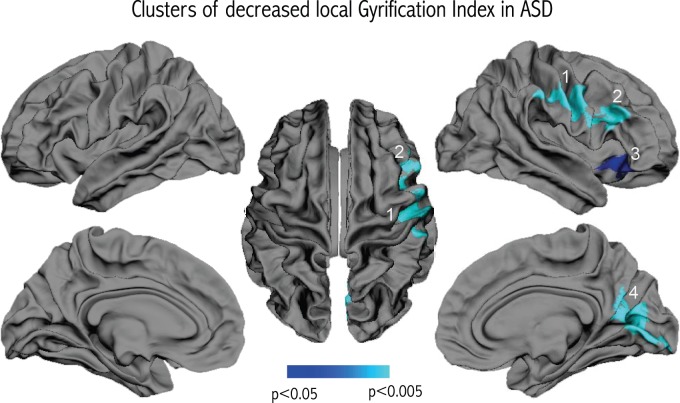
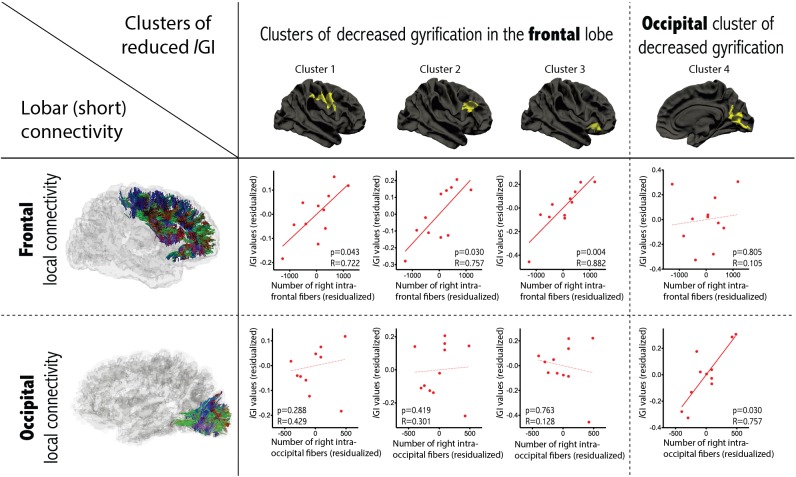
The structural correlates of functional dysconnectivity in autism spectrum disorders (ASD) have been seldom explored, despite the fact that altered functional connectivity is one of the most frequent neuropathological observations in the disorder. We analyzed cerebral morphometry and structural connectivity using multi-modal imaging for 11 children/adolescents with ASD and 11 matched controls. We estimated regional cortical and white matter volumes, as well as vertex-wise measures of cortical thickness and local Gyrification Index (lGI). Diffusion Tensor Images (DTI) were used to measure Fractional Anisotropy (FA) and tractography estimates of short- and long-range connectivity. We observed four clusters of lGI reduction in patients with ASD, three were located in the right inferior frontal region extending to the inferior parietal lobe, and one was in the right medial parieto-occipital region. Reduced volume was found in the anterior corpus callosum, along with fewer inter-hemispheric frontal streamlines. Despite the spatial correspondence of decreased gyrification and reduced long connectivity, we did not observe any significant relationship between the two. However, a positive correlation between lGI and local connectivity was present in all four clusters in patients with ASD. Reduced gyrification in the inferior fronto-parietal and posterior medial cortical regions lends support for early-disrupted cortical growth in both the mirror neuron system and midline structures responsible for social cognition. Early impaired neurodevelopment in these regions may represent an initial substrate for altered maturation in the cerebral networks that support complex social skills. We also demonstrate that gyrification changes are related to connectivity. This supports the idea that an imbalance between short- and long-range white matter tracts not only impairs the integration of information from multiple neural systems, but also alters the shape of the brain early on in autism.

Keywords: autism spectrum disorder; cerebral morphometry; cortical folding; neuroimaging; tractography.


Figures
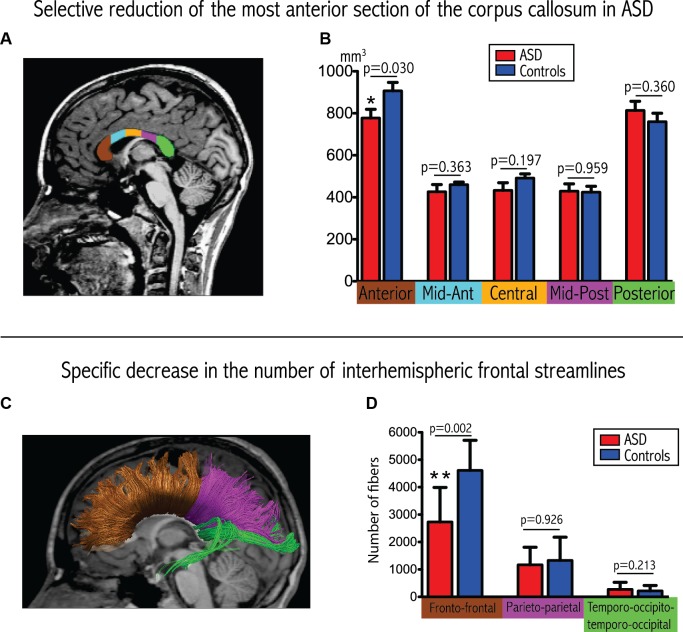
Figure 1
Figure 1
Convergent evidence for disrupted connectivity at the level of inter-hemispheric frontal connectivity in ASD. (A) Example of subdivision of the five sections of the corpus callosum displayed on a mid-sagittal slice. (B) Boxplots depicting volumetric measurements for the five sections in the two groups. The p-values are extracted from the MANCOVA (with correction for age and gender). (C) Example of tractographic reconstruction where the inter-hemispheric fibers are subdivided into three groups according to the cortical regions that they connect. (D) Boxplots comparing the number of streamlines connecting homologous lobes. The p-values are extracted from the MANCOVA (correction for age, gender and total number of streamlines).
Figure 2
Figure 2
Results of the vertex-wise comparison of lGI between groups. Four clusters of reduced lGI were observed in the group of children and adolescents with ASD compared to controls after correcting for multiple comparisons.
Figure 3
Figure 3
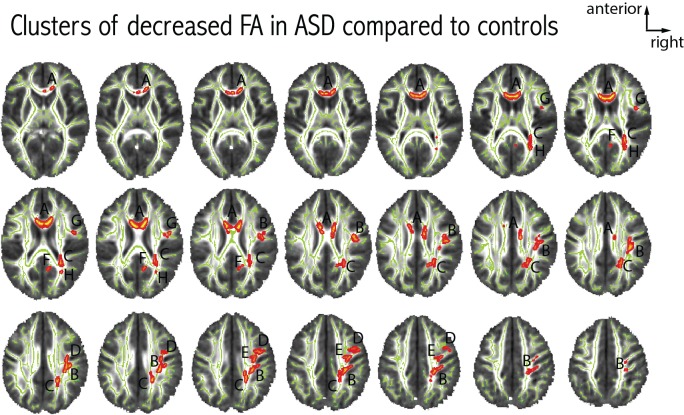
Differences in FA between patients with ASD and controls. Eight clusters of decreased FA in patients with ASD were observed at p < 0.05 (corrected for multiple comparisons). Each cluster was attributed a letter according to decreasing size. The clusters were centered at the following MNI coordinates: A: x = 81, y = 145, z = 90 (939 voxels); B: x = 52, y = 104, z = 104 (725 voxels); C: x = 66, y = 78, z = 101 (470 voxels); D: x = 57, y = 106, z = 129 (186 voxels); E: x = 46, y = 131, z = 112 (137 voxels); F: x = 82, y = 70, z = 93 (70 voxels); G: x = 43, y = 128, z = 90 (42 voxels); H: x = 60, y = 65, z = 88 (23 voxels). We did not observe any clusters with increased FA in patients with ASD compared to controls.
Figure 4
Figure 4
Correlations between gyrification and short-range connectivity within the group of patients with ASD. Partial correlations accounting for age, gender and total number of streamlines were conducted between lGI in the cluster of between-group differences and the number of intra-lobar streamlines in the lobe where most of the cluster was located. Significant positive correlations were observed only in the corresponding lobe (dashed lines report non-significant relationships).

References

    1. Alexander A. L., Lee J. E., Lazar M., Boudos R., Dubray M. B., Oakes T. R., et al. (2007). Diffusion tensor imaging of the corpus callosum in Autism. Neuroimage 34, 61–73 10.1016/j.neuroimage.2006.08.032 - DOI - PubMed
    1. Assaf M., Jagannathan K., Calhoun V. D., Miller L., Stevens M. C., Sahl R., et al. (2010). Abnormal functional connectivity of default mode sub-networks in autism spectrum disorder patients. Neuroimage 53, 247–256 10.1016/j.neuroimage.2010.05.067 - DOI - PMC - PubMed
    1. Avino T. A., Hutsler J. J. (2010). Abnormal cell patterning at the cortical gray-white matter boundary in autism spectrum disorders. Brain Res. 1360, 138–146 10.1016/j.brainres.2010.08.091 - DOI - PubMed
    1. Barttfeld P., Wicker B., Cukier S., Navarta S., Lew S., Sigman M. (2011). A big-world network in ASD: dynamical connectivity analysis reflects a deficit in long-range connections and an excess of short-range connections. Neuropsychologia 49, 254–263 10.1016/j.neuropsychologia.2010.11.024 - DOI - PubMed
    1. Belmonte M. K., Allen G., Beckel-Mitchener A., Boulanger L. M., Carper R. A., Webb S. J. (2004). Autism and abnormal development of brain connectivity. J. Neurosci. 24, 9228–9231 10.1523/jneurosci.3340-04.2004 - DOI - PMC - PubMed

LinkOut - more resources