Effect of sample type, centrifugation and storage conditions on vitamin D concentration
- PMID: 24266302
- PMCID: PMC3900071
- DOI: 10.11613/bm.2013.039
Effect of sample type, centrifugation and storage conditions on vitamin D concentration
Abstract
Introduction: Studies about vitamin D [25(OH)D] stability in plasma are limited and preanalytical variables such as tube type may affect results. We aimed to evaluate effect of storage conditions, sample type and some preanalytical variables on vitamin D concentration.
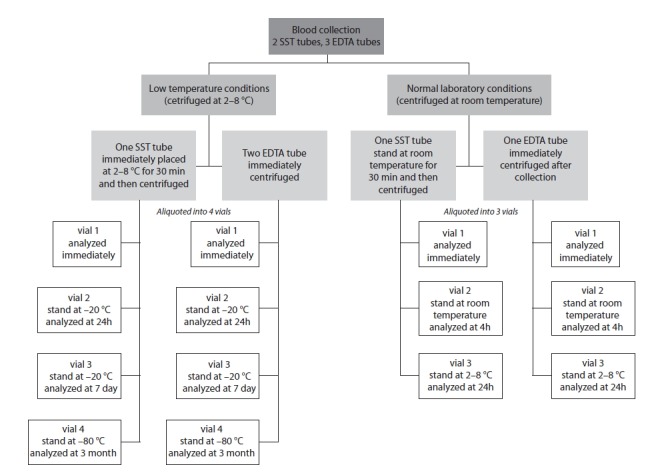
Materials and methods: Blood samples from 15 healthy subjects were centrifuged at different temperatures and stored under different conditions. Serum and plasma 25(OH)D difference, effect of centrifugation temperature and common storage conditions were investigated.
Results: There was no difference between serum and plasma vitamin D concentration. Centrifugation temperature had no impact on vitamin D concentration. 25(OH)D is stable under common storage conditions: 4 hours at room temperature, 24 hours at 2-8 degrees C, 7 days at -20 degrees C, 3 months at -80 degrees C.
Conclusion: Vitamin D does not require any special storage conditions and refrigeration. Both serum and plasma can be used for measurement.
References
-
- Davenport ML, Uckun A, Calikoglu AS. Pediatrician patterns of prescribing vitamin supplementation for infants: Do they contribute to rickets? Pediatrics. 2004;113:179–80. http://dx.doi.org/10.1542/peds.113.1.179. - DOI - PubMed
-
- Vieth R. Vitamin D supplementation, 25-hydroxyvitamin D concentrations, and safety. Am J Clin Nutr. 1999;69:842–56. - PubMed
-
- Norris RLG, Thomas MJ, Craswell PW. Assessment of a two-step high-performance liquid chromatographic assay using dual-wavelength ultraviolet monitoring for 25-hydroxyergocalciferol and 25-hydroxycholecalciferol in human serum or plasma. J Chromatogr. 1986;381:53–61. - PubMed
-
- Ocke MC, Schrijver J, Obermann-de Boer GL, Bloemberg BP, Haenen GR, Kromhout D. Stability of blood (pro)vitamins during four years of storage at −20 degrees C: consequences for epidemiologic research. J Clin Epidemiol. 1995;48:1077–85. http://dx.doi.org/10.1016/0895-4356(94)00232-F. - DOI - PubMed
-
- Lissner D, Mason RS, Posen S. Stability of vitamin D metabolites in human blood serum and plasma. Clin Chem. 1981;27:773–4. - PubMed
Publication types
MeSH terms
Substances
LinkOut - more resources
Full Text Sources
Other Literature Sources
Medical