. 2013 Nov 23;14(1):824.
doi: 10.1186/1471-2164-14-824.

The chromatin modification by SUMO-2/3 but not SUMO-1 prevents the epigenetic activation of key immune-related genes during Kaposi's sarcoma associated herpesvirus reactivation

Affiliations

The chromatin modification by SUMO-2/3 but not SUMO-1 prevents the epigenetic activation of key immune-related genes during Kaposi's sarcoma associated herpesvirus reactivation

Pei-Ching Chang et al. BMC Genomics. .

Abstract

Background: SUMOylation, as part of the epigenetic regulation of transcription, has been intensively studied in lower eukaryotes that contain only a single SUMO protein; however, the functions of SUMOylation during mammalian epigenetic transcriptional regulation are largely uncharacterized. Mammals express three major SUMO paralogues: SUMO-1, SUMO-2, and SUMO-3 (normally referred to as SUMO-1 and SUMO-2/3). Herpesviruses, including Kaposi's sarcoma associated herpesvirus (KSHV), seem to have evolved mechanisms that directly or indirectly modulate the SUMO machinery in order to evade host immune surveillance, thus advancing their survival. Interestingly, KSHV encodes a SUMO E3 ligase, K-bZIP, with specificity toward SUMO-2/3 and is an excellent model for investigating the global functional differences between SUMO paralogues.

Results: We investigated the effect of experimental herpesvirus reactivation in a KSHV infected B lymphoma cell line on genomic SUMO-1 and SUMO-2/3 binding profiles together with the potential role of chromatin SUMOylation in transcription regulation. This was carried out via high-throughput sequencing analysis. Interestingly, chromatin immunoprecipitation sequencing (ChIP-seq) experiments showed that KSHV reactivation is accompanied by a significant increase in SUMO-2/3 modification around promoter regions, but SUMO-1 enrichment was absent. Expression profiling revealed that the SUMO-2/3 targeted genes are primarily highly transcribed genes that show no expression changes during viral reactivation. Gene ontology analysis further showed that these genes are involved in cellular immune responses and cytokine signaling. High-throughput annotation of SUMO occupancy of transcription factor binding sites (TFBS) pinpointed the presence of three master regulators of immune responses, IRF-1, IRF-2, and IRF-7, as potential SUMO-2/3 targeted transcriptional factors after KSHV reactivation.

Conclusion: Our study is the first to identify differential genome-wide SUMO modifications between SUMO paralogues during herpesvirus reactivation. Our findings indicate that SUMO-2/3 modification near protein-coding gene promoters occurs in order to maintain host immune-related gene unaltered during viral reactivation.


Figures
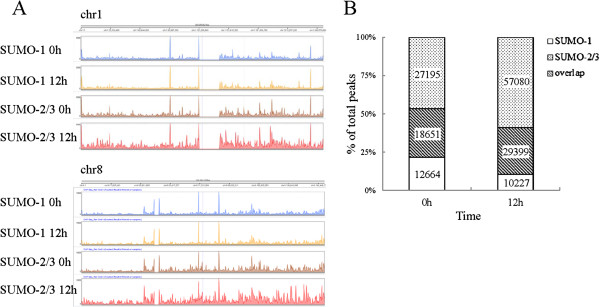
Figure 1
Figure 1
Overview of ChIP-seq data showing chromatin occupancy of SUMO paralogues during KSHV reactivation. (A) Histograms of ChIP-seq profiles across chromosome 1 and 8 for SUMO-1 and SUMO-2/3 binding sites before and after KSHV reactivation. (B) Overlap of SUMO-1 and SUMO-2/3 binding sites before and after KSHV reactivation in BCBL-1 cells; numbers indicate counts for overlapping and non-overlapping peaks.
Figure 2
Figure 2
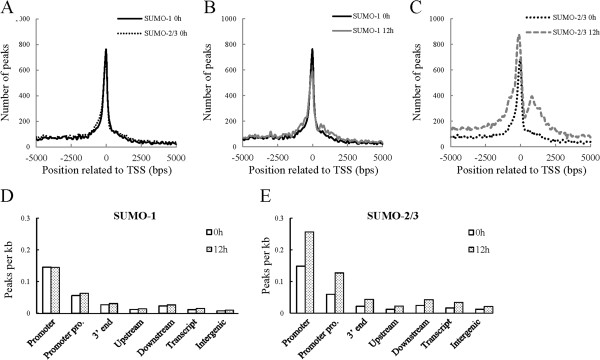
Genome-wide analysis of SUMO-1 and SUMO-2/3 binding region during KSHV reactivation. (A-C) Distance distribution of all SUMO-1 and SUMO-2/3 peaks. Distance to transcription start site (TSS) before (A) and after (B and C) K-Rta induction for viral reactivation. (D and E) Gene context of SUMO-1 (D) and SUMO-2/3 (E) binding sites during KSHV reactivation represented by peak density, after adjustment for the prevalence of gene context category in the genome. Promoter: TSS ± 500; Promoter pro. (Promoter proximal): TSS ± 2 Kb; 3′ end: TES ± 500; Upstream: -2 kb to −10 kb upstream of the TSS; Downstream: +2 kb to +10 kb downstream of the TES; Intergenic: ≥10 kb from any coding genes. TES: transcription end site.
Figure 3
Figure 3
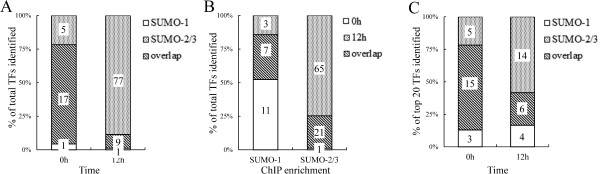
Overview of potential TFs targeting by SUMO paralogues during KSHV reactivation. (A) Percentage of overlapped TFs target sites for SUMO-1 and for SUMO-2/3 before and after K-Rta induction resulting in KSHV reactivation (B) Percentage of overlapped SUMO-1 or SUMO-2/3 target TFs before and after viral reactivation. (C) Percentage overlap of the top-20 potential TF targets for SUMO-1 and SUMO-2/3 before and after viral reactivation; numbers indicate overlapping and non-overlapping TF counts.
Figure 4
Figure 4
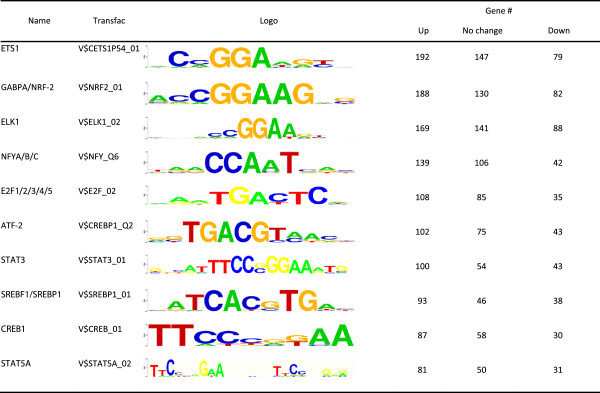
Top 10 potential SUMO-2/3 targeting TFs ranking by gene number before KSHV reactivation. bold: transcription factor with evidence of SUMO modification.
Figure 5
Figure 5
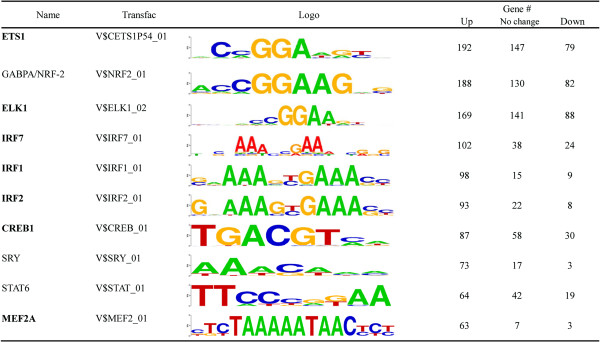
Top 10 potential SUMO-2/3 targeting TFs ranking by gene number after KSHV reactivation. bold: transcription factor with evidence of SUMO modification.
Figure 6
Figure 6
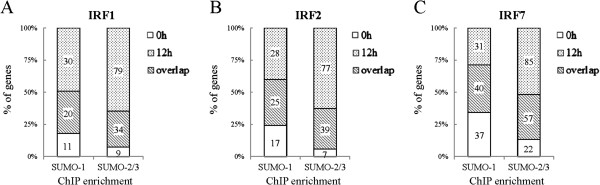
Overview of SUMO enrichment at IRF-1, IRF-2 and IRF-7 binding sites during viral reactivation. Percentage of SUMO-1 and SUMO-2/3 target gene numbers with SUMO enrichment at IRF-1 (A), IRF-2 (B) or IRF-7 (C) binding sites in promoter regions before and after K-Rta induction for KSHV reactivation; numbers indicate counts of overlapping and non-overlapping gene numbers.
Figure 7
Figure 7
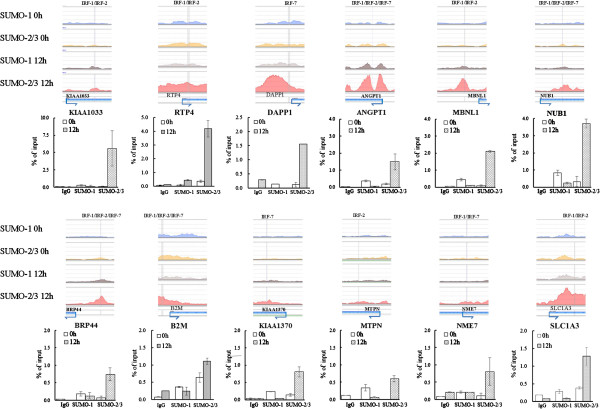
Confirmation of data derived from ChIP-seq for IRF-1, IRF-2 and IRF-7 binding sites with SUMO-2/3 enrichment relevant to K-Rta induction of KSHV reactivation in BCBL-1 cells. Chromatin samples derived from K-Rta-inducible BCBL-1 cells before and after 12 hours of K-Rta induction were used in ChIP reactions with antibodies specific for SUMO-1 and SUMO-2/3. Following ChIP assay, the IRF binding sites within the promoters of the genes, which are indicated at the bottom of the figure, were amplified using qPCR. All reactions were run in triplicate and normalized against the input. Nonspecific IgG was used as the control ChIP antibody.
Figure 8
Figure 8
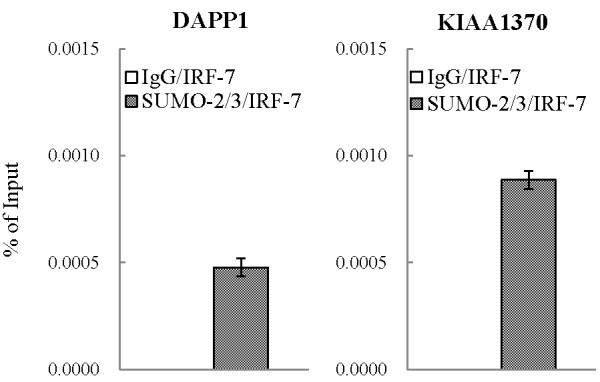
IRF-7 and SUMO-2/3 co-localized at IRF-7 binding sites with SUMO-2/3 binding enrichment after KSHV reactivation. Quantification of DNA recovered from DAPP1 and KIAA1370 promoters by real-time qPCR after enrichment by ChIP with rabbit non-immune serum IgG or anti-SUMO-2/3 antibodies and reChIP of IRF-7 with anti-IRF-7 antibody. One non-IRF-7 target gene, KIAA1033, was used in qPCR as negative controls.
Figure 9
Figure 9
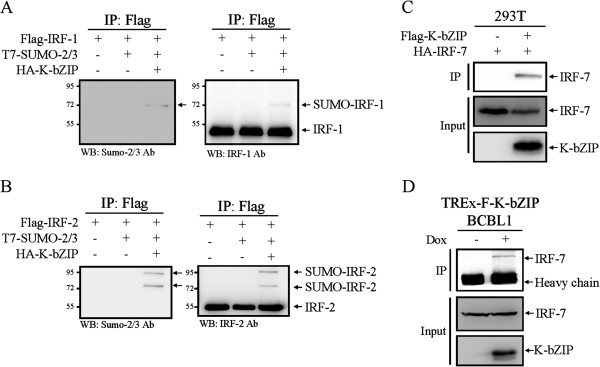
K-bZIP is able to SUMOylate IRF-1 and IRF-2 and to interact with IRF-7. Flag-tagged IRF-1 (A), IRF-2 (B) and IRF-7 (C) were transiently co-transfected with the indicated tagged constructs. Total cell lysates (TCLs) were prepared 48 hours after transfection. The lysates were immunoprecipitated with M2-beads and analyzed by immunoblotting using anti-IRF-1 (A; right panel), anti-IRF-2 (B; right panel), anti-SUMO-2/3 (A and B; left panel) and anti-IRF-7 (C) antibodies. (D) TCLs from TREx-F3H3-K-bZIP BCBL-1 cells before and after 48 hours of Dox induction for K-bZIP overexpression were used for immunoprecipitation with anti-K-bZIP antibody. The immunoprecipitates and TCLs were analyzed by immunoblot with antibodies as indicated.
Figure 10
Figure 10
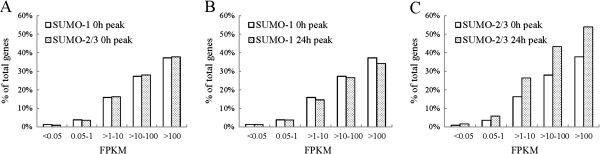
SUMO-2/3 are recruited to the promoters of genes with medium-level and high-level expression after KSHV reactivation. (A) Occupancy with SUMO-1 and SUMO-2/3 at the promoters of genes were categorized in terms of gene expression level from low to high in the control cells. (B and C) Occupancy of SUMO-1 (B) and SUMO-2/3 (C) after KSHV reactivation was plotted in a similar manner to (A) and compared with the control cells.
Figure 11
Figure 11
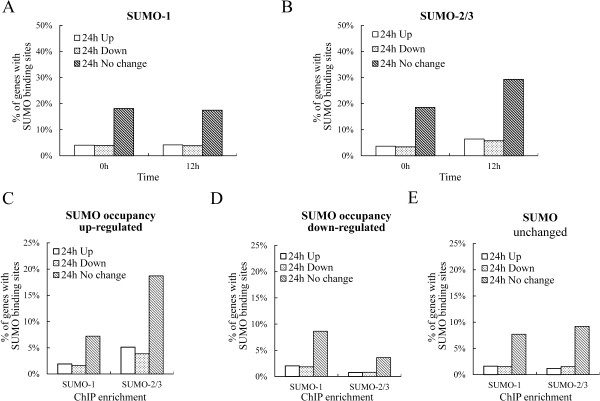
The distribution of transcriptional up-regulated, down-regulated and unchanged genes has SUMO binding within their promoter region before and after viral reactivation. (A and B) Genes transcriptionally up-regulated, down-regulated and unchanged after viral reactivation were plotted against SUMO-1 (A) or SUMO-2/3 (B) occupancy on the promoter region of control (0 hr; left panel) and KSHV reactivated (12 hr; right panel) BCBL-1 cells. (C to E) Genes transcriptionally up-regulated, down-regulated and unchanged after viral reactivation were plotted against SUMO-1 (left panel) and SUMO-2/3 (right panel) occupancy that was increased (C), decreased (D) or unchanged (E) on the promoter region during KSHV reactivation. Bars represent % of transcriptionally up-regulated, down-regulated and unchanged genes with SUMO occupancy that was normalized to total transcriptionally up-regulated, down-regulated and unchanged genes during viral reactivation, respectively.
Figure 12
Figure 12
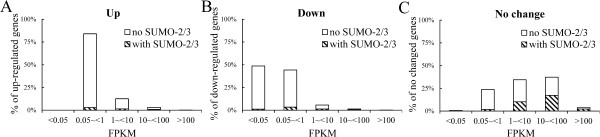
The association of the transcription level and the up-regulated, down-regulated and no change genes during KSHV reactivation. Genes in the up-regulated (A), down-regulated (B) and no-change (C) sets were categorized by gene expression level from low to high. Percentages of SUMO-2/3 occupancy at the promoters of genes with different transcription levels were plotted as slanted lines.
Figure 13
Figure 13
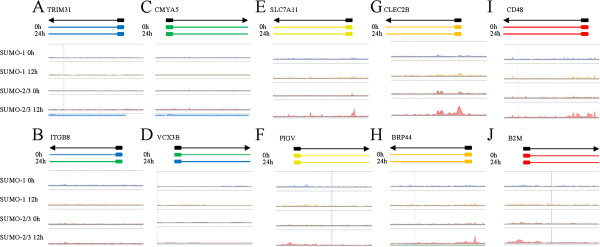
Histogram of SUMO paralogue binding sites before and after KSHV reactivation. Examples of the epigenetic features associated with no expression (A and B), low expression (C and D), medium expression (E and F), high expression (G and H), and very high expression (I and J) gene loci. No expression: blue; low expression: green; medium expression: yellow; high expression: orange; very high expression: red.
Figure 14
Figure 14
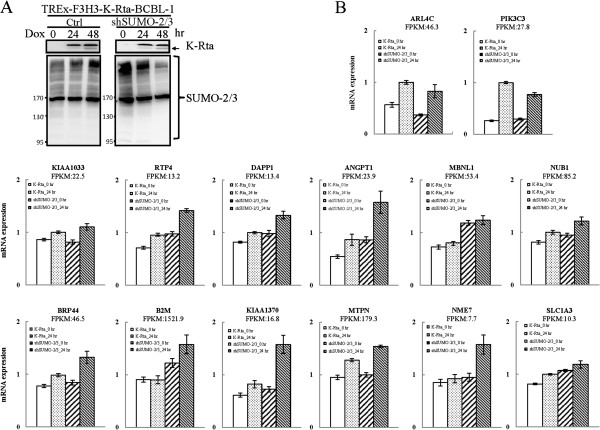
SUMO-2/3 enrichment in stabilizing gene transcriptional during KSHV reactivation. (A) TREx-F3H3-K-Rta-shSUMO-2/3 BCBL-1 cells were treated with Dox for 24 and 48 hours. TCLs were analyzed by immunoblotting using anti-SUMO-2/3 antibody. (B) Twelve IRF-1, IRF-2 and IRF-7 targeted genes showing SUMO-2/3 enrichment at the promoter region during KSHV reactivation were chosen. Two genes showing no SUMO-2/3 enrichment at the promoter region were chosen as control. RNA samples derived from TREx-F3H3-K-Rta BCBL-1 and TREx-F3H3-K-Rta-shSUMO-2/3 BCBL-1 cells before and after 24 hours of Dox induction were subjected to reverse transcription (RT) reaction. Following the RT reaction, the IRF target genes were amplified by qPCR using gene-specific primer sets. All reactions were run in triplicate and normalized against GAPDH.

References

    1. Lomeli H, Vazquez M. Emerging roles of the SUMO pathway in development. Cell Mol Life Sci. 2011;68:4045–4064. doi: 10.1007/s00018-011-0792-5. - DOI - PMC - PubMed
    1. Nacerddine K, Lehembre F, Bhaumik M, Artus J, Cohen-Tannoudji M, Babinet C, Pandolfi PP, Dejean A. The SUMO pathway is essential for nuclear integrity and chromosome segregation in mice. Dev Cell. 2005;9:769–779. doi: 10.1016/j.devcel.2005.10.007. - DOI - PubMed
    1. Prudden J, Perry JJ, Nie M, Vashisht AA, Arvai AS, Hitomi C, Guenther G, Wohlschlegel JA, Tainer JA, Boddy MN. DNA repair and global sumoylation are regulated by distinct Ubc9 noncovalent complexes. Mol Cell Biol. 2011;31:2299–2310. doi: 10.1128/MCB.05188-11. - DOI - PMC - PubMed
    1. Garcia-Dominguez M, Reyes JC. SUMO association with repressor complexes, emerging routes for transcriptional control. Biochim Biophys Acta. 2009;1789:451–459. doi: 10.1016/j.bbagrm.2009.07.001. - DOI - PubMed
    1. Wilkinson KA, Henley JM. Mechanisms, regulation and consequences of protein SUMOylation. Biochem J. 2010;428:133–145. doi: 10.1042/BJ20100158. - DOI - PMC - PubMed

Publication types

MeSH terms