. 2013;14 Suppl 12(Suppl 12):S1.
doi: 10.1186/1471-2105-14-S12-S1. Epub 2013 Sep 24.

Using context-specific effect of miRNAs to identify functional associations between miRNAs and gene signatures

Using context-specific effect of miRNAs to identify functional associations between miRNAs and gene signatures

Mohammed Alshalalfa et al. BMC Bioinformatics. 2013.

Abstract

Background: MicroRNAs are a class of short regulatory RNAs that act as post-transcriptional fine-tune regulators of a large host of genes that play key roles in many cellular processes and signaling pathways. A useful step for understanding their functional role is characterizing their influence on the protein context of the targets. Using miRNA context-specific influence as a functional signature is promising to identify functional associations between miRNAs and other gene signatures, and thus advance our understanding of miRNA mode of action.

Results: In the current study we utilized the power of regularized regression models to construct functional associations between gene signatures. Genes that are influenced by miRNAs directly(computational miRNA target prediction) or indirectly (protein partners of direct targets) are defined as functional miRNA gene signature. The combined direct and indirect miRNA influence is defined as context-specific effects of miRNAs, and is used to identify regulatory effects of miRNAs on curated gene signatures. Elastic-net regression was used to build functional associations between context-specific effect of miRNAs and other gene signatures (disease, pathway signatures) by identifying miRNAs whose targets are enriched in gene lists. As a proof of concept, elastic-net regression was applied on lists of genes downregulated upon pre-miRNA transfection, and successfully identified the treated miRNA. This model was then extended to construct functional relationships between miRNAs and disease and pathway gene lists. Integrating context-specific effects of miRNAs on a protein network reveals more significant miRNA enrichment in prostate gene signatures compared to miRNA direct targets. The model identified novel list of miRNAs that are associated with prostate clinical variables.

Conclusions: Elastic-net regression is used as a model to construct functional associations between miRNA signatures and other gene signatures. Defining miRNA context-specific functional gene signature by integrating the downstream effect of miRNAs demonstrates better performance compared to the miRNA signature alone (direct targets). miRNA functional signatures can greatly facilitate miRNA research to uncover new functional associations between miRNAs and diseases, drugs or pathways.


Figures
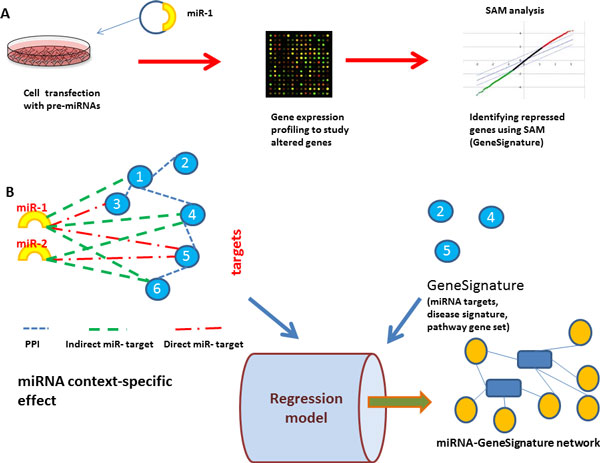
Figure 1
Figure 1
An overview of constructing influential miRNA-GeneSignature interactions. A. miRNA gene signature is identified by transfecting cells with pre-miRNA and then identify gene down-regulated upon the transfection. B. Using the context-specific effects of miRNAs (genes affected by miRNAs directly and indirectly) to build functional associations between miRNAs and GeneSignatures via elastic-net regression model. This step sheds light on the functional associations between miRNA and pathways, miRNAs and diseases. It is also used as a miRNA enrichment method to identify miRNAs whose targets are enriched in gene lists. Using miRNA-gene networks and disease or pathway gene networks, the model predicts functional interactions between diseases and miRNAs or pathways and miRNAs.
Figure 2
Figure 2
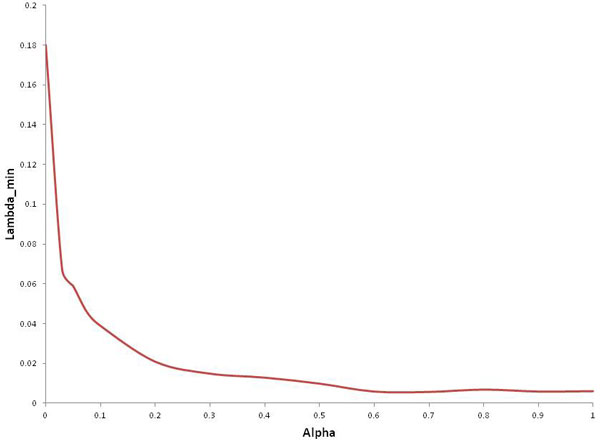
Optimizing alpha value with respect to min-lambda. 20 α values, ranging from 0 to 1, were initially selected to optimize α. For each α value, 100 values of λ were evaluated. 10-fold cross validation as conducted to select λ with minimum meas square error. We selected α=0.6 as λ-min values started to get steady.
Figure 3
Figure 3
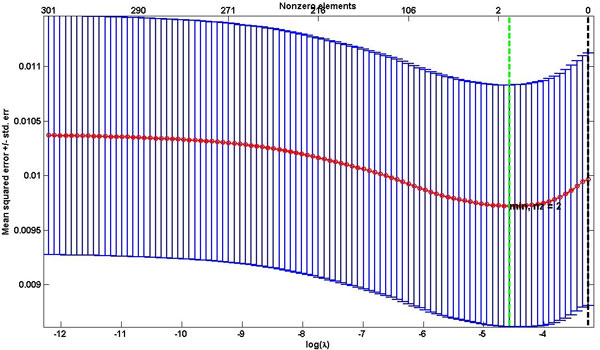
Mean Square Error vs lambda to optimize lambda value. Lambda value (λ) is optimized using 10-fold cross validation. We selected 100 values of λ and used those that minimize the mean square error when α=0.6.
Figure 4
Figure 4
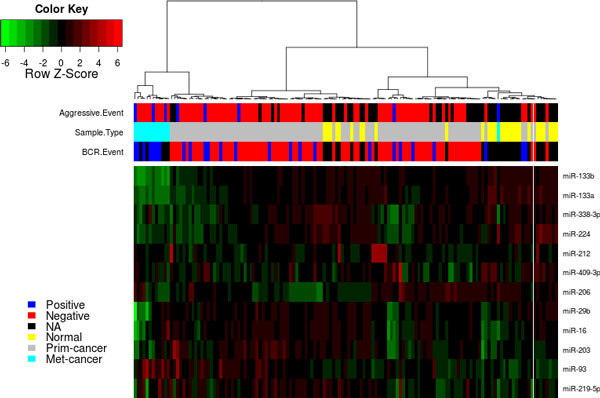
Heatmap of 12 miRNAs predicted using our model to be enriched in prostate cancer genes. Using the expression of the 12 miRNAs predicted by our model to be enriched in downregulated genes in prostate cancer, the miRNAs are associated with multiple clinical outcome. This supports our model that it predicts prostate related miRNAs and they can segregate prostate cancer into distinct subtypes.
Figure 5
Figure 5
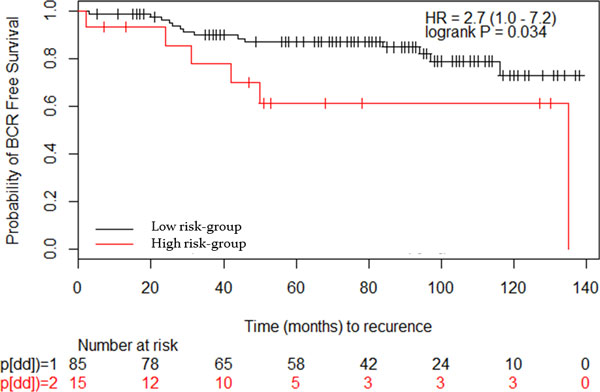
Kaplan Meier curves of two groups of patients based on BCR related miRNAs. Using the expression of the 5 miRNAs enriched in BCR related genes, hierarchical clustering was applied to identify two groups and then KM was used to associate them with survival analysis.
Figure 6
Figure 6
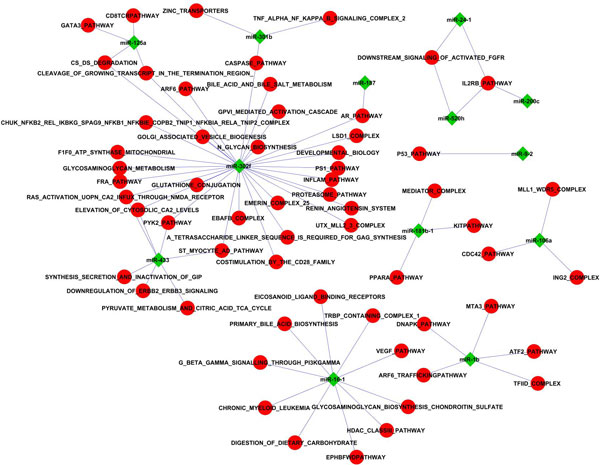
Functional associations between miRNAs and biological pathways. Using the context-specific effects of miRNAs and the GeneSignature of pathways as input to the regression model, functional associations between miRNAs and are constructed. In this figure only interactions of regression coefficient greater than 0.5 are selected.

References

    1. He L, Hannon G. MicroRNAs: small RNAs with a big role in gene regulation. Nat Rev Genet. 2004;5:522–531. doi: 10.1038/nrg1379. - DOI - PubMed
    1. Djuranovic S, Nahvi A, Green R. A parsimonious model for gene regulation by miRNAs. Science. 2011;331:550–553. doi: 10.1126/science.1191138. - DOI - PMC - PubMed
    1. Li L, Liu Y. Diverse small non-coding RNAs in RNA interference pathways. Methods Mol Biol. 2011;764:169–182. doi: 10.1007/978-1-61779-188-8_11. - DOI - PubMed
    1. Ruvkun G. Molecular biology: Glimpses of a tiny RNA world. Science. 2001;294:797–799. doi: 10.1126/science.1066315. - DOI - PubMed
    1. Gordanpour A, Nam RK, Sugar L, Seth A. MicroRNAs in prostate cancer: from biomarkers to molecularly-based therapeutics. Prostate Cancer Prostatic Dis. 2012;15:314–319. doi: 10.1038/pcan.2012.3. - DOI - PubMed

Publication types

LinkOut - more resources