Review
. 2014 Feb:108:65-77.
doi: 10.1016/j.nlm.2013.11.007. Epub 2013 Nov 20.

Dopamine and extinction: a convergence of theory with fear and reward circuitry

Affiliations
Review

Dopamine and extinction: a convergence of theory with fear and reward circuitry

Antony D Abraham et al. Neurobiol Learn Mem. 2014 Feb.

Abstract

Research on dopamine lies at the intersection of sophisticated theoretical and neurobiological approaches to learning and memory. Dopamine has been shown to be critical for many processes that drive learning and memory, including motivation, prediction error, incentive salience, memory consolidation, and response output. Theories of dopamine's function in these processes have, for the most part, been developed from behavioral approaches that examine learning mechanisms in reward-related tasks. A parallel and growing literature indicates that dopamine is involved in fear conditioning and extinction. These studies are consistent with long-standing ideas about appetitive-aversive interactions in learning theory and they speak to the general nature of cellular and molecular processes that underlie behavior. We review the behavioral and neurobiological literature showing a role for dopamine in fear conditioning and extinction. At a cellular level, we review dopamine signaling and receptor pharmacology, cellular and molecular events that follow dopamine receptor activation, and brain systems in which dopamine functions. At a behavioral level, we describe theories of learning and dopamine function that could describe the fundamental rules underlying how dopamine modulates different aspects of learning and memory processes.

Keywords: Amygdala; Dopamine; Extinction; Fear; Learning; Memory; Nucleus accumbens; Ventral tegmental area.


Figures

Figure 1
Figure 1. Dopamine receptor signaling pathways
Activation of Gαs/olf proteins on D1-like receptors stimulates adenylate cyclase (Beaulieu & Gainetdinov, 2011). Adenylate cyclase induces production of cyclic adenosine monophosphate (cAMP), leading to activation of protein kinase A, (PKA). PKA generates cellular signaling cascades necessary for long-term plasticity. PKA also induces phosphorylation of dopamine- and cAMP-regulated neuronal phosphoprotein (DARPP-32), which inhibits protein phosphatase 1 (PP1). Inhibitory interactions between DARPP-32 and PP1 regulate neural plasticity through extracellular signal-regulated kinase (ERK) pathways (Valjent et al., 2004). Activation of Gαi/o proteins on D2-like receptors inhibits adenylyl cyclase, regulating cAMP activity. The phospholipase C pathway can be induced by Gβ and Gγ proteins from D2 receptors, G proteins from D1-like receptors, or G proteins from D1-D2 heteromers. These convergent pathways regulate the PLC-mediated cleavage of the phospholipid phosphatidylinositol 4,5-bisphosphate (PIP2) into inositol 1,4,5-trisphosphate (IP3) and diacyl glycerol (DAG). DAG activity regulates protein kinase C, while IP3 binding to IP3 receptors in the endoplasmic reticulum increases intracellular calcium (Ca2+) levels. Increased Ca2+ levels leads to activation of protein phosphatase 2B (PP2B) and Ca2+/calmodulin-dependent protein kinase II (CaMKII) signaling cascades that have been identified as regulators of long-term plasticity. Expression of these different dopamine receptor types varies across neuronal populations innervated by dopamine neurons.
Figure 2
Figure 2. Dopamine circuitry in fear-related behaviors
Dopamine neurons in the ventral tegmental area (VTA) generate signals to encode discrepancy between expected and unexpected outcomes (prediction error). These signals are relayed to several regions that have reciprocal connections with the VTA, such as the amygdala, nucleus accumbens, prefrontal cortex, and hippocampus. These reciprocal connections allow for modification of signals arising from the VTA, leading to precise control of dopamine release within dopamine terminal regions. Within the amygdala, the basolateral amygdala (BLA) encodes CS-US associations, allowing for fear acquisition and retrieval. The BLA projects to the central amygdala (CeA) to generate fear responses and motivated behavior through motor circuitry. Dopamine receptor activity in the amygdala modulates the formation and retrieval of fear associations. Dopamine transmission in the nucleus accumbens core (NAcc Core) is important for encoding the general salience of environmental stimuli, and activity in the nucleus accumbens shell (Nacc Shell) encodes outcome-specific predictions to guide motivated behavior. In the prefrontal cortex, dopamine activity is important for working memory and fear extinction. In the infralimbic region of the prefrontal cortex (IL), dopamine D1 receptors are required for consolidation of fear extinction (Hikind & Maroun, 2008). Activation of D1 receptors in the prelimbic region of the prefrontal cortex (PL) blocks the expression of conditioned fear (Lauzon et al., 2013). Interactions between the hippocampus and VTA are important for relaying contextual information in fear and reward learning. The VTA provides a coordinating signal to generate particular patterns of activity in dopamine terminal regions based on environmental stimuli and prior experience. Dopamine neurons in the substantia nigra are involved in motor responses and project to the dorsal striatum, which selects and alters appropriate behavioral responses based on inputs from a variety of different regions. Together, activity in the substantia nigra, ventral tegmental area, and dopamine terminal regions allow for the generation of appropriate behavioral responses (e.g. freezing, approach, or active avoidance) in response to shifting external stimuli.
Figure 3
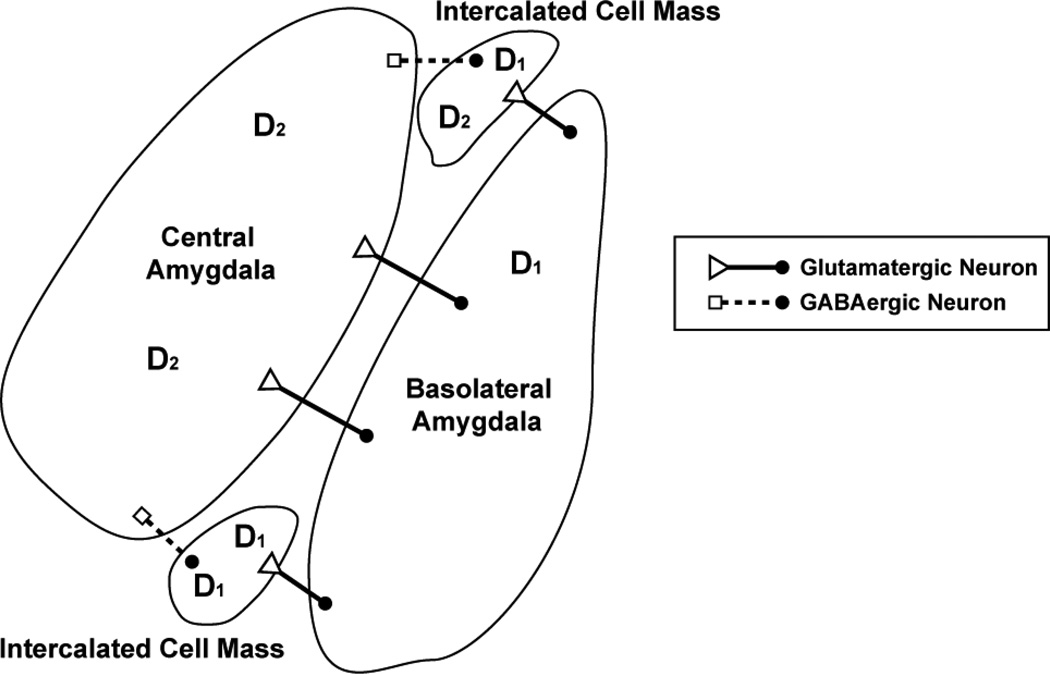
Figure 3. Distribution of dopamine receptors in the amygdala
Neurons in the central amygdala primarily express dopamine D2 receptors (Weiner et al., 1991). Blockade of these receptors may lead to impaired fear conditioning (Guaracci et al., 2000) or prevent the animal from generating appropriate fear or reward-related behaviors. The central amygdala receives glutamatergic input (open triangles) from the basolateral amygdala (cell body represented by filled circles). The basolateral amygdala (BLA) coordinates activity from the nucleus accumbens, prefrontal cortex, and many other regions to generate and retrieve CS-US associations. Dopamine D1 receptors are primarily expressed in the BLA and intercalated cell masses of the amygdala (ITC). Antagonism of D1 receptors in the basolateral amygdala impairs acquisition of fear extinction (Hikind & Maroun, 2008). Glutamatergic neurons from the BLA project to ITC and GABAergic ITC neurons inhibit central amygdala activity (output represented by open squares). The activation of GABAergic ITC neurons mediated by the basolateral amygdala and the infralimbic region of the prefrontal cortex is critical to extinction of fear behaviors and inhibitory control of the central amygdala (Busti et al., 2011). In addition to high D1 receptor expression, ITC express D2 receptors at low levels (Weiner et al., 1991). In summary, the release of dopamine in the amygdala can have complex effects on behavior due to the distribution of dopamine receptors and the dopamine receptor subfamilies expressed in this region.

References

    1. Abraham AD, Cunningham CL, Lattal KM. Methylphenidate enhances extinction of contextual fear. Learn Mem. 2012;19(2):67–72. - PMC - PubMed
    1. Allen JA, Yost JM, Setola V, Chen X, Sassano MF, Chen M, Jin J. Discovery of beta-arrestin-biased dopamine D2 ligands for probing signal transduction pathways essential for antipsychotic efficacy. Proc Natl Acad Sci U S A. 2011;108(45):18488–18493. - PMC - PubMed
    1. Arnt J, Hyttel J, Sanchez C. Partial and full dopamine D1 receptor agonists in mice and rats: relation between behavioural effects and stimulation of adenylate cyclase activity in vitro. Eur J Pharmacol. 1992;213(2):259–267. - PubMed
    1. Badrinarayan A, Wescott SA, Vander Weele CM, Saunders BT, Couturier BE, Maren S, Aragona BJ. Aversive stimuli differentially modulate real-time dopamine transmission dynamics within the nucleus accumbens core and shell. J Neurosci. 2012;32(45):15779–15790. - PMC - PubMed
    1. Balleine BW, Killcross S. Parallel incentive processing: an integrated view of amygdala function. Trends Neurosci. 2006;29(5):272–279. - PubMed

Publication types