Review
. 2014 Jan:101:122-30.
doi: 10.1016/j.antiviral.2013.11.006. Epub 2013 Nov 20.

SARS-CoV ORF1b-encoded nonstructural proteins 12-16: replicative enzymes as antiviral targets

Affiliations
Review

SARS-CoV ORF1b-encoded nonstructural proteins 12-16: replicative enzymes as antiviral targets

Lorenzo Subissi et al. Antiviral Res. 2014 Jan.

Abstract

The SARS (severe acute respiratory syndrome) pandemic caused ten years ago by the SARS-coronavirus (SARS-CoV) has stimulated a number of studies on the molecular biology of coronaviruses. This research has provided significant new insight into many mechanisms used by the coronavirus replication-transcription complex (RTC). The RTC directs and coordinates processes in order to replicate and transcribe the coronavirus genome, a single-stranded, positive-sense RNA of outstanding length (∼27-32kilobases). Here, we review the up-to-date knowledge on SARS-CoV replicative enzymes encoded in the ORF1b, i.e., the main RNA-dependent RNA polymerase (nsp12), the helicase/triphosphatase (nsp13), two unusual ribonucleases (nsp14, nsp15) and RNA-cap methyltransferases (nsp14, nsp16). We also review how these enzymes co-operate with other viral co-factors (nsp7, nsp8, and nsp10) to regulate their activity. These last ten years of research on SARS-CoV have considerably contributed to unravel structural and functional details of one of the most fascinating replication/transcription machineries of the RNA virus world. This paper forms part of a series of invited articles in Antiviral Research on "From SARS to MERS: 10years of research on highly pathogenic human coronaviruses".

Keywords: Coronavirus; Nonstructural proteins; Replication; SARS-CoV; Transcription.


Figures

Fig. 1
Fig. 1
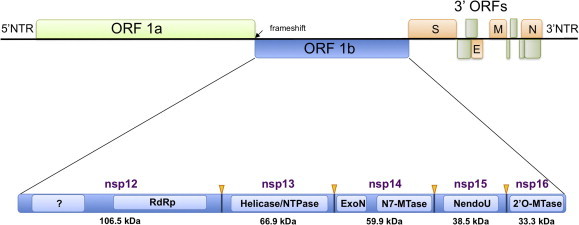
Coronavirus genome organization and expression. Coronavirus genome is depicted and divided into five main segments: 5′NTR (nontranslated region), ORF1a (light green), ORF1b (blue), 3′ORFs, corresponding to all open reading frames coding for structural (orange) and accessory proteins (dark green), and 3′NTR. The ORF1b is zoomed and the derived nonstructural proteins are shown. The nsp5 protease cleavage sites (yellow arrow), the domains harbouring enzymatic activities (soft blue) and the size of each nsp are also depicted. ?: predicted domain of unknown function; RdRp, RNA-dependent RNA polymerase; NTPase, nucleoside triphosphatase, also capable of hydrolysizing 5′-triphosphate-RNA to 5′-diphosphate-RNA); ExoN, 3′ to 5′ exonuclease; N7-MTase, guanine-N7-methyltransferase; NendoU, endoribonuclease; 2′-O-MTase, 2′-O-methyltransferase. Protein size is indicated below each nsp.
Fig. 2
Fig. 2
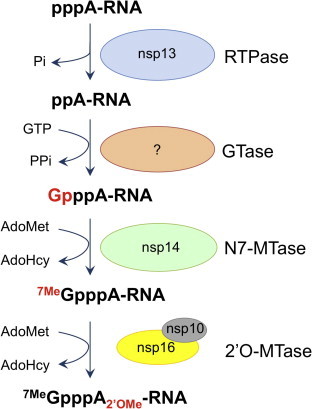
Coronavirus 5′ mRNA capping pathway. Coronaviruses use a conventional capping pathway made of four steps, as described in Decroly et al. (2011).
Fig. 3
Fig. 3
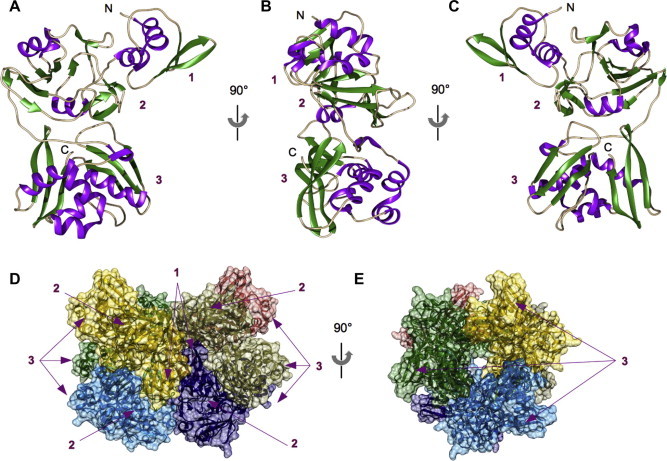
Structure of nsp15, the endoribonuclease from SARS-CoV. (A)–(C) Cartoon representations of nsp15 monomer. The structure consists of three domains: N-terminal domain (1), central domain (2), and C-terminal domain (3). Secondary structures are colored as follows: β-stands are colored in green, α-helix in purple, loops in light brown. (D) and (E) Views of the nsp15 hexamer. (D) Side view of surface representation of the nsp15 hexamer. Each monomer is colored with its own color. Solid arrows indicate the respective subdomains of the monomer. Domains 1 and 2 are involved in the assembly while 3 carries the active site. (E) Surface representation of the hexamer rotated by 90°, presenting a corolla like structure. PDB code: 2H85.
Fig. 4
Fig. 4
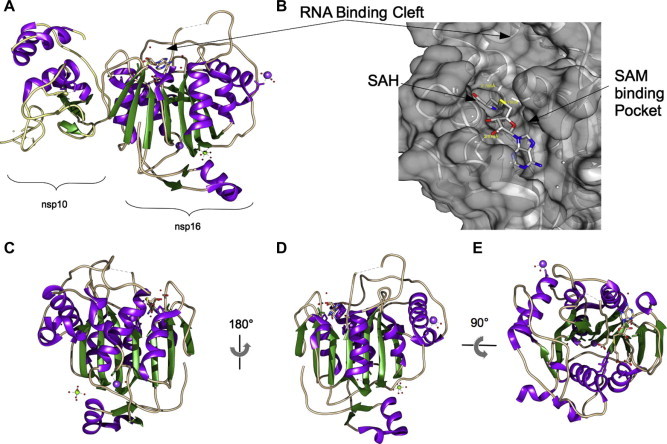
Structure of nsp10/nsp16. (A) Cartoon representation of the nsp10/nsp16 complex with the reaction product SAH and metal ions. Color code is as follow: β-stands are colored in green, α-helix in purple, loops in light brown, water (red) and ions are represented as small spheres (Na2+: pink, Mg2+: green, Zn2+: cream) and the SAH molecule shown in sticks colored following atom type. The nsp16 protein is bound to nsp10 through an interface which does not involve Zn ions present in nsp10. One metal ion is found in nsp16 on the opposite face from the active site to which a SAH molecule is found. (B) Closed caption of the SAM binding site represented in surface and the RNA binding cleft. The surface of the SAM-binding pocket is shown transparent to reveal details of the structural elements forming it. (C)–(E) Ribbon representation of nsp16 structure, in different orientations: (C) and (D) are side views, highlighting the Rossman fold; (E) is a top view of nsp16 showing the dispositions of the helices around the β-sheet. PDB codes: 2XYQ, 2XYV and 2XYR.
Fig. 5
Fig. 5
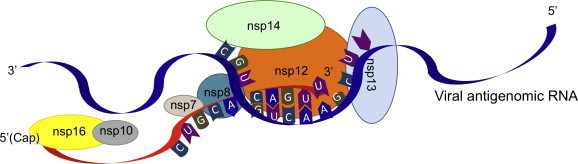
Model of how coronavirus enzymes associate in the replicative complex. A model of the current state of knowledge on coronavirus enzymes and their co-factors is depicted. At the head of the complex nsp13 is in charge of the first capping step and disrupts RNA secondary structures during replication. Nsp12 may be in charge of the GMP transfer to RNA, while the third step of capping is performed by nsp14, bound to nsp12, and also in charge of RNA proofreading during nsp7/nsp8/nsp12-mediated RNA synthesis. Nsp16, in complex with nsp10, performs 2′-O-methylation. Since nsp16 has not been shown to tightly interact with other ORF1b-encoded nsps, nsp10/nsp16 complex may act right after replication has started.

References

    1. Adedeji A.O., Marchand B., Te Velthuis A.J.W., Snijder E.J., Weiss S., Eoff R.L., Singh K., Sarafianos S.G. Mechanism of nucleic acid unwinding by SARS-CoV helicase. PLoS ONE. 2012;7:e36521. - PMC - PubMed
    1. Adedeji A.O., Singh K., Calcaterra N.E., DeDiego M.L., Enjuanes L., Weiss S., Sarafianos S.G. Severe acute respiratory syndrome coronavirus replication inhibitor that interferes with the nucleic acid unwinding of the viral helicase. Antimicrob. Agents Chemother. 2012;56:4718–4728. - PMC - PubMed
    1. Ahn D.-G., Choi J.-K., Taylor D.R., Oh J.-W. Biochemical characterization of a recombinant SARS coronavirus nsp12 RNA-dependent RNA polymerase capable of copying viral RNA templates. Arch. Virol. 2012;157:2095–2104. - PMC - PubMed
    1. Barnard D.L., Day C.W., Bailey K., Heiner M., Montgomery R., Lauridsen L., Winslow S., Hoopes J., Li J.K.-K., Lee J., Carson D.A., Cottam H.B., Sidwell R.W. Enhancement of the infectivity of SARS-CoV in BALB/c mice by IMP dehydrogenase inhibitors, including ribavirin. Antiviral Res. 2006;71:53–63. - PMC - PubMed
    1. Belshaw R., Gardner A., Rambaut A., Pybus O.G. Pacing a small cage: mutation and RNA viruses. Trends Ecol. Evol. 2008;23:188–193. - PMC - PubMed

Publication types

MeSH terms