


The UCSC Genome Browser database: 2014 update
- PMID: 24270787
- PMCID: PMC3964947
- DOI: 10.1093/nar/gkt1168
The UCSC Genome Browser database: 2014 update
Abstract
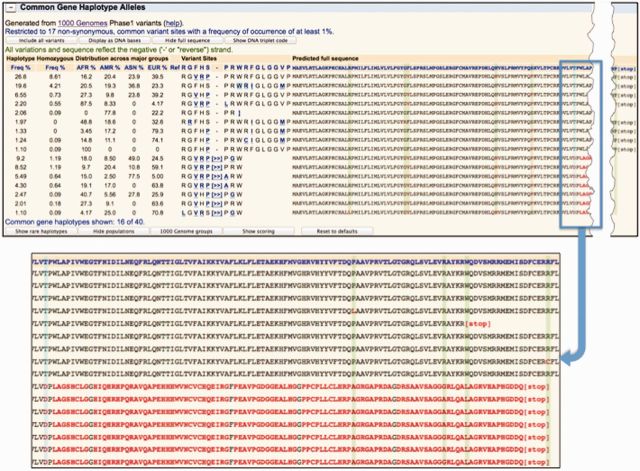
The University of California Santa Cruz (UCSC) Genome Browser (http://genome.ucsc.edu) offers online public access to a growing database of genomic sequence and annotations for a large collection of organisms, primarily vertebrates, with an emphasis on the human and mouse genomes. The Browser's web-based tools provide an integrated environment for visualizing, comparing, analysing and sharing both publicly available and user-generated genomic data sets. As of September 2013, the database contained genomic sequence and a basic set of annotation 'tracks' for ∼90 organisms. Significant new annotations include a 60-species multiple alignment conservation track on the mouse, updated UCSC Genes tracks for human and mouse, and several new sets of variation and ENCODE data. New software tools include a Variant Annotation Integrator that returns predicted functional effects of a set of variants uploaded as a custom track, an extension to UCSC Genes that displays haplotype alleles for protein-coding genes and an expansion of data hubs that includes the capability to display remotely hosted user-provided assembly sequence in addition to annotation data. To improve European access, we have added a Genome Browser mirror (http://genome-euro.ucsc.edu) hosted at Bielefeld University in Germany.
Figures
References
-
- Blanchette M, Diallo AB, Green ED, Miller W, Haussler D. Computational reconstruction of ancestral DNA sequences. In: Murphy WJ, editor. Methods in Molecular Biology: Phylogenomics. New York: Springer; 2007. pp. 171–184. - PubMed
Publication types
MeSH terms
Grants and funding
- HHMI/Howard Hughes Medical Institute/United States
- U41 HG007234/HG/NHGRI NIH HHS/United States
- U41 HG006992/HG/NHGRI NIH HHS/United States
- 1U41HG007234 SUBCONTRACT 2186-03/HG/NHGRI NIH HHS/United States
- U24 CA143858/CA/NCI NIH HHS/United States
- 5U24CA143858/CA/NCI NIH HHS/United States
- 5U01DE020057 SUBCONTRACT 1000736806/DE/NIDCR NIH HHS/United States
- 1U41HG006992/HG/NHGRI NIH HHS/United States
- 60141508-106846-A/PHS HHS/United States
- U01 DE020057/DE/NIDCR NIH HHS/United States
- 5U4 HG002371/HG/NHGRI NIH HHS/United States
- U41 HG002371/HG/NHGRI NIH HHS/United States
- U24 HG002371/HG/NHGRI NIH HHS/United States
