


doi: 10.3201/eid1912.130863.
Treponemal infection in nonhuman primates as possible reservoir for human yaws
- PMID: 24274094
- PMCID: PMC3840862
- DOI: 10.3201/eid1912.130863
Item in Clipboard
Treponemal infection in nonhuman primates as possible reservoir for human yaws
Emerg Infect Dis.
2013 Dec.
No abstract available
Keywords: Africa; World Health Organization; bacteria; eradication; nonhuman primates; pallidum; pertenue; syphilis; treponeme; yaws; zoonoses.
Figures
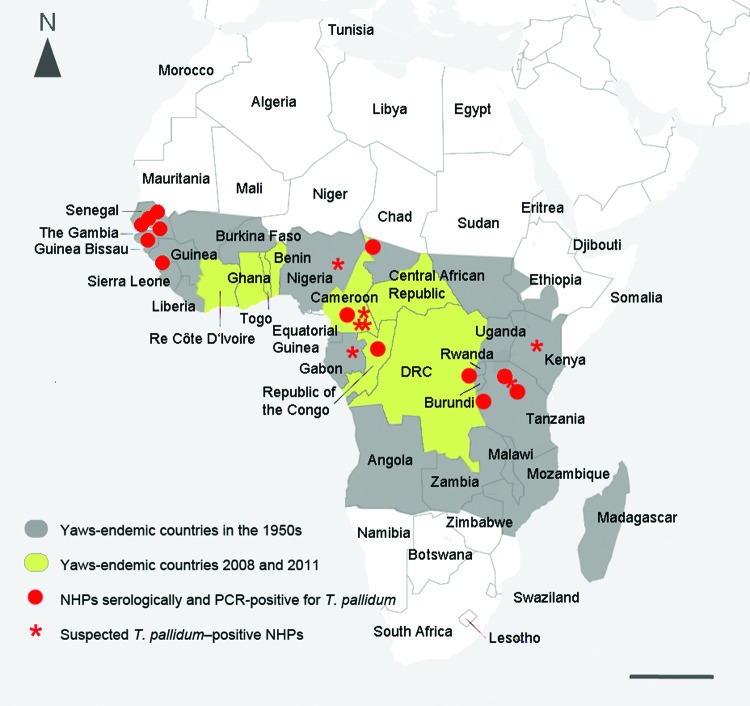
Geographic proximity between human yaws and endemic syphilis, as estimated by the World Health Organization, and locations in which treponemal infection has been identified in nonhuman primates (NHPs), Africa, 1990s. Red dots indicate infection in NHPs confirmed by sensitive and specific treponemal serologic tests (TPI/FTA-ABS/MHA-TP [Treponema-pallidum-immobilization reaction/fluorescence-Treponema-antibody-absorption test/Treponema pallidum microhemagglutination assay]) and, in some cases, PCR. Stars indicate suspected infection (i.e., sightings of NHPs with lesions consistent with infection). Sources include the following: 1) Cameroon: Gorilla gorilla, observation (W. Karesh, pers. comm.); Pan troglodytes, G. gorilla, and Papio sp., skeletal analysis and serology (4;11 in Technical Appendix. 2) Chad: Erythrocebus patas, serology (4). 3) Democratic Republic of Congo (DRC): Pan troglodytes, serology (4). 4) Gabon: G. gorilla, observation (W. Karesh, pers. comm.). 5) Guinea: Papio sp., serology and PCR (4,8). 6) Kenya: Papio anubis and Chlorocebus sp., observation and serology (J. Fischer, pers. comm.); 12 in Technical Appendix). 7) Nigeria, Papio anubis (J. Wallis, pers. comm.). 8) Republic of Congo: G. gorilla, serology and observation (W. Karesh, unpub. data; 5). 9) Tanzania: P. anubis; observation, serology, PCR (6,7; 13 in Technical Appendix; S. Knauf, unpub. data). 10) Senegal: Papio sp., Chlorocebus sp., colobus monkeys, and Erythrocebus patas; serology (S. Knauf, unpub. data; 4; 14 in Technical Appendix). Scale bar = 1,000 km.
References
-
- Fribourg-Blanc A, Mollaret HH. Natural treponematosis of the African primate. Primates Med. 1969;3:113–21 . - PubMed
Publication types
MeSH terms
LinkOut - more resources
Full Text Sources