


doi: 10.3201/eid1912.130340.
Novel variants of clade 2.3.4 highly pathogenic avian influenza A(H5N1) viruses, China
- PMID: 24274396
- PMCID: PMC3840869
- DOI: 10.3201/eid1912.130340
Item in Clipboard
Novel variants of clade 2.3.4 highly pathogenic avian influenza A(H5N1) viruses, China
Emerg Infect Dis.
2013 Dec.
Abstract
We characterized 7 highly pathogenic avian influenza A(H5N1) viruses isolated from poultry in China during 2009-2012 and found that they belong to clade 2.3.4 but do not fit within the 3 defined subclades. Antigenic drift in subtype H5N1 variants may reduce the efficacy of vaccines designed to control these viruses in poultry.
Keywords: AIV; China; H5; H5N1; HPAI; avian; avian influenza virus; birds; chickens; clade; clade 2.3.4; flu; highly pathogenic; influenza; influenza virus; phylogeny; viruses.
Figures
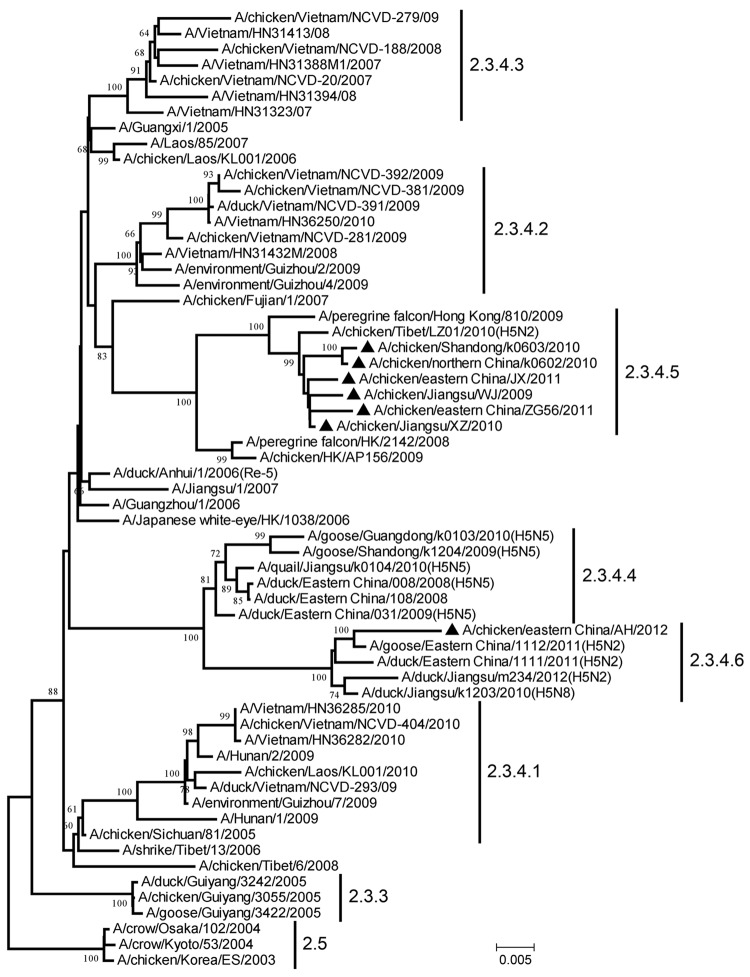
Phylogenetic tree of the hemagglutinin (HA) genes of the diverged avian influenza H5 subtype clade 2.3.4 variants from China and reference sequences retrieved from the GenBank database and partially recommended by the World Health Organization/World Organisation for Animal Health/Food and Agriculture Organization of the United Nations H5N1 Evolution Working Group The neighbor-joining tree was generated by using MEGA 5.1 software (www.megasoftware.net ). Numbers above or below the branch nodes denote bootstrap values > 60% with 1,000 replicates. Numbers on the right are existing (2.3.3, 2.3.4.1, 2.3.4.2, 2.3.4.3, 2.5) and proposed (2.3.4.4, 2.3.4.5, 2.3.4.6) virus subclades. Black triangles indicate the 7 variants identified in this study; GenBank accession numbers for their HA genes are KC631941–KC631946 and KC261450. Scale bar indicates nucleotide substitutions per site.
References
Publication types
MeSH terms
Substances
LinkOut - more resources
Full Text Sources
Other Literature Sources
Medical