


Understanding the gap between cognitive abilities and daily living skills in adolescents with autism spectrum disorders with average intelligence
- PMID: 24275020
- PMCID: PMC7398153
- DOI: 10.1177/1362361313510068
Understanding the gap between cognitive abilities and daily living skills in adolescents with autism spectrum disorders with average intelligence
Abstract
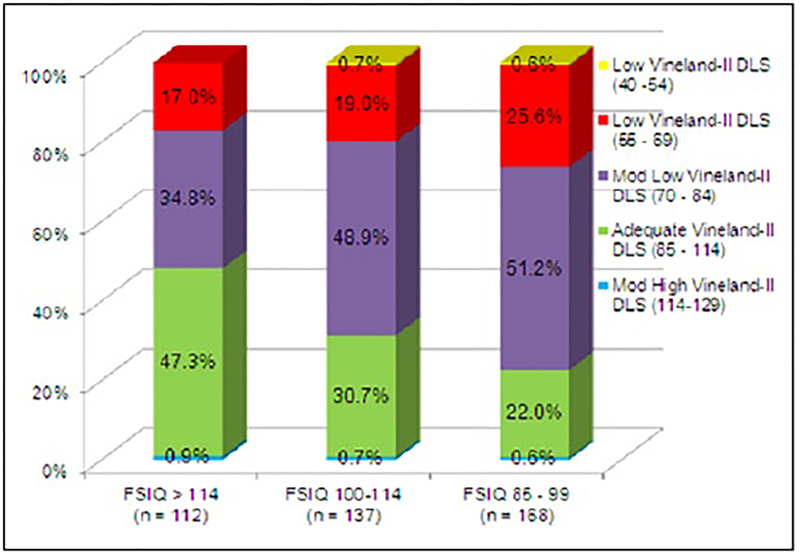
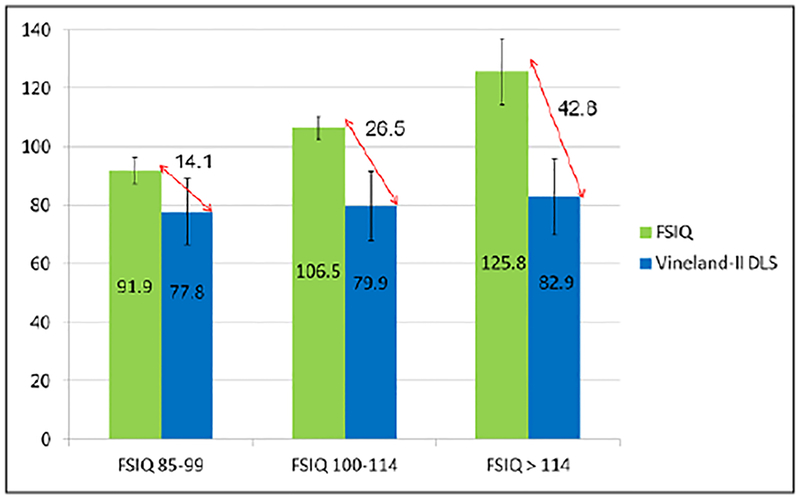
Daily living skills standard scores on the Vineland Adaptive Behavior Scales-2nd edition were examined in 417 adolescents from the Simons Simplex Collection. All participants had at least average intelligence and a diagnosis of autism spectrum disorder. Descriptive statistics and binary logistic regressions were used to examine the prevalence and predictors of a "daily living skills deficit," defined as below average daily living skills in the context of average intelligence quotient. Approximately half of the adolescents were identified as having a daily living skills deficit. Autism symptomatology, intelligence quotient, maternal education, age, and sex accounted for only 10% of the variance in predicting a daily living skills deficit. Identifying factors associated with better or worse daily living skills may help shed light on the variability in adult outcome in individuals with autism spectrum disorder with average intelligence.
Keywords: adaptive behavior; adolescence; autism spectrum disorder; cognitive abilities; daily living skills.
© The Author(s) 2013.
Figures
References
-
- Achenbach TM and Rescorla LA (2001) Manual for the ASEBA School-Age Forms & Profiles: An Integrated System of Multi-Informant Assessment. Burlington, VT: Vermont Center for Children, Youth and Families, University of Vermont.
-
- American Psychiatric Association (2011) Proposed draft revisions to DSM disorders and criteria: a 09 autism spectrum disorder. Available at: http://www.dsm5.org/proposedrevision/Pages/Default.aspx
-
- Benson P, Karlof KL and Siperstein GN (2008) Maternal involvement in the education of young children with autism spectrum disorders. Autism 12(1): 47–63. - PubMed
Publication types
MeSH terms
Grants and funding
LinkOut - more resources
Full Text Sources
Other Literature Sources
Miscellaneous
