. 2014 Jan;42(Database issue):D903-9.
doi: 10.1093/nar/gkt1188. Epub 2013 Nov 25.

1000 Genomes Selection Browser 1.0: a genome browser dedicated to signatures of natural selection in modern humans

Affiliations

1000 Genomes Selection Browser 1.0: a genome browser dedicated to signatures of natural selection in modern humans

Marc Pybus et al. Nucleic Acids Res. 2014 Jan.

Abstract

Searching for Darwinian selection in natural populations has been the focus of a multitude of studies over the last decades. Here we present the 1000 Genomes Selection Browser 1.0 (http://hsb.upf.edu) as a resource for signatures of recent natural selection in modern humans. We have implemented and applied a large number of neutrality tests as well as summary statistics informative for the action of selection such as Tajima's D, CLR, Fay and Wu's H, Fu and Li's F* and D*, XPEHH, ΔiHH, iHS, F(ST), ΔDAF and XPCLR among others to low coverage sequencing data from the 1000 genomes project (Phase 1; release April 2012). We have implemented a publicly available genome-wide browser to communicate the results from three different populations of West African, Northern European and East Asian ancestry (YRI, CEU, CHB). Information is provided in UCSC-style format to facilitate the integration with the rich UCSC browser tracks and an access page is provided with instructions and for convenient visualization. We believe that this expandable resource will facilitate the interpretation of signals of selection on different temporal, geographical and genomic scales.


Figures
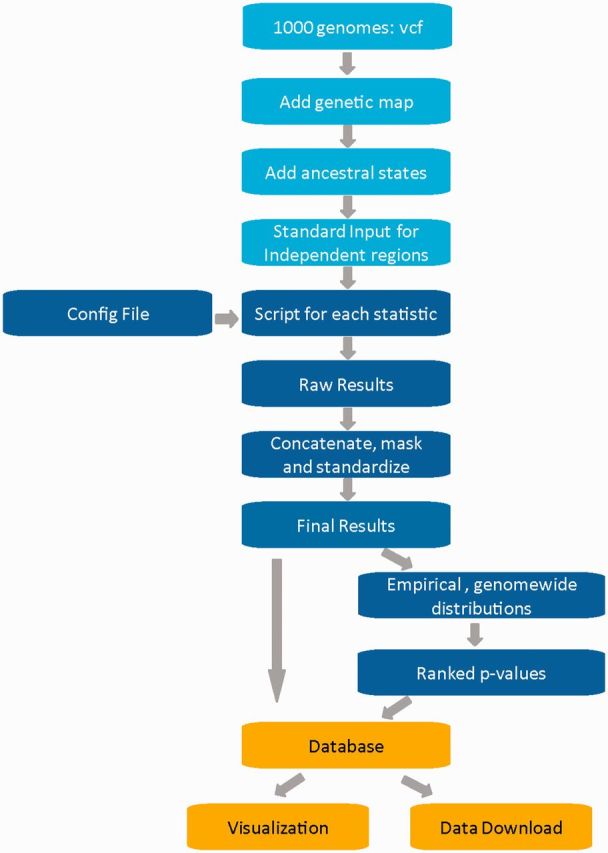
Figure 1.
Figure 1.
Schematic workflow developed in order to calculate diverse genome-wide summary statistics informative for the action of selection and to build a database in order to share and visualize the results.
Figure 2.
Figure 2.
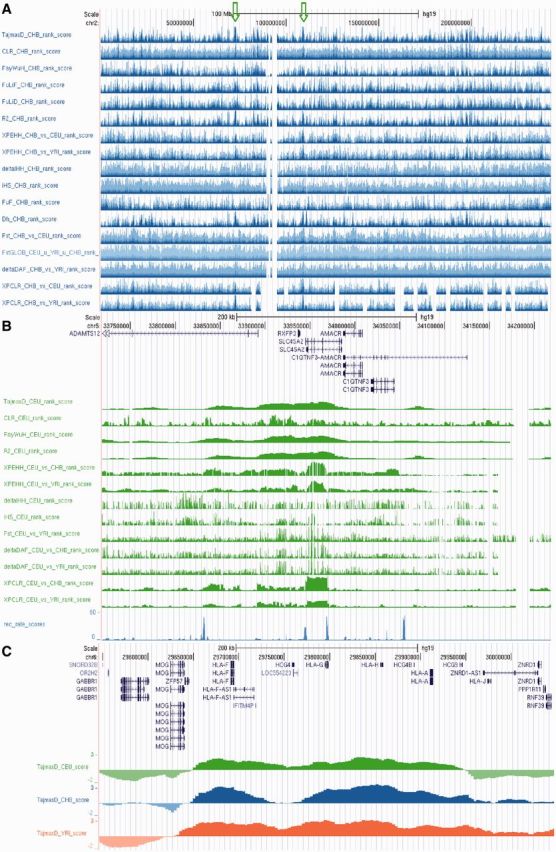
Examples of genomic regions under selection in the 1000 genomes selection browser. Tracks of statistics from different populations are visualized in colour (CEU in green, CHB in red and YRI in blue). Additional examples are given at http://hsb.upf.edu (A) The p- and q-arms of chromosome 2 (−log10 of empirically ranked scores). Recurrent peaks at around 72.5 Mb (left green arrow) and 109.5 Mb (right green arrow) indicate the loci CYP26B1/EXOC6B and EDAR, respectively. (B) Signature of positive selection around SLC45A2, another established skin colour gene, in the CEU population (0.5-Mb window; −log10 of empirically ranked scores). (C) Widespread balancing selection in the HLA region indicated by strongly positive scores for Tajima’s D in all three analysed human populations (0.5-Mb window).

References

    1. The 1000 Genomes Project Consortium. Abecasis GR, Auton A, Brooks LD, DePristo MA, Durbin RM, Handsaker RE, Kang HM, Marth GT, McVean GA. An integrated map of genetic variation from 1,092 human genomes. Nature. 2012;491:56–65. - PMC - PubMed
    1. The 1000 Genomes Project Consortium. A map of human genome variation from population-scale sequencing. Nature. 2010;467:1061–1073. - PMC - PubMed
    1. Tajima F. Statistical method for testing the neutral mutation hypothesis by DNA polymorphism. Genetics. 1989;123:585–595. - PMC - PubMed
    1. Nielsen R, Williamson S, Kim Y, Hubisz MJ, Clark AG, Bustamante C. Genomic scans for selective sweeps using SNP data. Genome Res. 2005;15:1566–1575. - PMC - PubMed
    1. Fay JC, Wu CI. Hitchhiking under positive Darwinian selection. Genetics. 2000;155:1405–1413. - PMC - PubMed

Publication types