


Early adoption of dabigatran and its dosing in US patients with atrial fibrillation: results from the outcomes registry for better informed treatment of atrial fibrillation
- PMID: 24275632
- PMCID: PMC3886732
- DOI: 10.1161/JAHA.113.000535
Early adoption of dabigatran and its dosing in US patients with atrial fibrillation: results from the outcomes registry for better informed treatment of atrial fibrillation
Abstract
Background: Dabigatran is a novel oral anticoagulant approved for thromboprophylaxis in atrial fibrillation. Adoption patterns of this new agent in community practice are unknown.
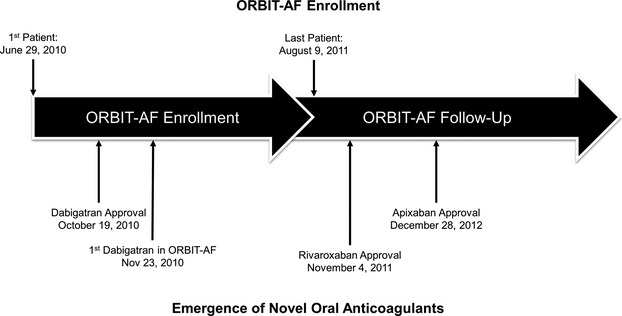
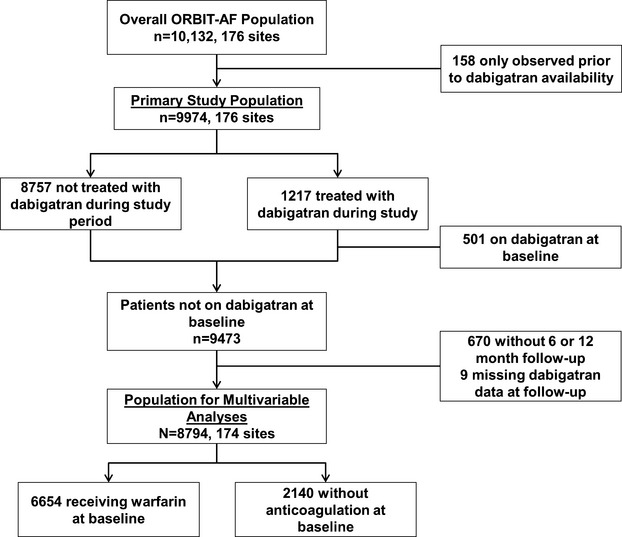
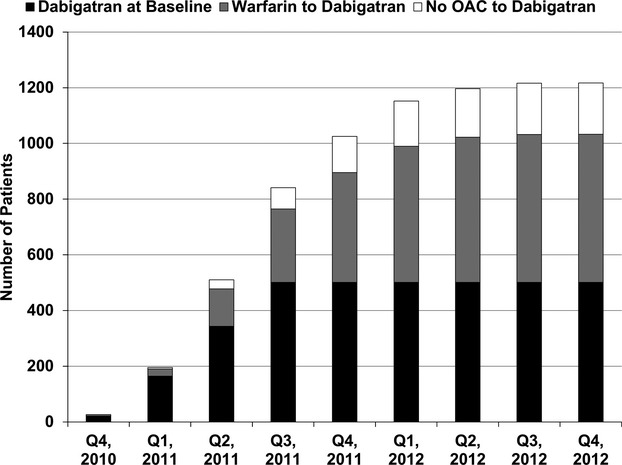
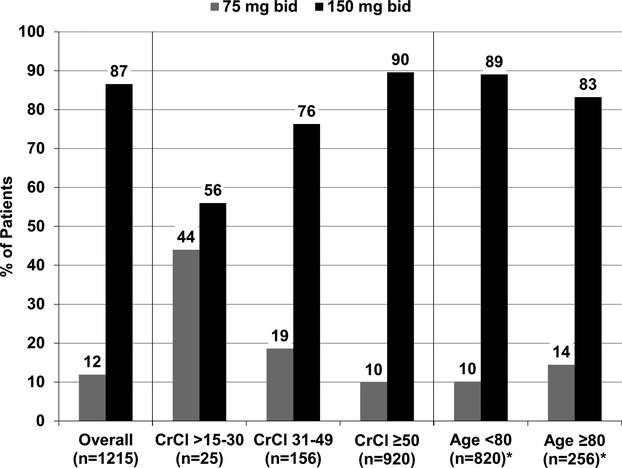
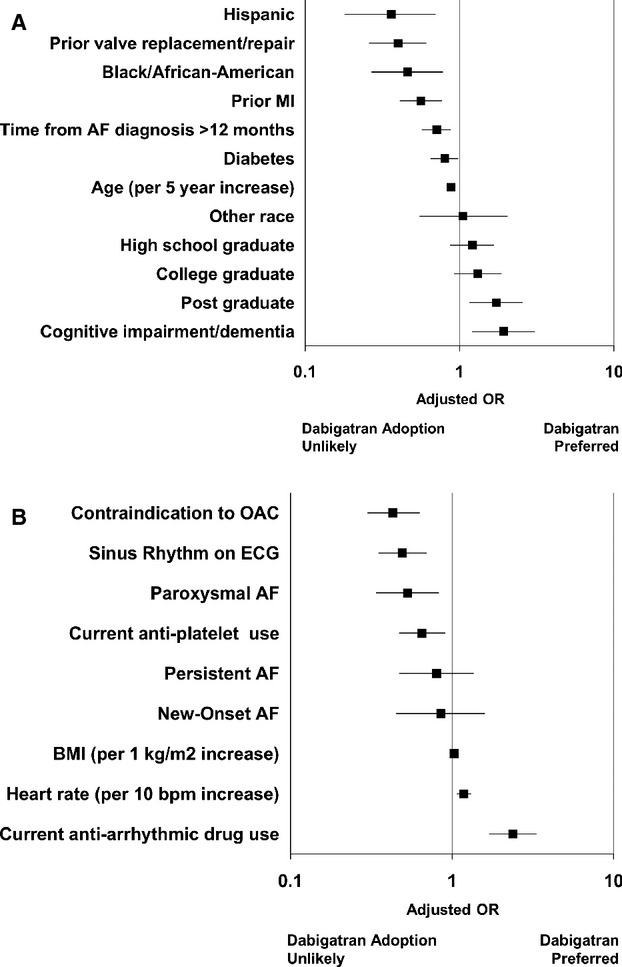
Methods and results: We studied patterns of dabigatran use among patients enrolled in the Outcomes Registry for Better Informed Treatment of Atrial Fibrillation (ORBIT-AF) Registry between June 2010 and August 2011 and followed for 12 months. Among 9974 atrial fibrillation patients included, 1217 (12%) were treated with dabigatran during the study. Overall, patients receiving dabigatran were younger (median age 72 versus 75 years, P<0.0001), more likely to be white (92% versus 89%, P=0.005), more likely to have private insurance (33% versus 25%, P<0.0001), and less likely to have prior cardiovascular disease (4% versus 33%, P<0.0001). They had more new-onset atrial fibrillation (8.8% versus 4.1%, P<0.0001), lower CHADS2 scores (estimated risk based on the presence of congestive heart failure, hypertension, aged ≥75 years, diabetes mellitus, and prior stroke or transient ischemic attack; mean 2.0 versus 2.3, P<0.0001), and lower Anticoagulation and Risk Factors in Atrial Fibrillation scores (mean 2.4 versus 2.8, P<0.0001). More than half (n=14/25, 56%) of patients with severe kidney disease were not prescribed reduced dosing, whereas 10% (n=91/920) with preserved renal function received lower dosing. Among patients not on dabigatran at baseline, 8% had dabigatran initiated during follow-up. Patient education was significantly associated with switching from warfarin to dabigatran (adjusted odds ratio for postgraduate 1.73, P=0.007), whereas antiarrhythmic drug use significantly correlated with de novo adoption of dabigatran (adjusted odds ratio 2.4, P<0.0001).
Conclusions: Patients receiving dabigatran were younger and at a lower risk of stroke and bleeding. Patients appeared to drive switching from warfarin, whereas clinical characteristics influenced de novo start of dabigatran. These data suggest cautious early uptake of dabigatran, and more careful attention to dosing adjustments is warranted.
Clinical trial registration url: Clinicaltrials.gov. Unique identifier: NCT01165710.
Keywords: anticoagulant; atrial fibrillation; dabigatran; dosing; pharmacoepidemiology.
Figures
References
-
- Wolf PA, Abbott RD, Kannel WB. Atrial fibrillation as an independent risk factor for stroke: the Framingham Study. Stroke. 1991; 22:983-988 - PubMed
-
- Ezekowitz MD, Levine JA. Preventing stroke in patients with atrial fibrillation. JAMA. 1999; 281:1830-1835 - PubMed
-
- Connolly SJ, Ezekowitz MD, Yusuf S, Eikelboom J, Oldgren J, Parekh A, Pogue J, Reilly PA, Themeles E, Varrone J, Wang S, Alings M, Xavier D, Zhu J, Diaz R, Lewis BS, Darius H, Diener HC, Joyner CD, Wallentin L. Dabigatran versus warfarin in patients with atrial fibrillation. N Engl J Med. 2009; 361:1139-1151 - PubMed
-
- Beasley BN, Unger EF, Temple R. Anticoagulant options—why the FDA approved a higher but not a lower dose of dabigatran. N Engl J Med. 2011; 364:1788-1790 - PubMed
-
- Huang C, Siu M, Vu L, Wong S, Shin J. Factors influencing doctors' selection of dabigatran in non‐valvular atrial fibrillation. J Eval Clin Pract. 2013; 19:938-943 - PubMed
Publication types
MeSH terms
Substances
Associated data
Grants and funding
LinkOut - more resources
Full Text Sources
Other Literature Sources
Medical
