. 2013 Nov 20;8(11):e79740.
doi: 10.1371/journal.pone.0079740. eCollection 2013.

The pathogen- and incidence-based DALY approach: an appropriate [corrected] methodology for estimating the burden of infectious diseases

Collaborators, Affiliations

The pathogen- and incidence-based DALY approach: an appropriate [corrected] methodology for estimating the burden of infectious diseases

Marie-Josée J Mangen et al. PLoS One. .

Erratum in

  • PLoS One. 2013;8(12). doi:10.1371/annotation/caf33818-3453-4e30-b307-7526427b09b7

Abstract

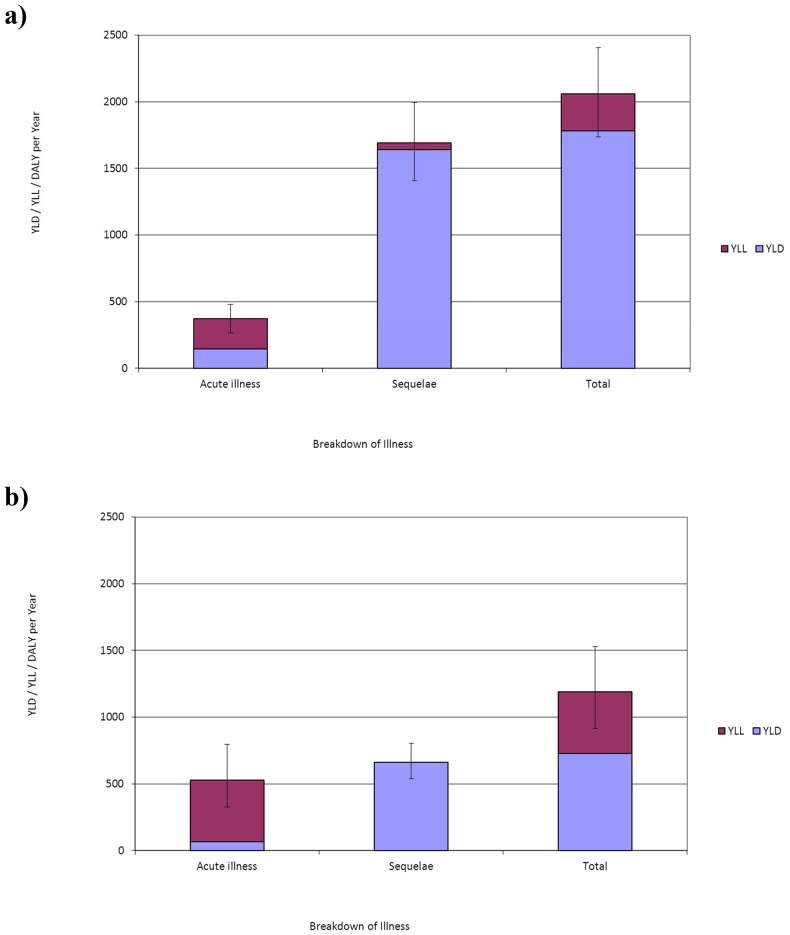
In 2009, the European Centre for Disease Prevention and Control initiated the 'Burden of Communicable Diseases in Europe (BCoDE)' project to generate evidence-based and comparable burden-of-disease estimates of infectious diseases in Europe. The burden-of-disease metric used was the Disability-Adjusted Life Year (DALY), composed of years of life lost due to premature death (YLL) and due to disability (YLD). To better represent infectious diseases, a pathogen-based approach was used linking incident cases to sequelae through outcome trees. Health outcomes were included if an evidence-based causal relationship between infection and outcome was established. Life expectancy and disability weights were taken from the Global Burden of Disease Study and alternative studies. Disease progression parameters were based on literature. Country-specific incidence was based on surveillance data corrected for underestimation. Non-typhoidal Salmonella spp. and Campylobacter spp. were used for illustration. Using the incidence- and pathogen-based DALY approach the total burden for Salmonella spp. and Campylobacter spp. was estimated at 730 DALYs and at 1,780 DALYs per year in the Netherlands (average of 2005-2007). Sequelae accounted for 56% and 82% of the total burden of Salmonella spp. and Campylobacter spp., respectively. The incidence- and pathogen-based DALY methodology allows in the case of infectious diseases a more comprehensive calculation of the disease burden as subsequent sequelae are fully taken into account. Not considering subsequent sequelae would strongly underestimate the burden of infectious diseases. Estimates can be used to support prioritisation and comparison of infectious diseases and other health conditions, both within a country and between countries.


Conflict of interest statement

Competing Interests: The authors have declared that no competing interests exist.

Figures

Figure 1
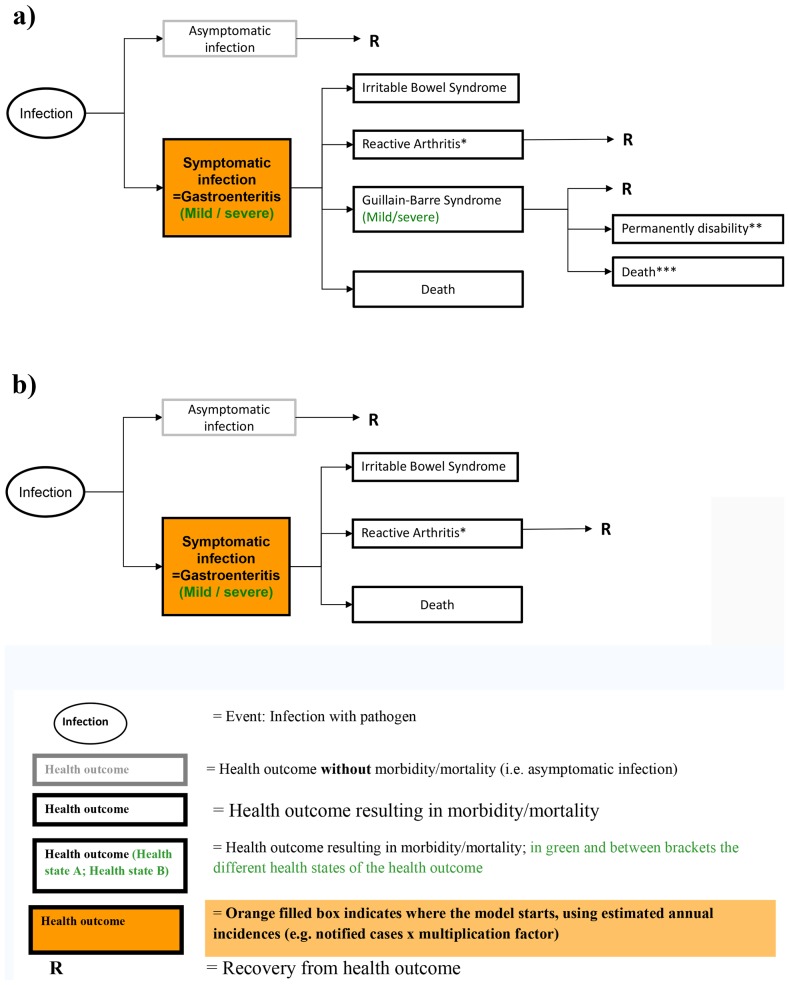
Figure 1. Outcome tree for Campylobacter spp. (a) and Salmonella spp. (b) – an illustration. Note:
*Only severe GE cases are at risk to develop ReA. ** Non-fatal severe GBS cases may develop permanent disability. *** For reasons of simplicity we assume that only severe GBS cases may be fatal.
Figure 2
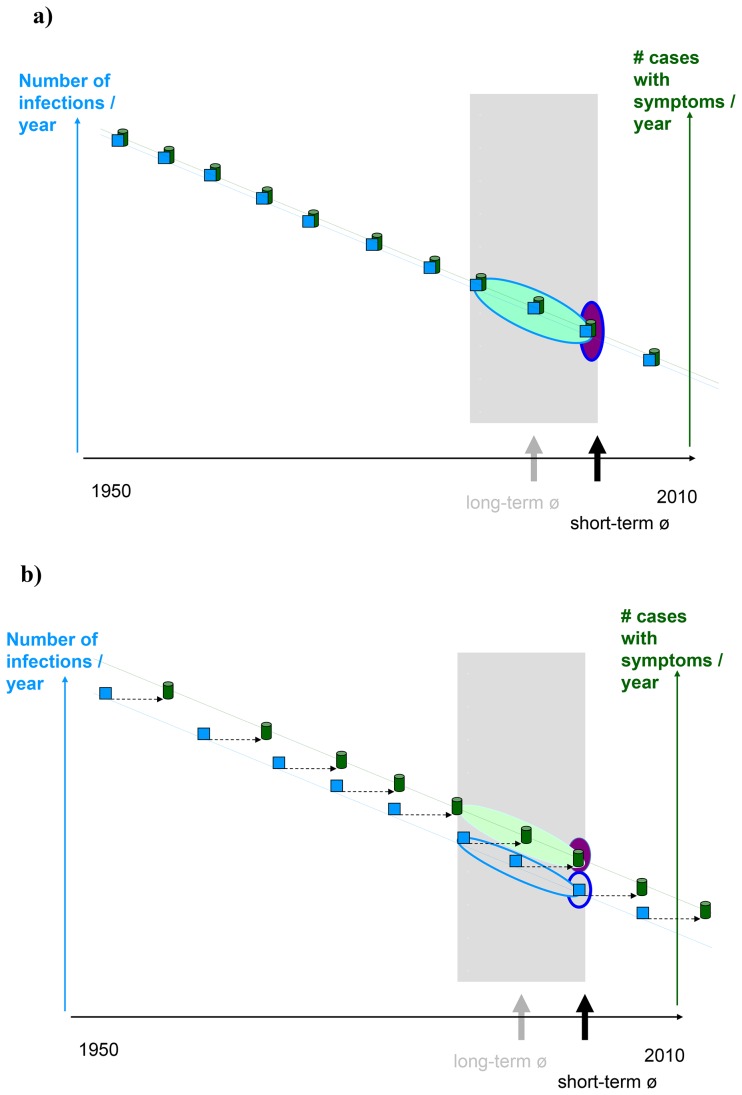
Figure 2. Assuming a downwards time trend for an infection having symptoms in the same years (a) and for an infection where symptoms occur only after 10 years (b). Note:
Blue rectangles represent the number of infections in the year of infection (exposure to an infection). Green “cans” represent the number of cases with symptoms; where these symptomatic cases occur in the same year as the infection (a.) or a few years later (b.) as indicated by the dashed arrow. The long-term average (e.g. 10-year average) is highlighted by a light blue oval for incidence, and by a light green oval for prevalence. The short-term average (e.g. 3-year average) is represented by a dark blue oval for incidence and purple oval for prevalence.
Figure 3
Figure 3. The undiscounted average burden of Campylobacter spp.
(a) and Salmonella spp. (b) in the Netherlands (average of 2005–2007) in DALY per year, subdivided in YLL and YLD for acute illness, sequelae and total. The 95% uncertainty range is shown using error bars.
Figure 4
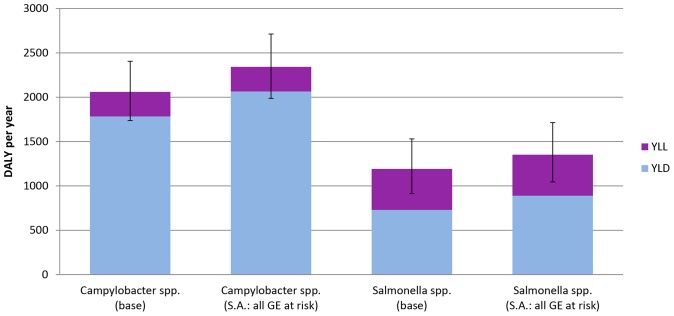
Figure 4. The undiscounted average burden of Campylobacter spp. and Salmonella spp.
in the Netherlands (average of 2005–2007) in DALY per year, for base case and scenario analysis. DALY are subdivided in YLL and YLD for actue illness, sequelae and total. The 95% uncertainty range is shown using error bars. Note: “Base case” represents a situation where only severe GE cases are at risk to develop reactive arthritis (ReA). “SA: ReA” represents the scenario analysis where all GE cases are at risk to develop ReA.

References

    1. Murray CJL, Lopez AD, Jamison DT (1994) The global burden of disease in 1990 : summary results, sensitivity analysis and future directions. Bull World Health Organ. 72(3): 495–509. - PMC - PubMed
    1. Murray CJL, Lopez AD (1994) Global and regional cause-of-death patterns in 1990. Bull World Health Organ. 72(3): 447–80. - PMC - PubMed
    1. Murray CJL, Lopez AD (1994) Quantifying disability: data, methods and results. Bull World Health Organ. 72(3): 481–94. - PMC - PubMed
    1. Murray CJL (1994) Quantifying the burden of disease: the technical basis for disability-adjusted life years. Bull World Health Organ. 72(3): 429–45. - PMC - PubMed
    1. World Bank (1993) World development report 1993: investing in health. New York: Oxford University Press.

Publication types