. 2014 May 15;209(10):1524-32.
doi: 10.1093/infdis/jit663. Epub 2013 Nov 26.

Increased incidence of urolithiasis and bacteremia during Proteus mirabilis and Providencia stuartii coinfection due to synergistic induction of urease activity

Affiliations

Increased incidence of urolithiasis and bacteremia during Proteus mirabilis and Providencia stuartii coinfection due to synergistic induction of urease activity

Chelsie E Armbruster et al. J Infect Dis. .

Abstract

Background: Catheter-associated urinary tract infections (CaUTIs) are the most common hospital-acquired infections worldwide and are frequently polymicrobial. The urease-positive species Proteus mirabilis and Providencia stuartii are two of the leading causes of CaUTIs and commonly co-colonize catheters. These species can also cause urolithiasis and bacteremia. However, the impact of coinfection on these complications has never been addressed experimentally.

Methods: A mouse model of ascending UTI was utilized to determine the impact of coinfection on colonization, urolithiasis, and bacteremia. Mice were infected with P. mirabilis or a urease mutant, P. stuartii, or a combination of these organisms. In vitro experiments were conducted to assess growth dynamics and impact of co-culture on urease activity.

Results: Coinfection resulted in a bacterial load similar to monospecies infection but with increased incidence of urolithiasis and bacteremia. These complications were urease-dependent as they were not observed during coinfection with a P. mirabilis urease mutant. Furthermore, total urease activity was increased during co-culture.

Conclusions: We conclude that P. mirabilis and P. stuartii coinfection promotes urolithiasis and bacteremia in a urease-dependent manner, at least in part through synergistic induction of urease activity. These data provide a possible explanation for the high incidence of bacteremia resulting from polymicrobial CaUTI.

Keywords: Proteus mirabilis; Providencia stuartii; UTI; bacteremia; coinfection; urease; urolithiasis.


Figures
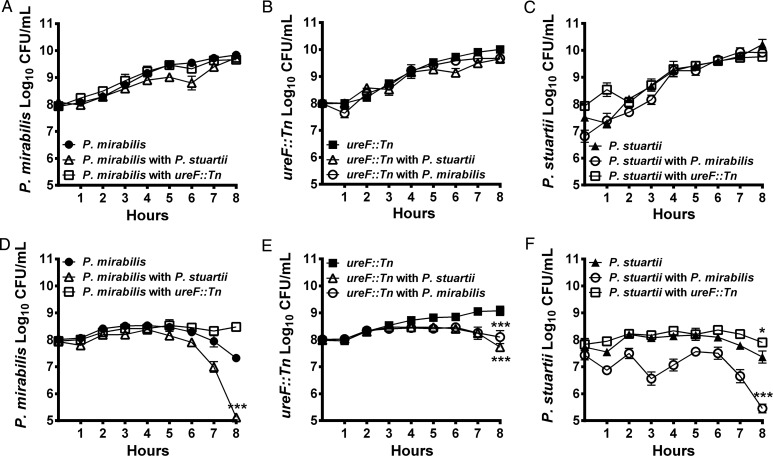
Figure 1.
Figure 1.
P. mirabilis and P. stuartii coexist during co-culture. P. mirabilis HI4320, P. mirabilis ureF::Tn, and P. stuartii BE2467 were cultured individually (filled symbols) or co-cultured (open symbols) in LB (AC) and human urine (DF). CFU/mL were determined by sampling cultures every hour and plating on plain LB agar and LB containing either 10 µg/mL ampicillin or 25 µg/mL kanamycin to distinguish between species. Error bars represent mean ± SD for 3–8 independent experiments. *P < .05, ***P < .001 by two-way ANOVA.
Figure 2.
Figure 2.
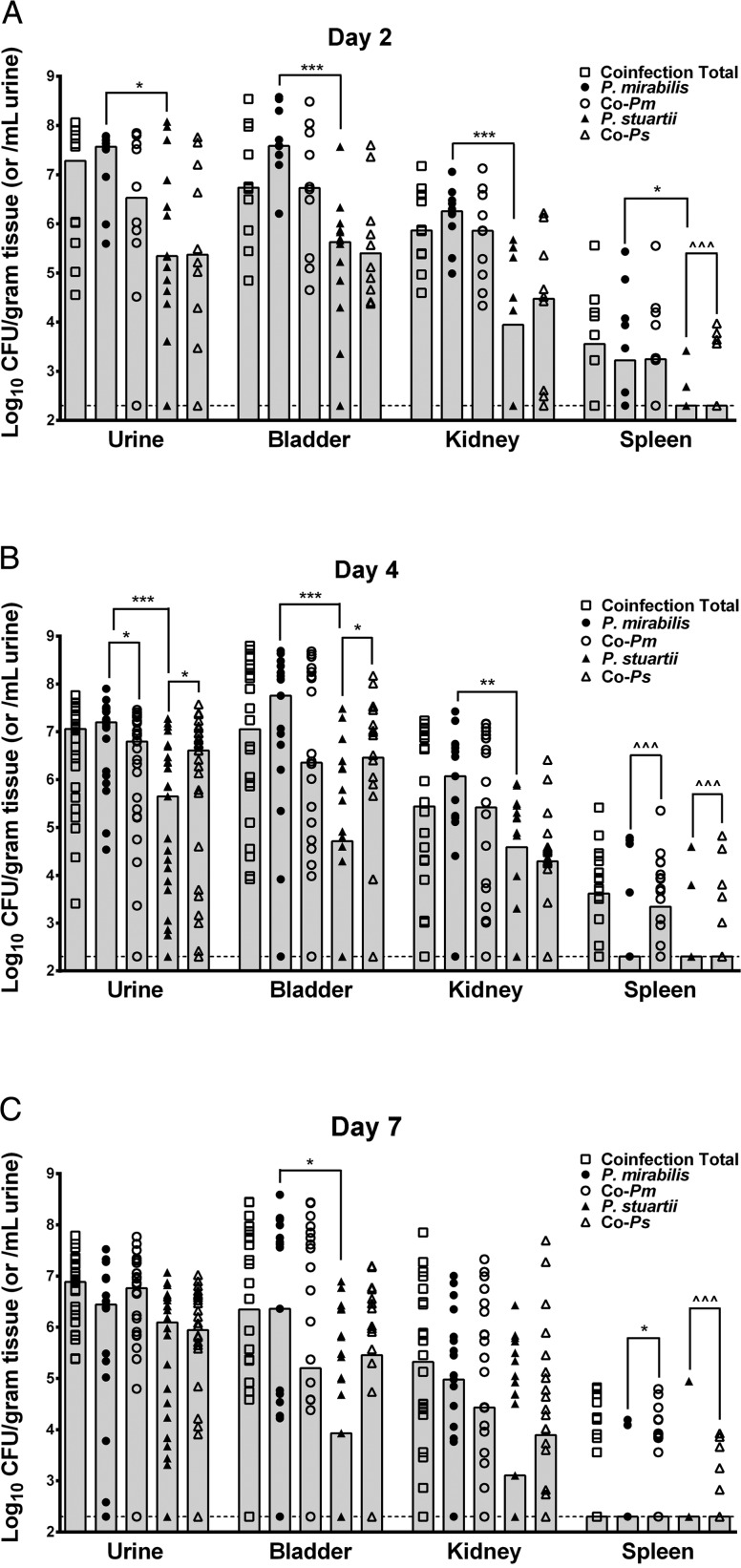
Coinfection does not alter total bacterial load but increases colonization by P. stuartii and incidence of bacteremia. CBA/J mice were inoculated by transurethral injection of 50 µL of 2 × 10⁸ CFU/mL (1 × 10⁷ CFU/mouse) of each species or a 1:1 mixture containing the same total CFU/mL. Urine was collected and mice were sacrificed 2 (A), 4 (B), or 7 (C) days post-inoculation. Samples from monospecies infection were plated on plain LB agar to determine CFU/mL urine or gram of tissue of P. mirabilis (filled circles) or P. stuartii (filled triangles). Samples from coinfected animals were plated on plain LB agar to determine total CFUs (open boxes) and LB containing 25 µg/mL kanamycin to distinguish CFU of P. mirabilis (open circles) from P. stuartii (open triangles). Each symbol represents CFU/gram of tissue or ml of urine for one mouse. Gray bars represent the median for a total of 4 independent experiments. Dashed lines indicate limit of detection. *P < .05, **P < .01, ***P < .001 by the nonparametric Mann–Whitney test, ^^^P < .001 by Chi-square test.
Figure 3.
Figure 3.
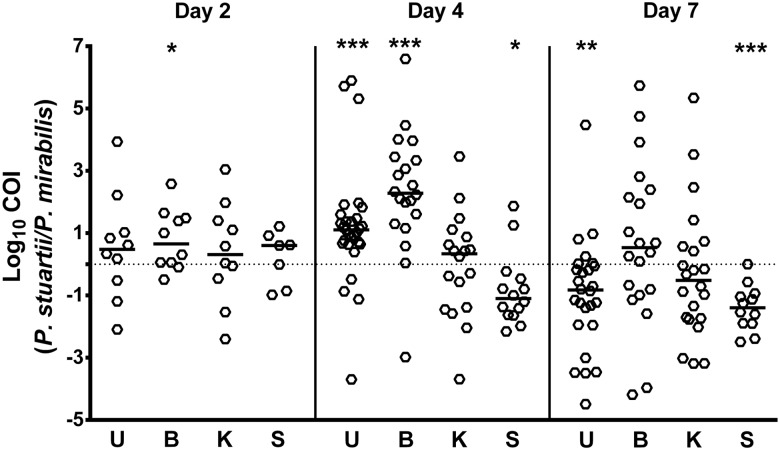
Coinfection favors P. stuartii in the bladder and P. mirabilis in the spleen. A coinfection index (COI) was calculated for the urine (U), bladder (B), kidney (K), and spleen (S) at each time point by determining the ratio of P. stuartii to P. mirabilis CFUs recovered from individual coinfected mice divided by the ratio of the median CFUs of each species from monospecies infections. Each symbol represents COI for one mouse. Bars represent the median, dashed line indicates a COI of 1. *P < .05, **P < .01, ***P < .001 by the Wilcoxon signed rank test.
Figure 4.
Figure 4.
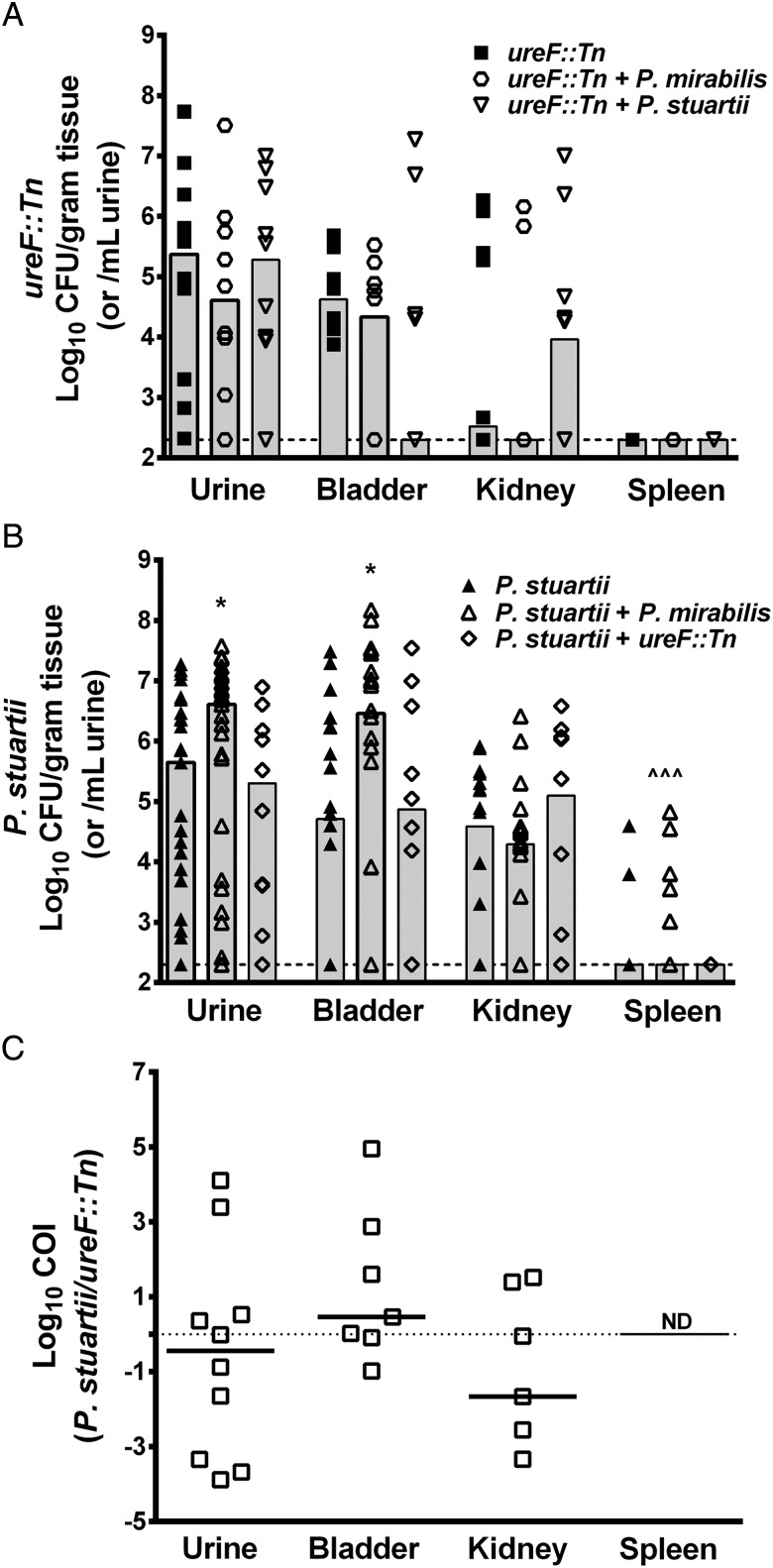
Coinfection increases incidence of bacteremia in a urease-dependent manner. CBA/J mice were inoculated by transurethral injection of 50 µL of 2 × 10⁸ CFU/mL (1 × 10⁷ CFU/mouse) of ureF::Tn, a 1:1 mixture of ureF::Tn and the parental strain of P. mirabilis, or a 1:1 mixture of ureF::Tn and P. stuartii. Urine was collected and mice were sacrificed 4 days post-inoculation. A, ureF::Tn CFU/mL urine or gram of tissue from monospecies infection (filled boxes), coinfection with the parental strain of P. mirabilis (open circles), or coinfection with P. stuartii (open triangles). Each symbol represents one mouse. Gray bars represent the median, dashed line indicates limit of detection. Coinfection did not significantly alter ureF::Tn colonization as determined by the nonparametric Mann–Whitney test. B, P. stuartii CFU/mL urine or gram of tissue from monospecies infections (filled triangles), coinfection with P. mirabilis (open triangles), or coinfection with ureF::Tn (open diamonds). Each symbol represents one mouse. Gray bars represent the median, dashed line indicates limit of detection. *P < .05 compared to monospecies infection by the nonparametric Mann–Whitney test, ^^^P < .001 by Chi-square test. C, COI was calculated for coinfection of P. stuartii and ureF::Tn (open boxes). Bars represent the median, dashed line indicates a COI of 1. COI was not significantly different than 1 for any organ by the Wilcoxon signed rank test. COI in spleen not determined (ND) for P. stuartii and ureF::Tn coinfection as no animals exhibited spleen colonization.
Figure 5.
Figure 5.
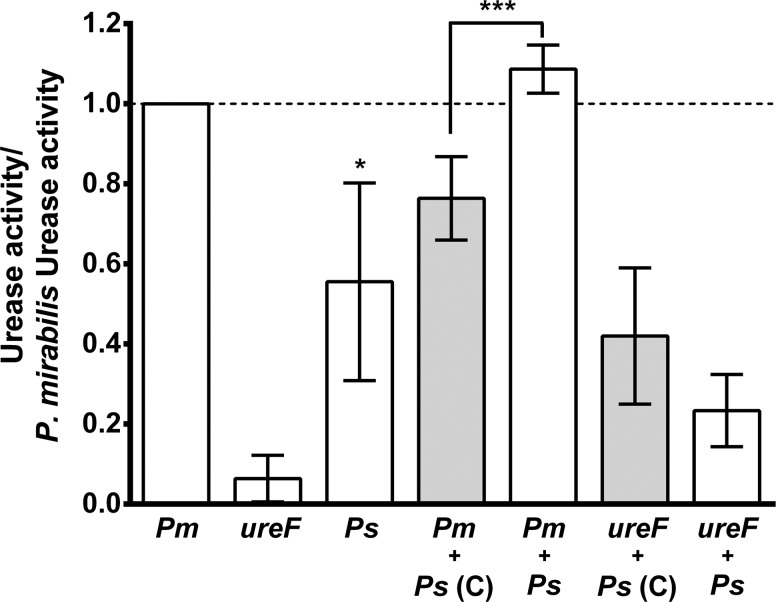
Co-culture results in synergistic induction of urease activity. P. mirabilis HI4320 (Pm), P. mirabilis ureF::Tn (ureF), and P. stuartii BE2467 (Ps) were cultured individually or co-cultured and incubated in sterile-filtered human urine to induce urease activity. Bars represent mean ± SD urease activity/mg protein normalized to P. mirabilis activity for each of 4–5 independent biological replicates. White bars represent urease activity measured in cell free extracts of each culture. Grey bars represent the expected urease activity as calculated from the activity of single cultures and the proportion of each species in the co-culture (see Materials and Methods). *P < .05 by the Wilcoxon signed rank test, ***P < .001 by Student's t test.

References

    1. Hooton TM, Bradley SF, Cardenas DD, et al. Diagnosis, Prevention, and Treatment of Catheter-Associated Urinary Tract Infection in Adults: 2009 International Clinical Practice Guidelines from the Infectious Diseases Society of America. Clin Infect Dis. 2010;50:625–63. - PubMed
    1. Dedeic-Ljubovic A, Hukic M. Catheter-related urinary tract infection in patients suffering from spinal cord injuries. Bosn J Basic Med Sci. 2009;9:2–9. - PMC - PubMed
    1. Ronald A. The etiology of urinary tract infection: traditional and emerging pathogens. Dis Mon. 2003;49:71–82. - PubMed
    1. Siegman-Igra Y, Kulka T, Schwartz D, Konforti N. Polymicrobial and monomicrobial bacteraemic urinary tract infection. J Hosp Infect. 1994;28:49–56. - PubMed
    1. Rahav G, Pinco E, Silbaq F, Bercovier H. Molecular epidemiology of catheter-associated bacteriuria in nursing home patients. J Clin Microbiol. 1994;32:1031–4. - PMC - PubMed

Publication types