


doi: 10.3390/cancers2021288.
Interfering with ROS Metabolism in Cancer Cells: The Potential Role of Quercetin
Affiliations
- PMID: 24281116
- PMCID: PMC3835130
- DOI: 10.3390/cancers2021288
Item in Clipboard
Interfering with ROS Metabolism in Cancer Cells: The Potential Role of Quercetin
Cancers (Basel).
.
Abstract
A main feature of cancer cells, when compared to normal ones, is a persistent pro-oxidative state that leads to an intrinsic oxidative stress. Cancer cells have higher levels of reactive oxygen species (ROS) than normal cells, and ROS are, in turn, responsible for the maintenance of the cancer phenotype. Persistent ROS stress may induce adaptive stress responses, enabling cancer cells to survive with high levels of ROS and maintain cellular viability. However, excessive ROS levels render cancer cells highly susceptible to quercetin, one of the main dietary flavonoids. Quercetin depletes intracellular glutathione and increases intracellular ROS to a level that can cause cell death.
Figures
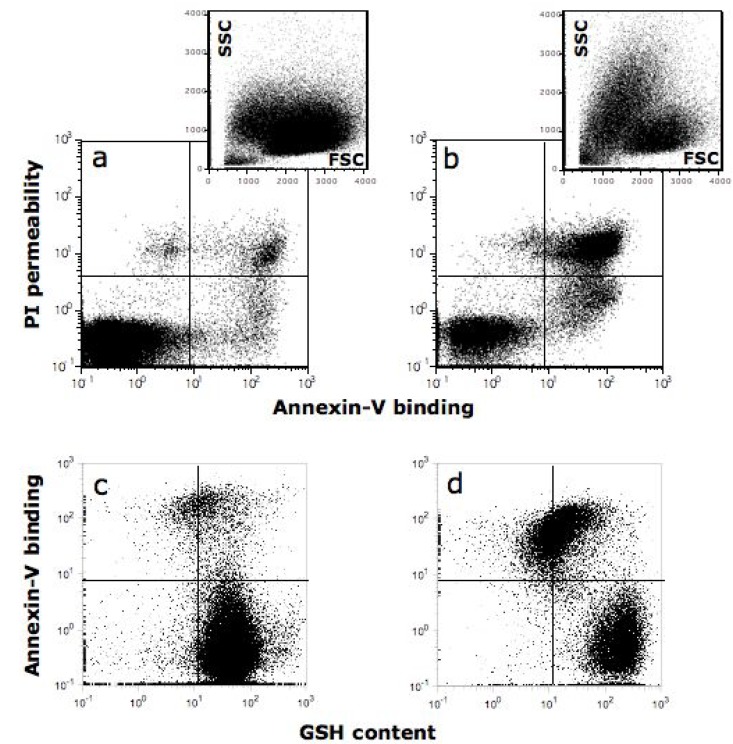
Quercetin induces apoptosis and changes in GSH content in SW872 liposarcoma cells. Polychromatic cytofluorimetric analysis of SW872 cells stained with Alexa 647-labeled annexin-V (ANX-V) and propidium iodide (PI) to detect apoptosis (panels a and b), and with monobromobimane (MBB) to detect intracellular glutathione (GSH) content (panels c and d). Cells were incubated in the absence (left column) or in the presence of 50 μM Qu (right column) for 48 hours. Physical parameters (FSC vs. SSC) are shown in the inserts of panels a and b. It is important to note that: (i) the amount of early apoptotic (ANX-V+/PI-) and of late apoptotic cells (ANX-V+/PI+) significantly increases in the presence of Qu (compare panels a and b); (ii) cells that survive the pro-oxidant stress induced by Qu have high GSH content, whereas apoptotic cells have low GSH content (see in panel d that ANX-V negative cells have an increased GSH content, as revealed by MBB fluorescence).
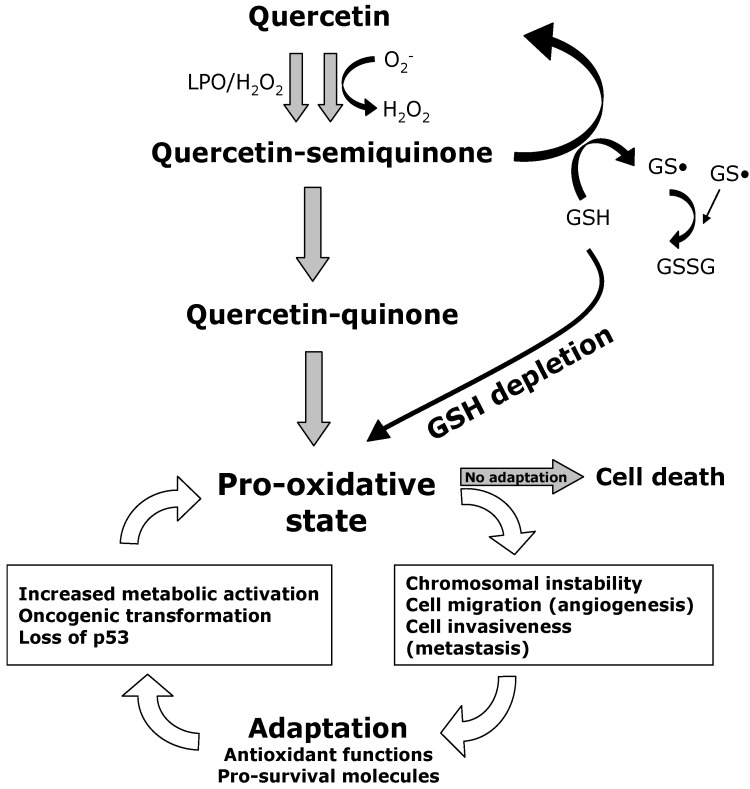
The role of quercetin in the metabolism of ROS in cancer cells. Reactive oxygen species (ROS) are continuously generated in cancer cells as a result of several factors, including increased metabolic activity, the activation of oncogenes, and the eventual loss of p53. The increase of ROS plays an important role in the maintenance of cancer phenotype and leads to a condition of pro-oxidative state. In turn, ROS can determine chromosomal instability (accumulation of mutations and deletions), and can stimulate cell growth and proliferation, as well as cell migration and invasiveness (angiogenesis and metastasis). The adaptation of cancer cells to this setting essentially involves the rearrangement of the antioxidant functions and the upregulation of pro-survival proteins. These changes allow them to bypass the cell death caused by excessive levels of ROS. The exposure to Quercetin (Qu) leads to the formations of quercetin-semiquinones and quercetin-quinones, which exert pro-oxidant effects within the cells. These compounds are highly reactive towards thiols and react with reduced glutathione (GSH), causing GSH depletion. The disruption of GSH antioxidant defense in cells with persistent ROS overload, like malignant cells, leads to cell death by apoptosis. LPO, lactic peroxidase; O2−, superoxide anion; H2O2, hydrogen peroxide; GSH, glutathione; GS•, oxidized GSH; GSSG, glutathione disulfide.
References
-
- Lambeth J.D. NOX enzymes and the biology of reactive oxygen. Nat. Rev. Immunol. 2004;4:181–189. - PubMed
LinkOut - more resources
Full Text Sources
Other Literature Sources
