Global motion perception in 2-year-old children: a method for psychophysical assessment and relationships with clinical measures of visual function
- PMID: 24282224
- PMCID: PMC3876766
- DOI: 10.1167/iovs.13-13051
Global motion perception in 2-year-old children: a method for psychophysical assessment and relationships with clinical measures of visual function
Abstract
Purpose: We developed and validated a technique for measuring global motion perception in 2-year-old children, and assessed the relationship between global motion perception and other measures of visual function.
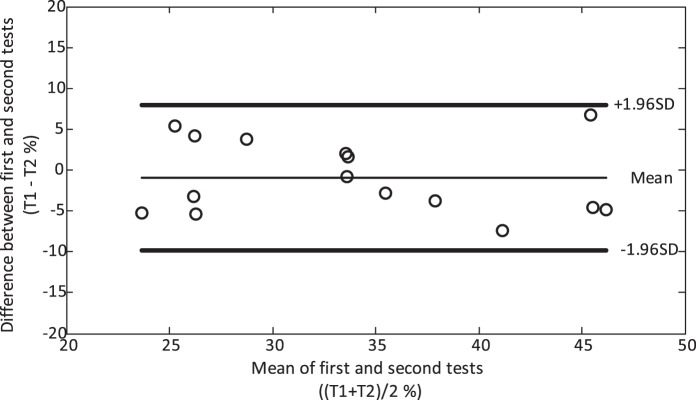
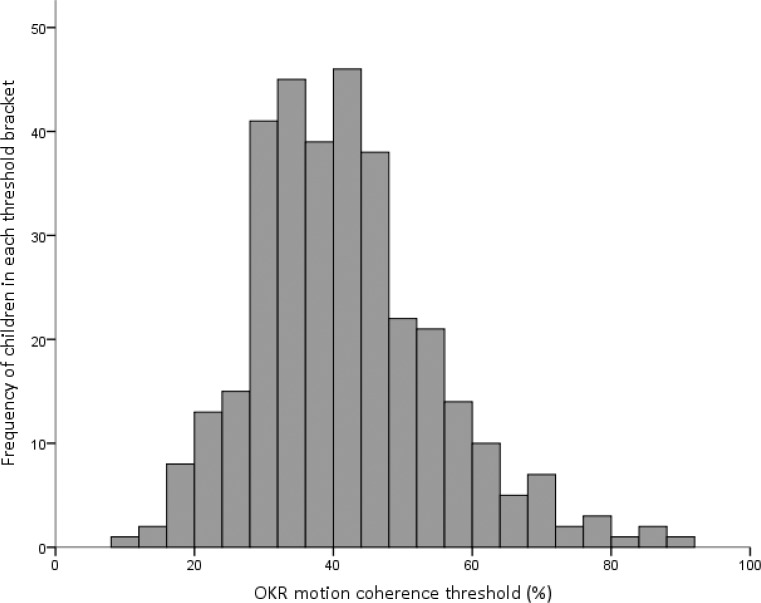
Methods: Random dot kinematogram (RDK) stimuli were used to measure motion coherence thresholds in 366 children at risk of neurodevelopmental problems at 24 ± 1 months of age. RDKs of variable coherence were presented and eye movements were analyzed offline to grade the direction of the optokinetic reflex (OKR) for each trial. Motion coherence thresholds were calculated by fitting psychometric functions to the resulting datasets. Test-retest reliability was assessed in 15 children, and motion coherence thresholds were measured in a group of 10 adults using OKR and behavioral responses. Standard age-appropriate optometric tests also were performed.
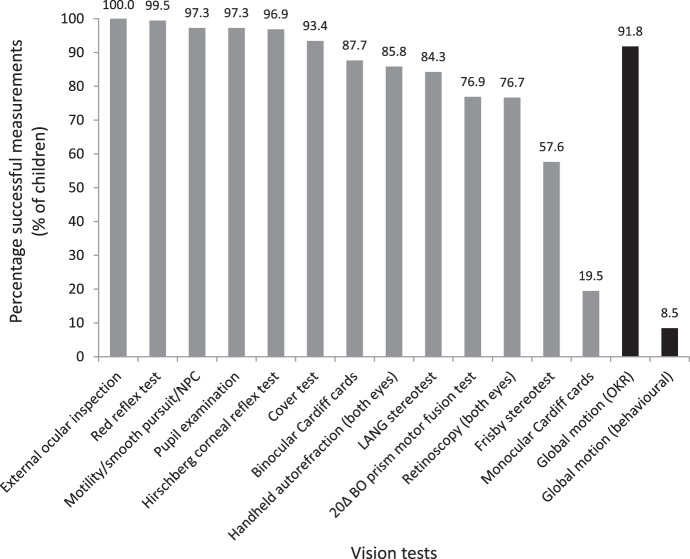
Results: Motion coherence thresholds were measured successfully in 336 (91.8%) children using the OKR technique, but only 31 (8.5%) using behavioral responses. The mean threshold was 41.7 ± 13.5% for 2-year-old children and 3.3 ± 1.2% for adults. Within-assessor reliability and test-retest reliability were high in children. Children's motion coherence thresholds were significantly correlated with stereoacuity (LANG I & II test, ρ = 0.29, P < 0.001; Frisby, ρ = 0.17, P = 0.022), but not with binocular visual acuity (ρ = 0.11, P = 0.07). In adults OKR and behavioral motion coherence thresholds were highly correlated (intraclass correlation = 0.81, P = 0.001).
Conclusions: Global motion perception can be measured in 2-year-old children using the OKR. This technique is reliable and data from adults suggest that motion coherence thresholds based on the OKR are related to motion perception. Global motion perception was related to stereoacuity in children.
Keywords: dorsal stream; motion coherence threshold; optokinetic nystagmus; random-dot-kinematogram; vision.
Figures


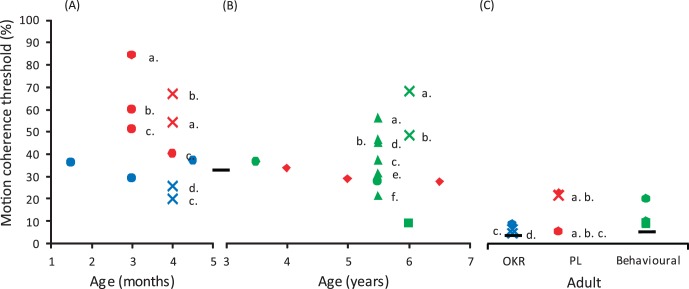
 = Wattam-Bell,
 = Bantan and Bertenthal,
 = Mason et al.,
 = Ellemberg et al.,
 = Gunn et al.,
 = Parrish et al.,
 = Hadad et al.,
 and
and  = Narasimhan and Giaschi. The (a–f) labels are to be used in conjunction with Table A1 provided in the Appendix and identify different stimulus parameters used within individual studies. The black horizontal lines represent the average thresholds found in our study for 2-year-old children (OKR) and adults (OKR and behavioral).
References
-
- Braddick O, Atkinson J, Wattam-Bell J. Normal and anomalous development of visual motion processing: motion coherence and ‘dorsal-stream vulnerability'. Neuropsychologia. 2003; 41: 1769–1784 - PubMed
-
- Macintyre-Béon C, Ibrahim H, Hay I, et al. Dorsal stream dysfunction in children. A review and an approach to diagnosis and management. Curr Ped Rev. 2010; 6: 166–182
-
- Grinter EJ, Maybery MT, Badcock DR. Vision in developmental disorders: is there a dorsal stream deficit? Brain Res Bull. 2010; 82: 147–160 - PubMed
-
- Dutton GN. ‘Dorsal stream dysfunction' and ‘dorsal stream dysfunction plus': a potential classification for perceptual visual impairment in the context of cerebral visual impairment? Dev Med Child Neurol. 2009; 51: 170–172 - PubMed
-
- Atkinson J, Braddick O. From genes to brain development to phenotypic behavior. “Dorsal-stream vulnerability” in relation to spatial cognition, attention, and planning of actions in Williams syndrome (WS) and other developmental disorders. Prog Brain Res. 2011; 189: 261–283 - PubMed
Publication types
MeSH terms
Grants and funding
LinkOut - more resources
Full Text Sources
Other Literature Sources