Review
. 2013 Nov 21;19(43):7603-19.
doi: 10.3748/wjg.v19.i43.7603.

Rare cystic liver lesions: a diagnostic and managing challenge

Affiliations
Review

Rare cystic liver lesions: a diagnostic and managing challenge

Andreas Bakoyiannis et al. World J Gastroenterol. .

Abstract

Cystic formations within the liver are a frequent finding among populations. Besides the common cystic lesions, like simple liver cysts, rare cystic liver lesions like cystadenocarcinoma should also be considered in the differential diagnosis. Thorough knowledge of each entity's nature and course are key elements to successful treatment. Detailed search in PubMed, Cochrane Database, and international published literature regarding rare cystic liver lesions was carried out. In our research are included not only primary rare lesions like cystadenoma, hydatid cyst, and polycystic liver disease, but also secondary ones like metastasis from gastrointestinal stromal tumors lesions. Up-to date knowledge regarding diagnosis and management of rare cystic liver lesions is provided. A diagnostic and therapeutic algorithm is also proposed. The need for a multidisciplinary approach by a team including radiologists and surgeons familiar with liver cystic entities, diagnostic tools, and treatment modalities is stressed. Patients with cystic liver lesions must be carefully evaluated by a multidisciplinary team, in order to receive the most appropriate treatment, since many cystic liver lesions have a malignant potential and evolution.

Keywords: Caroli; Cystadenocarcinoma; Cystadenoma; Cystic tumor; Echinococcus; Gastrointestinal stromal tumors; Hepatic lesion; Hydatid cyst; Liver cyst; Metastases; Polycystic liver disease.


Figures
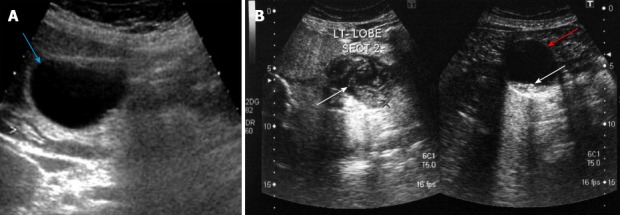
Figure 1
Figure 1
Ultrasound image. A: Showing an anechoic mass in the liver (light blue arrow), with a rather thin capsule (cystadenoma); B: Showing two echinococcal cysts. The first on the right (red arrow-right image) appears as an anechoic mass with hydatid sand (type CE1) (white arrow-right image), while in the second (on the left), the detached and folded endocyst membrane is obvious (type CE3) (white arrow-left image).
Figure 2
Figure 2
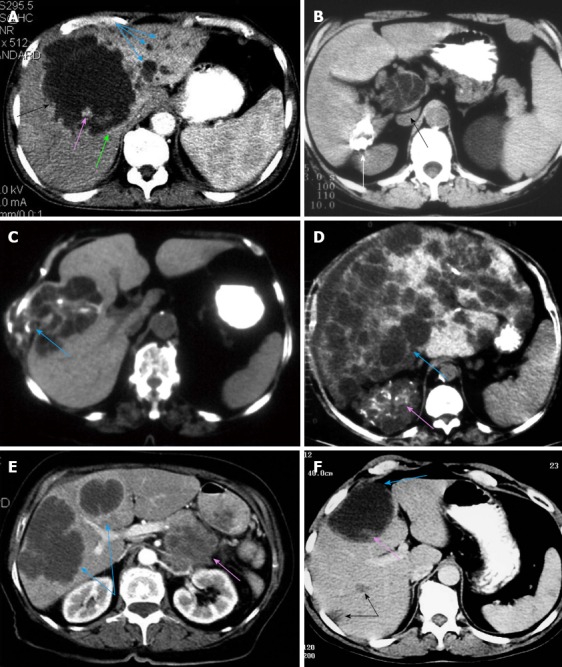
Computed tomography image. A: In liver segment IV there is a large cystic lesion (black arrow) causing compression with dilatation of biliary ducts (light blue arrows) in the left liver lobe. Peripheral contrast enhancement (light green arrow) as well as a nodule (pink arrow) is evident in this case of cystadenoma; B: Echinococcal disease evaluated. Two lesions are evident. The first in liver segment I appears as a multilocular cystic lesion (black arrow) and the second in liver segment VI as a calcified mass with irregular margins (white arrow); C: Demonstrates direct infiltration of a liver hydatid cyst in the adjacent peritoneal surface and abdominal wall (light blue arrow); D: A typical case of multicystic disease with liver (light blue arrow) and kidney (pink arrow) involvement were very well depicted; E: Showing two large cystic-appearing liver lesions (light blue arrows) in a case of a metastatic pancreatic cystadenocarcinoma that is also evident (pink arrow); F: A large cystic lesion (light blue arrow) with a small solid component at the periphery (pink arrow), as well as two small hypodense liver lesions (black arrows), are seen on this image, in a case of proven gastrointestinal stromal tumors metastatic lesions.
Figure 3
Figure 3
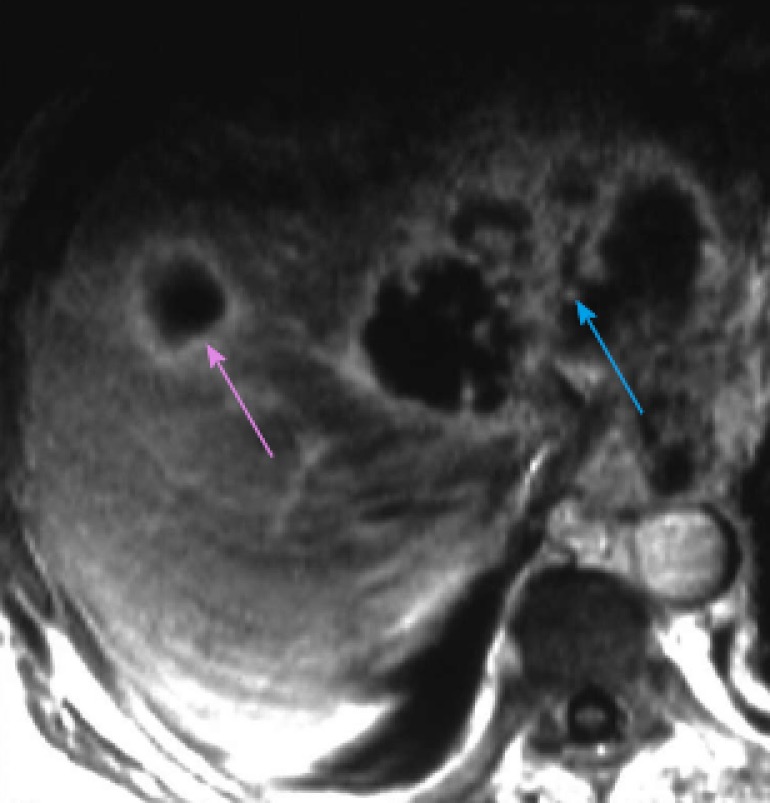
Magnetic resonance T1-w image shows an echinococcal cyst as a multiloculated cystic liver lesion, indicative of the presence of daughter cysts (light blue arrow). A second smaller unilocular lesion with peripheral contrast enhancement is also seen (pink arrow).
Figure 4
Figure 4
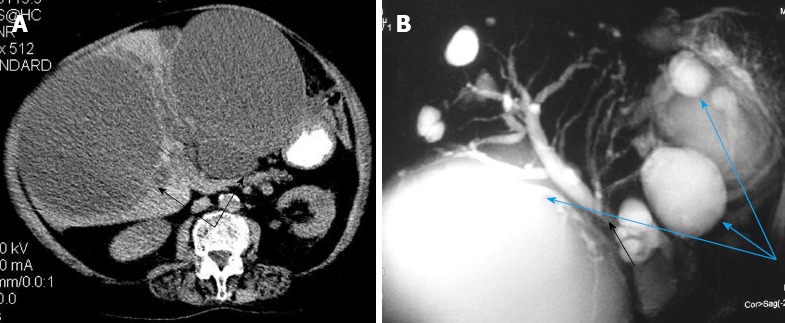
Image. A: Computed tomography image in a case of multicystic disease, showing two large dominant cysts causing mild intrahepatic biliary dilatation (black arrows); B: Magnetic resonance cholangiopancreatography image shows multiple hepatic cysts (light blue arrows) while the common bile duct seems compressed between the two larger cysts (black arrow).
Figure 5
Figure 5
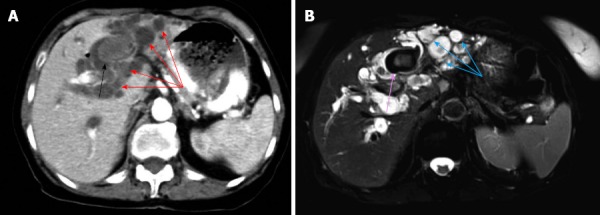
A case of Caroli disease. A: On computed tomography. A large intra-biliary stone (black arrow) is evident in the dilated ducts (red arrows); B: On magnetic resonance imaging. A large intra-biliary stone (pink arrow) is evident in the dilated ducts (blue arrows).
Figure 6
Figure 6
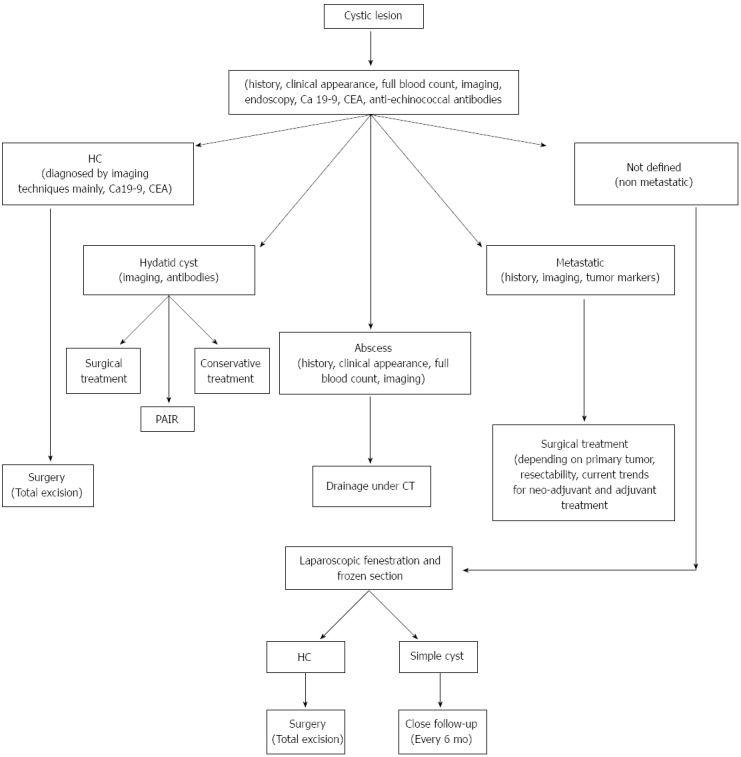
Liver cystic lesions management algorithm.

References

    1. Caremani M, Vincenti A, Benci A, Sassoli S, Tacconi D. Ecographic epidemiology of non-parasitic hepatic cysts. J Clin Ultrasound. 1993;21:115–118. - PubMed
    1. Hai S, Hirohashi K, Uenishi T, Yamamoto T, Shuto T, Tanaka H, Kubo S, Tanaka S, Kinoshita H. Surgical management of cystic hepatic neoplasms. J Gastroenterol. 2003;38:759–764. - PubMed
    1. Vogt DP, Henderson JM, Chmielewski E. Cystadenoma and cystadenocarcinoma of the liver: a single center experience. J Am Coll Surg. 2005;200:727–733. - PubMed
    1. Carson JG, Huerta S, Butler JA. Hepatobiliary cystadenoma: a case report and a review of the literature. Curr Surg. 2006;63:285–289. - PubMed
    1. Ishak KG, Willis GW, Cummins SD, Bullock AA. Biliary cystadenoma and cystadenocarcinoma: report of 14 cases and review of the literature. Cancer. 1977;39:322–338. - PubMed

Supplementary concepts