Review
. 2013 Nov 22;5(11):2856-80.
doi: 10.3390/v5112856.

Differential virulence and pathogenesis of West Nile viruses

Affiliations
Review

Differential virulence and pathogenesis of West Nile viruses

Emilie Donadieu et al. Viruses. .

Abstract

West Nile virus (WNV) is a neurotropic flavivirus that cycles between mosquitoes and birds but that can also infect humans, horses, and other vertebrate animals. In most humans, WNV infection remains subclinical. However, 20%-40% of those infected may develop WNV disease, with symptoms ranging from fever to meningoencephalitis. A large variety of WNV strains have been described worldwide. Based on their genetic differences, they have been classified into eight lineages; the pathogenic strains belong to lineages 1 and 2. Ten years ago, Beasley et al. (2002) found that dramatic differences exist in the virulence and neuroinvasion properties of lineage 1 and lineage 2 WNV strains. Further insights on how WNV interacts with its hosts have recently been gained; the virus acts either at the periphery or on the central nervous system (CNS), and these observed differences could help explain the differential virulence and neurovirulence of WNV strains. This review aims to summarize the current state of knowledge on factors that trigger WNV dissemination and CNS invasion as well as on the inflammatory response and CNS damage induced by WNV. Moreover, we will discuss how WNV strains differentially interact with the innate immune system and CNS cells, thus influencing WNV pathogenesis.


Figures
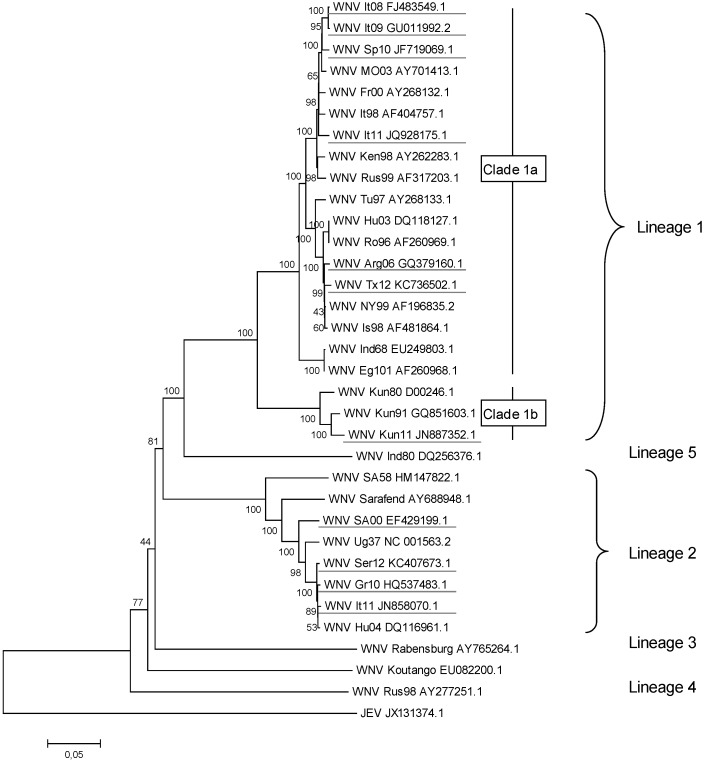
Figure 1
Figure 1
West Nile Virus (WNV) genetic diversity, evaluated using genetic alignment of complete genomic sequences. GenBank accession numbers are indicated on the tree branches of each virus; the first two or three letters stand for the country or the USA state reporting WNV (It = Italy, Sp = Spain, Mo = Morocco, Fr = France, Ken = Kenya, Rus = Russia, Tu = Tunisia, Hu = Hungary, Ro = Romania, Arg = Argentina, Tx = Texas, NY = New York, Is = Israel, Ind = India, Eg = Egypt, Kun = Kunjin Australia, SA = South Africa, Ug=Uganda, Ser = Serbia, and Gr = Greece) and the numbers indicate the year of isolation (96 = 1996, 10 = 2010). Japanese encephalitis virus (JEV), a closely related flavivirus, was used as an outgroup. The rooted phylogenetic tree was constructed using neighbor-joining with Jukes-Cantor parameter distances (scale bar) in MEGA (MEGA software, version 5.2 [25]). A bootstrapped confidence interval (1,000 replicates) and a confidence probability value based on the standard error test were also calculated using MEGA. The WNV strains responsible for recent human or equine outbreaks are underlined. The complete sequences of the most recent Romanian and Russian lineage 2 variants are not available, but at least two introduction events of lineage 2 strains have occurred in Europe: divergent lineage 2 strains have been observed in Romania/Russia and Hungary/Greece/Italy/Serbia/Austria [26].
Figure 2
Figure 2
(A) Simplified schematic of the initial pathogenesis of WNV infections after inoculation of the virus into the skin. After intradermal inoculation by infected mosquitoes, WNV replicates in skin cells, specifically in Langherhans cells (LCs). Infected LCs migrate to regional lymph nodes and pass through efferent lymphatic vessels to reach the bloodstream. This primary viremia results in the infection of leukocytes and of peripheral tissues such as the spleen, liver and kidneys; (B) Simplified schematic of the regulation of BBB permeability following WNV infection and entry into the brain. WNV infects and replicates in leukocytes, which act as reservoirs for the virus in a Trojan Horse-like fashion. Viral sensors (such as TLR3) recognize WNV and initiate the production of matrix metalloproteinases, such as MMP9, and pro-inflammatory cytokines, such as TNFα, which have both been shown to increase BBB permeability and facilitate WNV dissemination into the brain. Infected microglia respond by releasing pro-inflammatory mediators (TNFα, iNOS, Cox2, IL6, and IL1β), which cause neuronal death. Infected astrocytes also produce inflammatory mediators that can amplify the local immune response and modify BBB permeability. Neuronal death results, in large part, from an upregulation of the apoptotic caspase-3 and caspase-9 pathways following infection with North American isolates. BBB: blood-brain barrier, TLR3: Toll-like Receptor 3, MMP9: matrix metalloproteinase 9, TNFα: tumor necrosis factor alpha, iNOS: nitric oxide synthase, Co-2: cyclooxygenase 2, IL6: interleukin 6, IL1β: interleukin 1 beta.
Figure 3
Figure 3
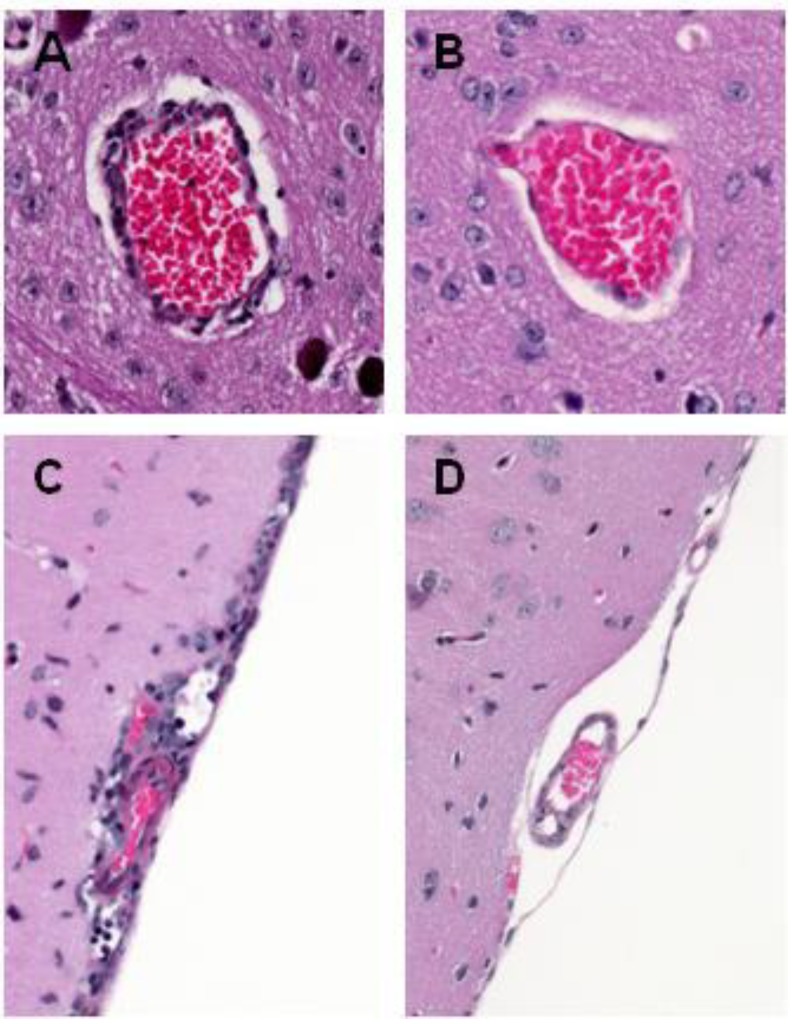
Representative histologic lesions in the brains of mice infected with WNV. (A) Haematoxylin- and eosin-stained section showing perivascular infiltrates of lymphocytesand macrophages (WNV infection) (×20 magnification); (B) Haematoxylin- and eosin-stained section showing a control blood vessel (without perivascular infiltrates, Control) (×20 magnification); (C) Haematoxylin- and eosin-stained section showing mild meningitis (WNV infection) (×20 magnification). (D) Haematoxylin- and eosin-stained section showing control meninges (without infiltrate, Control) (×20 magnification).
Figure 4
Figure 4
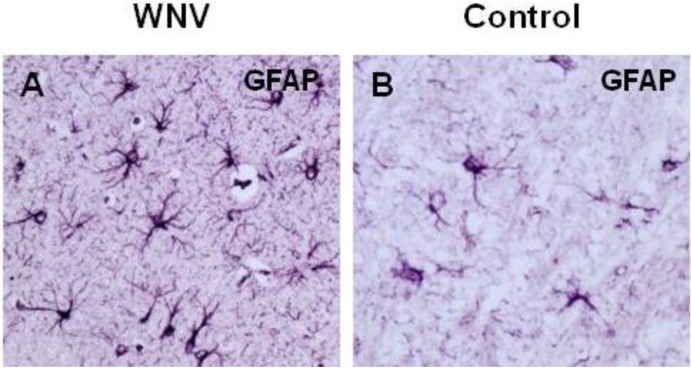
Neuroinflammation in mice infected with WNV. (A) A high level of astrocyte reactivity was observed in WNV-infected mice using paraffin-embedded tissue stained for the astrocyte GFAP marker. Astrocytes displayed modified morphologies and hypertrophic cell bodies (×20 magnification); (B) A low level of astrocyte reactivity was observed in non-infected mice.

References

    1. Kramer L.D., Li J., Shi P.Y. West Nile virus. Lancet Neurol. 2007;6:171–181. doi: 10.1016/S1474-4422(07)70030-3. - DOI - PubMed
    1. Smithburn K.C., Hughes T.P., Burke A.W., Paul J.H. A neurotropic virus isolated from the blood of a native of Uganda. Am. J. Trop. Med. Hyg. 1940;20:471–492.
    1. Hayes E.B., Komar N., Nasci R.S., Montgomery S.P., O’Leary D.R., Campbell G.L. Epidemiology and transmission dynamics of West Nile virus disease. Emerg. Infect. Dis. 2005;11:1167–1173. - PMC - PubMed
    1. Hayes E.B., Gubler D.J. West Nile virus: Epidemiology and clinical features of an emerging epidemic in the United States. Ann. Rev. Med. 2006;57:181–194. doi: 10.1146/annurev.med.57.121304.131418. - DOI - PubMed
    1. Leis A.A., Fratkin J., Stokic D.S., Harrington T., Webb R.M., Slavinski S.A. West Nile poliomyelitis. Lancet Infect. Dis. 2003;3:9–10. doi: 10.1016/S1473-3099(03)00478-X. - DOI - PubMed

Publication types

MeSH terms

LinkOut - more resources