. 2014 Jan;42(Database issue):D810-7.
doi: 10.1093/nar/gkt1225. Epub 2013 Nov 26.

The Mouse Genome Database: integration of and access to knowledge about the laboratory mouse

Collaborators, Affiliations

The Mouse Genome Database: integration of and access to knowledge about the laboratory mouse

Judith A Blake et al. Nucleic Acids Res. 2014 Jan.

Abstract

The Mouse Genome Database (MGD) (http://www.informatics.jax.org) is the community model organism database resource for the laboratory mouse, a premier animal model for the study of genetic and genomic systems relevant to human biology and disease. MGD maintains a comprehensive catalog of genes, functional RNAs and other genome features as well as heritable phenotypes and quantitative trait loci. The genome feature catalog is generated by the integration of computational and manual genome annotations generated by NCBI, Ensembl and Vega/HAVANA. MGD curates and maintains the comprehensive listing of functional annotations for mouse genes using the Gene Ontology, and MGD curates and integrates comprehensive phenotype annotations including associations of mouse models with human diseases. Recent improvements include integration of the latest mouse genome build (GRCm38), improved access to comparative and functional annotations for mouse genes with expanded representation of comparative vertebrate genomes and new loads of phenotype data from high-throughput phenotyping projects. All MGD resources are freely available to the research community.


Figures

Figure 1.
Figure 1.
Homology Detail Page: Complete orthology set representation in MGD, derived from HomoloGene cluster 20103.
Figure 2.
Figure 2.
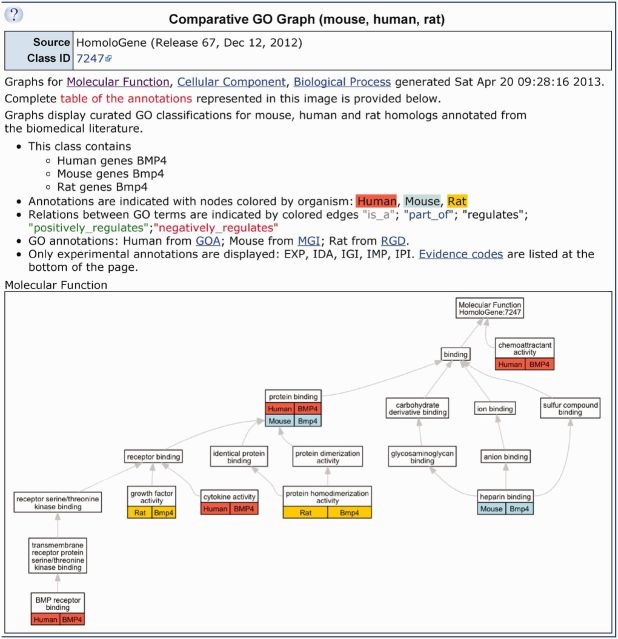
GO Comparative Graphs: Experimentally derived GO annotations available for human, rat and mouse for the Molecular Function domain. In the mouse annotation file, these human and rat annotations form the basis for Inferred from Sequence Orthology annotations for the mouse.
Figure 3.
Figure 3.
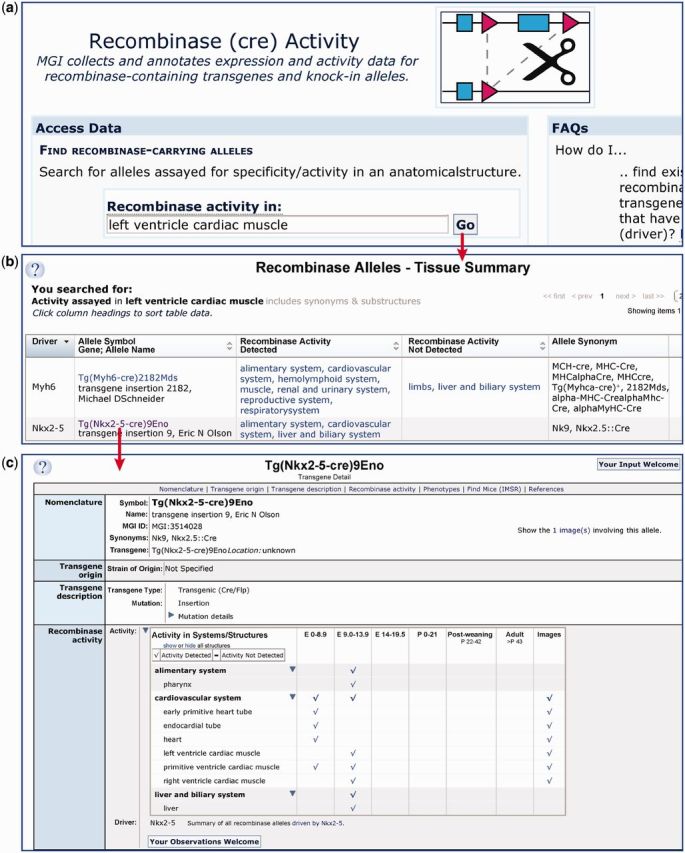
New features in the CrePortal: (a) Cre Search Form accessed at www.creportal.org or by choosing the Recombinase (Cre) icon box at www.informatics.jax.org. The term ‘left ventricle cardiac muscle’ has been entered in the search box. This field has an auto-complete feature that indicates both annotated terms (black type) and terms with no annotation (gray type). (b) Results from the above search for ‘left ventricle cardiac muscle’. Two Cre transgenes that show specific Cre activity in this tissue are returned. Formerly only systems searches were allowed; a search by ‘cardiovascular system’ returns 266 transgenes and knock-ins, most of which are not specific for left ventricle cardiac muscle (searches done 29 September 2013). (c) Overview of data for the Cre transgene, Tg(Nkx2-5-Cre)9Eno clicking through from the symbol on the Results page in (b). The recombinase activity matrix shows activity for this Cre transgene in structures/tissues assayed versus age. Note that anatomical systems have been toggled open to show specific tissues. For left ventricle cardiac muscle, one can visualize its activity by age distribution, and also note off-target embryonic expression of this Cre transgene in pharynx and liver.
Figure 4.
Figure 4.
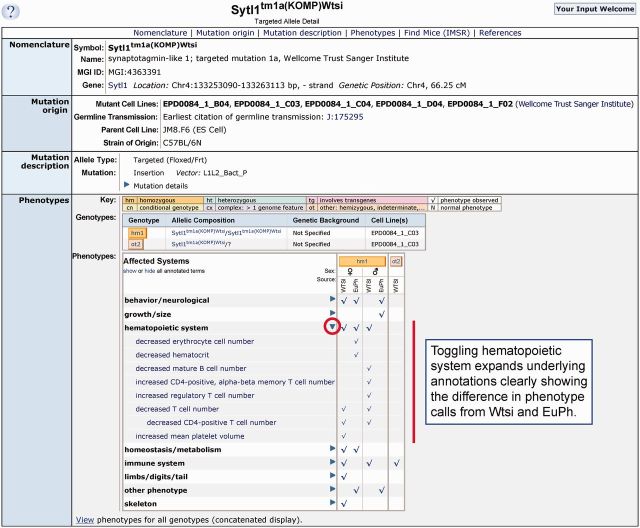
High-throughput Phenotype Data: This partial image of the phenotype detail page for the targeted allele Sytl1tm1a(KOMP)Wtsi illustrates the ability to compare high-throughput data results. In the ‘Phenotypes’ section, one is first presented with a colored key of the specific genotypes analyzed. This key corresponds to the columns of the phenotype table. In this example, the data for the ‘hm1’ homozygous females and males have been analyzed by both WTSI and EuPh databases. The hematopoietic system phenotype section has been expanded to show the clear differences in phenotype calls made on the same animal data sets by these two centers based on their differing analysis methods.

References

    1. Bult CJ, Eppig JT, Blake JA, Kadin JA, Richardson JE the Mouse Genome Database Group. The mouse genome database: genotypes, phenotypes, and models of human disease. Nucleic Acids Res. 2013;41:D885–D891. - PMC - PubMed
    1. Eppig JT, Blake JA, Bult CJ, Kadin JA, Richardson JE the Mouse Genome Database Group. The mouse genome database (MGD): comprehensive resource for genetics and genomics of the laboratory mouse. Nucleic Acids Res. 2012;40:D881–D886. - PMC - PubMed
    1. The Gene Ontology Consortium. Gene ontology annotations and resources. Nucleic Acids Res. 2013;41:D530–D535. - PMC - PubMed
    1. Smith CL, Eppig JT. The mammalian phenotype ontology as a unifying standard for experimental and high-throughput phenotyping data. Mamm. Genome. 2012;23:653–668. - PMC - PubMed
    1. Bello SM, Richardson JE, Davis AP, Wiegers TC, Mattingly CJ, Dolan ME, Smith CL, Blake JA, Eppig JT. Disease model curation improvements at Mouse Genome Informatics. Database. 2012;2012:bar063. - PMC - PubMed

Publication types