


doi: 10.1002/anie.201308816.
Epub 2013 Nov 27.
Tunable visible and near-IR photoactivation of light-responsive compounds by using fluorophores as light-capturing antennas
Affiliations
- PMID: 24285381
- PMCID: PMC4036634
- DOI: 10.1002/anie.201308816
Item in Clipboard
Tunable visible and near-IR photoactivation of light-responsive compounds by using fluorophores as light-capturing antennas
Angew Chem Int Ed Engl.
.
Abstract
Although the corrin ring of vitamin B12 is unable to efficiently absorb light beyond 550 nm, it is shown that commercially available fluorophores can be used as antennas to capture long-wavelength light to promote scission of the Co-C bond at wavelengths up to 800 nm. The ability to control the molecular properties of bioactive species with long visible and near-IR light has implications for drug delivery, nanotechnology, and the spatiotemporal control of cellular behavior.
Keywords: cobalamins; drug delivery; energy transfer; fluorescence; photochemistry.
Copyright © 2014 WILEY-VCH Verlag GmbH & Co. KGaA, Weinheim.
Figures
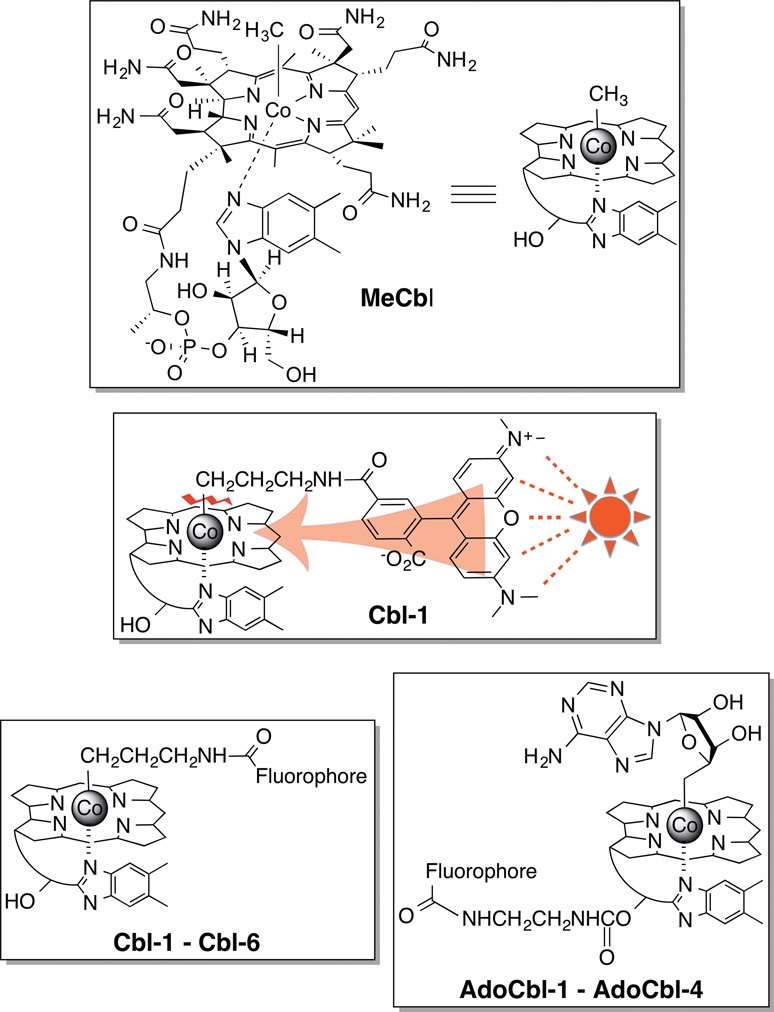
Methylcobalamin (MeCbl) and cobalamin-fluorophore conjugates: Cbl-1 (TAMRA), Cbl-2 (Acetyl), Cbl-3 (SulfoCy5), Cbl-4 (Atto725), Cbl-5 (Dylight 800), Cbl-6 (Alexa700), AdoCbl-1 (TAMRA), AdoCbl-2 (SulfoCy5), AdoCbl-3 (Atto725), AdoCbl-4 (Dylight800).
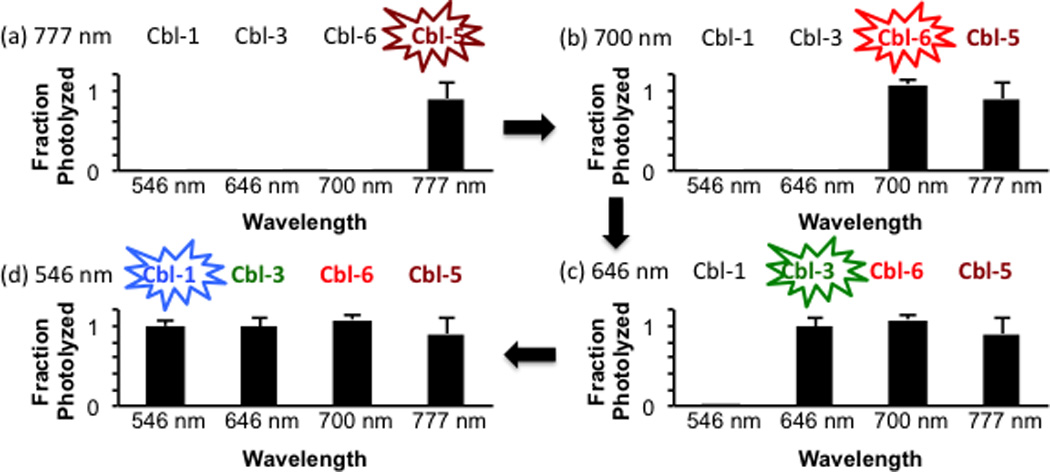
Selective photolysis of individual cobalamin-conjugates from a mixture using serial illumination [(a) 777 nm → (b) 700 nm → (c) 646 nm → (d) 546 nm] sequentially photolyzes Cbl-5, Cbl-6, Cbl-3, and Cbl-1, respectively.
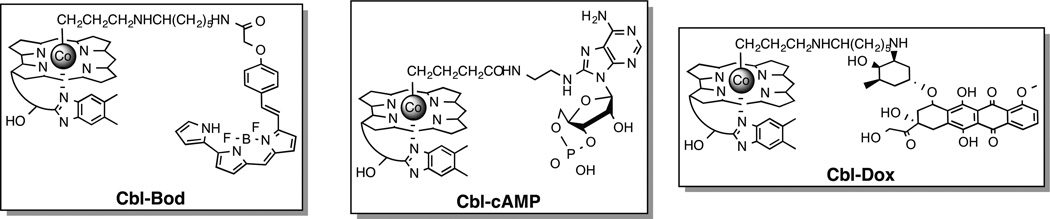
The Bodipy650-, cAMP-, and doxorubicin-cobalamin conjugates Cbl-Bod, Cbl-cAMP, and Cbl-Dox, respectively.
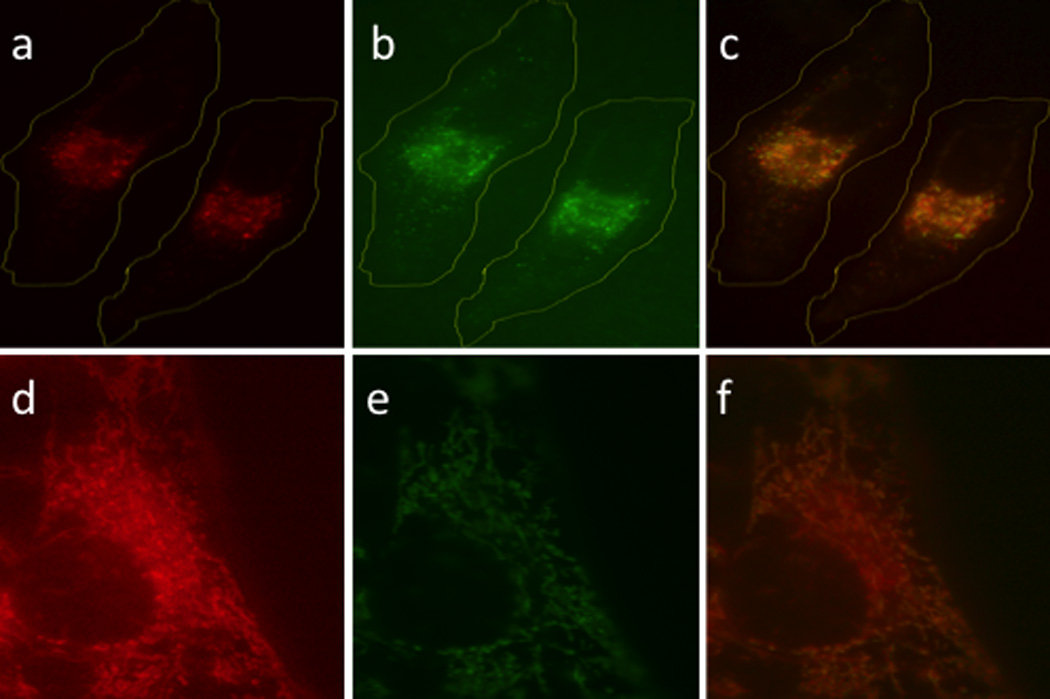
Red light induced translocation of Bodipy 650 in HeLa cells. (a) Cbl-Bod before photolysis (b) Rhodamine B-dextran endosomal marker (c) overlay of (a) and (b). (d) Cbl-Bod after photolysis (e) MitoTracker Green mitochondria marker (f) overlay of (d) and (e).
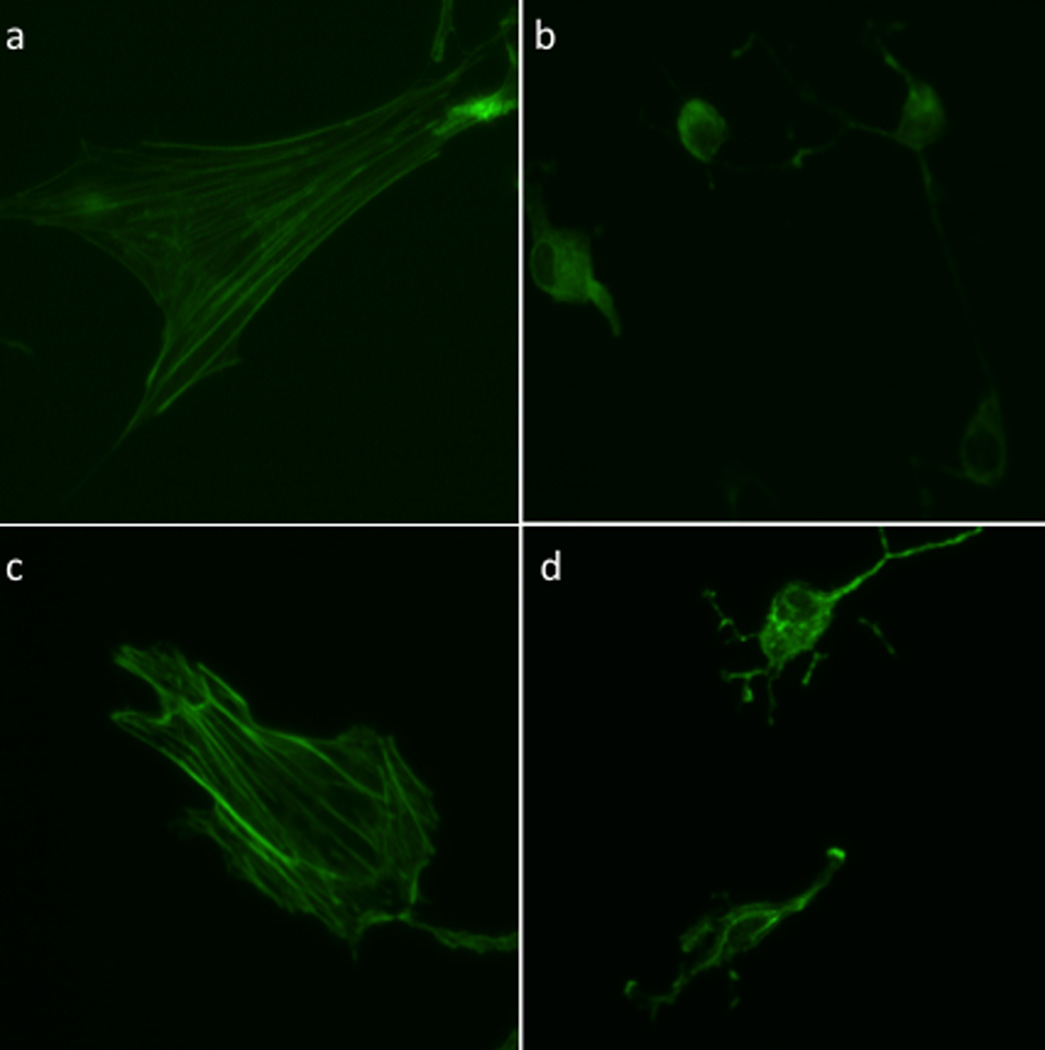
Light-dependent Cbl-cAMP-mediated rearrangement of actin cytoskeleton in rat embryonic fibroblasts (REF-52). Ref-52s were exposed to Cbl-cAMP, illuminated at 530 nm, and stained with Dylight 488-phalloidin to visualize the actin stress fibers. (a) No treatment, media alone (b) CPT-cAMP as a positive control (c) Cbl-cAMP, no illumination (d) Cbl-cAMP with illumination. Images are representative of 10 – 20 cells.
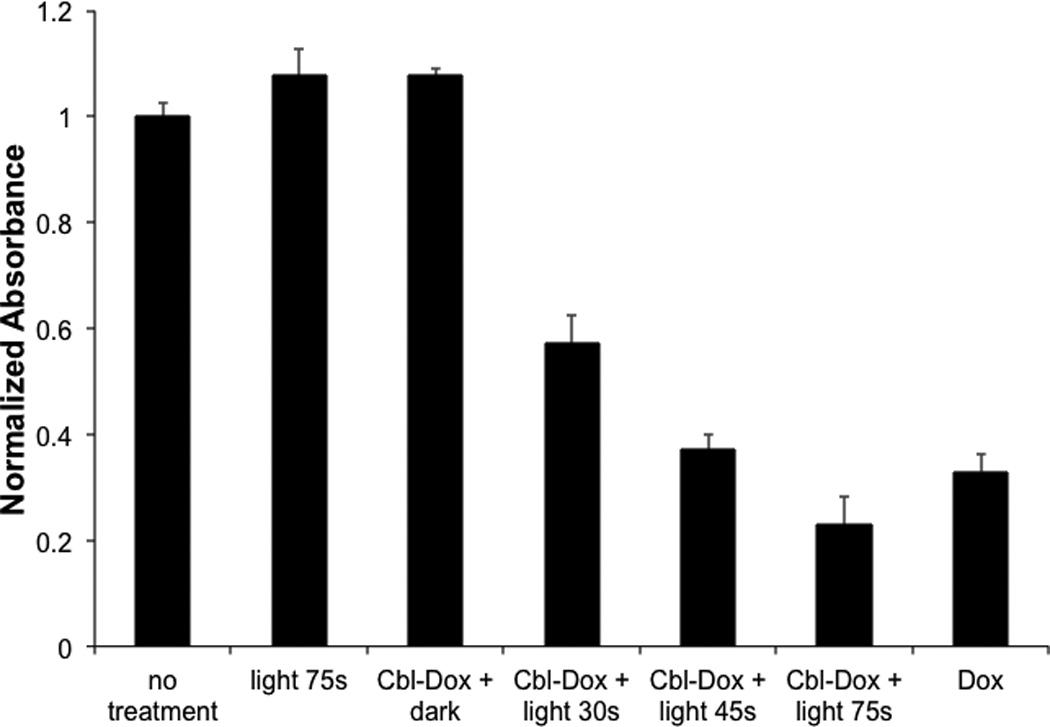
Light-induced release of doxorubicin from Cbl-Dox induces apoptosis of HeLa cells. Cells were loaded with 10 µM Cbl-Dox and illuminated for 30, 45, and 75 s at 530 nm. Cell viability was assessed, after 24 h, via an MTS assay (absorbance measured at 520 nm and normalized to the untreated control). The data shown are the average of three experiments ± SEM.
References
-
- Brieke C, Rohrbach F, Gottschalk A, Mayer G, Heckel A. Angew Chem Int Ed Engl. 2012;51:8446–8476. - PubMed
- Klan P, Solomek T, Bochet CG, Blanc A, Givens R, Rubina M, Popik V, Kostikov A, Wirz J. Chem Rev. 2013;113:119–191. - PMC - PubMed
- Lee HM, Larson DR, Lawrence DS. ACS Chem Biol. 2009;4:409–427. - PMC - PubMed
-
- Goguen BN, Aemissegger A, Imperiali B. J Am Chem Soc. 2011;133:11038–11041. - PMC - PubMed
- Hagen V, Dekowski B, Nache V, Schmidt R, Geissler D, Lorenz D, Eichhorst J, Keller S, Kaneko H, Benndorf K, Wiesner B. Angew Chem Int Ed Engl. 2005;44:7887–7891. - PubMed
- Kantevari S, Matsuzaki M, Kanemoto Y, Kasai H, Ellis-Davies GC. Nat Methods. 2010;7:123–125. - PMC - PubMed
- Menge C, Heckel A. Org Lett. 2011;13:4620–4623. - PubMed
- Priestman MA, Sun L, Lawrence DS. ACS Chem Biol. 2011;6:377–384. - PMC - PubMed
Publication types
MeSH terms
Substances
Grants and funding
LinkOut - more resources
Full Text Sources
Other Literature Sources
