Levonorgestrel-impregnated intrauterine device as treatment for endometrial hyperplasia: a national multicentre randomised trial
- PMID: 24286192
- PMCID: PMC4155866
- DOI: 10.1111/1471-0528.12499
Levonorgestrel-impregnated intrauterine device as treatment for endometrial hyperplasia: a national multicentre randomised trial
Abstract
Objective: The purpose of this study was to investigate if the levonorgestrel-impregnated intrauterine device (LNG-IUS, Mirena(®) ) is safe and effective as therapy for low-risk and medium-risk endometrial hyperplasia compared with oral medroxyprogesterone (MPA).
Design: A multicentre randomised trial.
Setting: Norway.
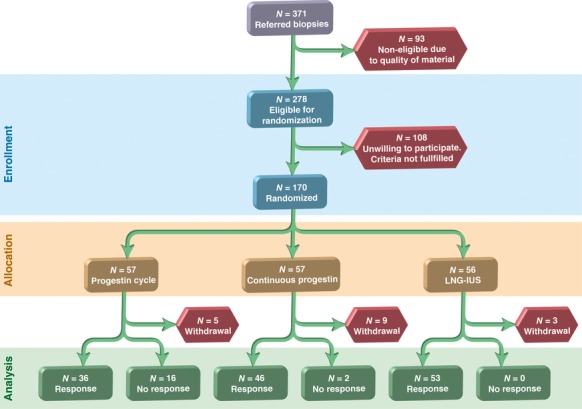
Population: In all, 170 women aged 30-70 years with low- or medium-risk endometrial hyperplasia who met inclusion criteria.
Methods: Patients were randomly assigned to one of three treatment arms: LNG-IUS; oral MPA 10 mg administered for 10 days per cycle, or continuous oral MPA 10 mg daily, for 6 months.
Main outcome measures: The primary outcome measure was normalisation or persisting hyperplasia.
Results: After 6 months all three treatment regimens showed significant effect when the outcome was evaluated as therapy response or not (P < 0.001). Responses were obtained for all the women in the LNG-IUS group (53/53, 95% CI 0.93-1.0) and for 96% of the women in the continuous oral group (46/48, 95% CI 0.86-0.99). Only 69% of the women in the cyclic oral group were responders (36/52, 95% CI 0.55-0.81). Adverse effects were relatively common with minimal differences between therapy groups.
Conclusion: In the first trial of its kind, women treated with the LNG-IUS showed histologically normal endometrium after 6 months of therapy for endometrial hyperplasia. Cyclical progestogens are found to be less effective compared with continuous oral therapy and LNG-IUS and should not be used for this purpose.
Trial registration: ClinicalTrials.gov NCT01074892.
Keywords: Endometrial hyperplasia; levonorgestrel-impregnated intrauterine device versus oral progestin; therapy.
© 2013 The Authors. BJOG An International Journal of Obstetrics and Gynaecology published by John Wiley & Sons Ltd on behalf of Royal College of Obstetricians and Gynaecologists.
References
-
- Horn LC, Schnurrbusch U, Bilek K, Hentschel B, Einenkel J. Risk of progression in complex and atypical endometrial hyperplasia: clinicopathologic analysis in cases with and without progestogen treatment. Int J Gynecol Cancer. 2004;14:348–53. - PubMed
-
- Norwegian Cancer Registry. Annual report. Oslo: Norwegian Cancer Registry; 2009.
-
- Kurman RJ, Kaminski PF, Norris HJ. The behavior of endometrial hyperplasia. A long-term study of “untreated” hyperplasia in 170 patients. Cancer. 1985;56:403–12. - PubMed
-
- Ferenczy A, Gelfand M. The biologic significance of cytologic atypia in progestogen-treated endometrial hyperplasia. Am J Obstet Gynecol. 1989;160:126–31. - PubMed
-
- Lindahl B, Alm P, Ferno M, Norgren A. Endometrial hyperplasia: a prospective randomized study of histopathology, tissue steroid receptors and plasma steroids after abrasio, with or without high dose gestagen treatment. Anticancer Res. 1990;10:725–30. - PubMed
Publication types
MeSH terms
Substances
Associated data
LinkOut - more resources
Full Text Sources
Other Literature Sources
Medical
Miscellaneous