


Why related bacterial species bloom simultaneously in the gut: principles underlying the 'Like will to like' concept
- PMID: 24286560
- PMCID: PMC4013256
- DOI: 10.1111/cmi.12245
Why related bacterial species bloom simultaneously in the gut: principles underlying the 'Like will to like' concept
Abstract
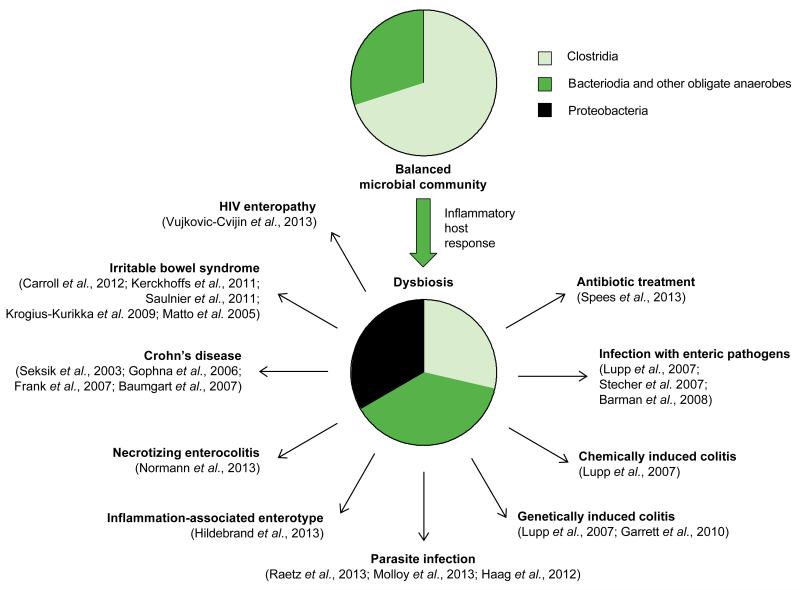
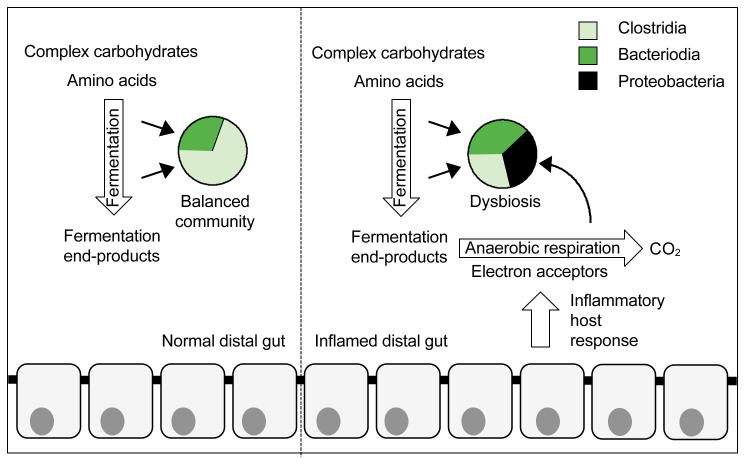
The large intestine is host to a complex ecological community composed predominantly of obligate anaerobic bacteria belonging to the classes Bacteroidia and Clostridia. This community confers benefits through its metabolic activities and host interactions. However, a microbial imbalance (dysbiosis) characterized by a decreased abundance of Clostridia and a bloom of facultative anaerobic Proteobacteria is commonly observed during inflammation in the large bowel. Here we review recent insights into the principles that favour simultaneous increases in the abundance of closely related species belonging to the Proteobacteria during inflammation, which provides important clues for the rational design of strategies to treat dysbiosis.
© 2013 John Wiley & Sons Ltd.
Figures
References
-
- Atarashi K, Nishimura J, Shima T, Umesaki Y, Yamamoto M, Onoue M, Yagita H, Ishii N, Evans R, Honda K, Takeda K. ATP drives lamina propria T(H)17 cell differentiation. Nature. 2008;455:808–812. - PubMed
-
- Baumgart M, Dogan B, Rishniw M, Weitzman G, Bosworth B, Yantiss R, Orsi RH, Wiedmann M, McDonough P, Kim SG, Berg D, Schukken Y, Scherl E, Simpson KW. Culture independent analysis of ileal mucosa reveals a selective increase in invasive Escherichia coli of novel phylogeny relative to depletion of Clostridiales in Crohn’s disease involving the ileum. ISME J. 2007;1:403–418. - PubMed
Publication types
MeSH terms
Grants and funding
LinkOut - more resources
Full Text Sources
Other Literature Sources
