Review
. 2014 Feb;32(1):33-45, vii.
doi: 10.1016/j.ccl.2013.09.010.

The sympathetic nervous system and heart failure

Affiliations
Review

The sympathetic nervous system and heart failure

David Y Zhang et al. Cardiol Clin. 2014 Feb.

Abstract

Heart failure (HF) is a syndrome characterized by upregulation of the sympathetic nervous system and abnormal responsiveness of the parasympathetic nervous system. Studies in the 1980s and 1990s demonstrated that inhibition of the renin-angiotensin-aldosterone system with angiotensin-converting enzyme inhibitors improved symptoms and mortality in HF resulting from systolic dysfunction, thus providing a framework to consider the use of β-blockers for HF therapy, contrary to the prevailing wisdom of the time. Against this backdrop, this article reviews the contemporary understanding of the sympathetic nervous system and the failing heart.

Keywords: Heart failure; Neurohormone; Renin-angiotensin-aldosterone; Sympathetic nervous system.


Figures

Fig. 1
Fig. 1
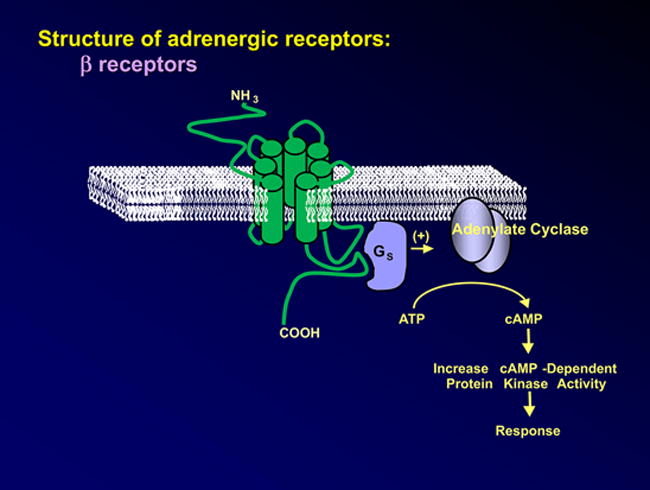
β-Receptors are G-protein–coupled receptors, and they act by activating a Gs protein. Gs activates adenylyl cyclase, leading to an increase in levels of intracellular cyclic adenosine monophosphate (cAMP). Increased cAMP activates protein kinase A, which phosphorylates cellular proteins. ATP, adenosine triphosphate.
Fig. 2
Fig. 2
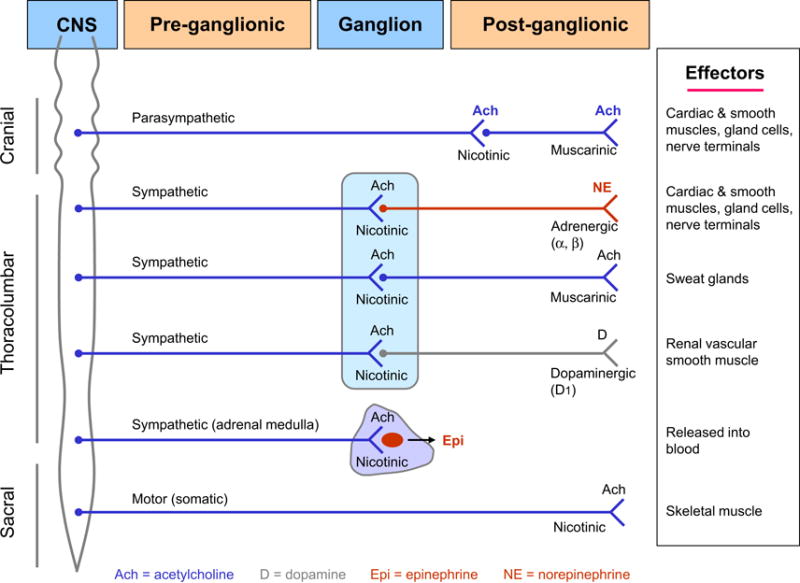
Summary of sympathetic and parasympathetic autonomic neural outflows from the central nervous system (CNS) that regulate the cardiovascular system. There are 2 major sets of neurons serially connected to regulate peripheral target organs controlled by the motor outflow of the sympathetic nervous system. The first set, called preganglionic neurons, originates in the brainstem or the spinal cord. The postganglionic neurons are the second set, located in a group of nerve cells called sympathetic ganglia outside the central nervous system. The predominant neurotransmitter of the sympathetic preganglionic neurons is acetylcholine. On the other hand, the predominant neurotransmitter of most sympathetic postganglionic neurons is norepinephrine, with exceptions such as postganglionic neurons innervating sweat glands by releasing acetylcholine. (Adapted from Johnston TB, Whillis J. Gray’s anatomy. 31st edition. London: Longmans; 1954.)
Fig. 3
Fig. 3
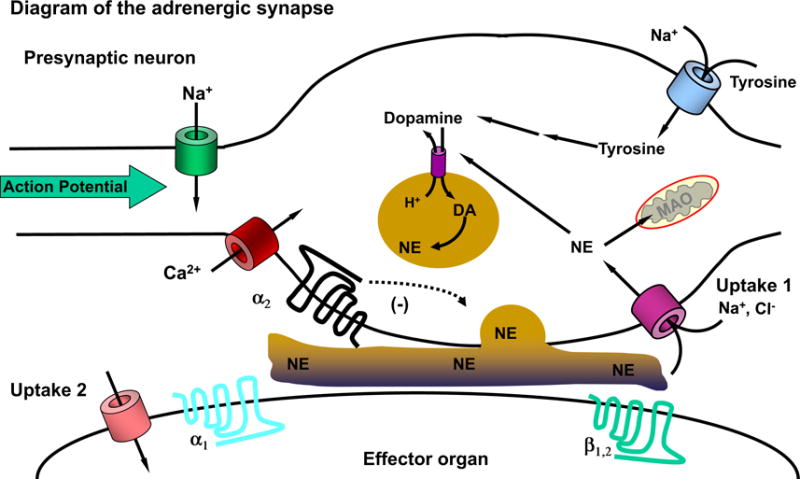
Adrenergic receptors and norepinephrine (NE) transport in the cardiac presynaptic nerve terminal. Thick solid black arrows indicate processes that facilitate NE transport to and from the synaptic cleft. Dashed black arrow shows negative feedback mechanisms that affect secretion. NE is stored within vesicles at the sympathetic nerve terminal. Sympathetic nerve activity results in release of NE from the storage vesicles in the synaptic cleft, where it is available to attach to postsynaptic α1-, β1-, and β2-adrenergic receptors, as well as presynaptic adrenergic receptors. In addition to these postsynaptic adrenergic receptors, there are presynaptic α2-adrenergic receptors located on the sympathetic nerve terminal. Activation of the α2 presynaptic receptor by an agonist reduces release of NE from the sympathetic nerve terminal, decreasing NE in the cleft and decreasing adrenergic activation of the cardiomyocyte. MAO, monoamine oxidase.

References

    1. Triposkiadis F, Karayannis G, Giamouzis G, et al. The sympathetic nervous system in heart failure: physiology, pathophysiology, and clinical implications. J Am Coll Cardiol. 2009;54(19):1747–62. - PubMed
    1. Cohn JN, Pfeffer MA, Rouleau J, et al. Adverse mortality effect of central sympathetic inhibition with sustained-release moxonidine in patients with heart failure (MOXCON) Eur J Heart Fail. 2003;5(5):659–67. - PubMed
    1. Floras JS. Sympathetic nervous system activation in human heart failure: clinical implications of an updated model. J Am Coll Cardiol. 2009;54(5):375–85. - PubMed
    1. Schwartz PJ. Vagal stimulation for heart diseases: from animals to men. An example of translational cardiology. Circ J. 2011;75(1):20–7. - PubMed
    1. Schwartz PJ, De Ferrari GM. Sympathetic-parasympathetic interaction in health and disease: abnormalities and relevance in heart failure. Heart Fail Rev. 2011;16(2):101–7. - PubMed

MeSH terms