Transverse sinus stenting for pseudotumor cerebri: a cost comparison with CSF shunting
- PMID: 24287092
- PMCID: PMC7964533
- DOI: 10.3174/ajnr.A3806
Transverse sinus stenting for pseudotumor cerebri: a cost comparison with CSF shunting
Abstract
Background and purpose: Transverse sinus venous stent placement has been shown to lower intracranial pressure in patients with venogenic pseudotumor cerebri and to reverse, or at least stabilize, its symptoms and signs. There have been no studies comparing the cost of venous stenting with the time-honored treatment for pseudotumor cerebri-CSF shunting. The purpose of this study was to compare the cost of trasverse sinus stenting versus CSF shunting for the treatment of pseudotumor cerebri.
Materials and methods: This work was a retrospective cost analysis of individual resource use in 86 adults who were stented for pseudotumor cerebri during a 12-year period compared with resource use in 110 children who were shunted for hydrocephalus during a 3-year period.
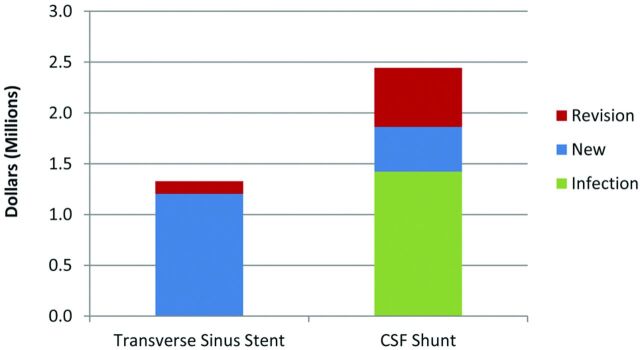
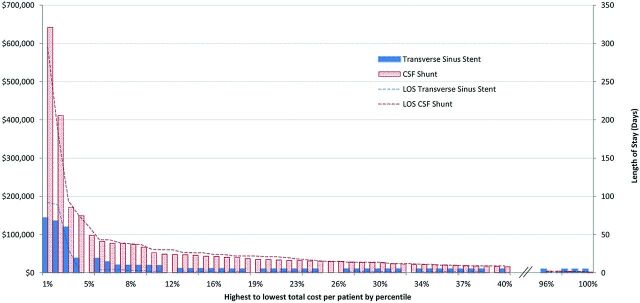
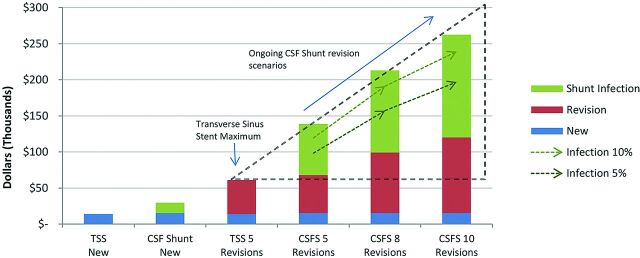
Results: There was no significant difference between the cost of inserting an initial venous stent ($13,863 ± 4890) versus inserting an initial CSF shunt ($15,797 ± 5442) (P = .6337) or between inserting an additional venous stent ($9421 ± 69) versus revising a CSF shunt ($10,470 ± 1245) (P = .4996). There were far fewer additional venous stent insertions per patient than there were subsequent CSF shunt revisions; 87% of stents placed required just 1 stent procedure, whereas only 45% of shunts required 1 shunt procedure. The main cause of the cost difference was the need for repeated revisions of the shunts, especially when they became infected-24 instances of a total 143 shunt procedures (16.8%) at an average cost of $84,729, approximately 5 times the cost of an initial shunt insertion.
Conclusions: Venous stenting costs significantly less per 100 procedures than does CSF shunting, due largely to the high cost of treating shunt infections and the need for repeated shunt revisions.
© 2014 by American Journal of Neuroradiology.
Figures
References
-
- Kumpe DA, Bennett JL, Seinfeld J, et al. Dural sinus stent placement for idiopathic intracranial hypertension. J Neurosurg 2012;116:538–48 - PubMed
-
- Radvany MG, Solomon D, Nijjar S, et al. Visual and neurological outcomes following endovascular stenting for pseudotumor cerebri associated with transverse sinus stenosis. J Neuroophthalmol 2013;33:117–22 - PubMed
-
- Friesner D, Rosenman R, Lobb BM, et al. Idiopathic intracranial hypertension in the USA: the role of obesity in establishing prevalence and healthcare costs. Obes Rev 2011;12:e372–80 - PubMed
-
- Simon TD, Riva-Cambrin J, Srivastava R, et al. Hospital care for children with hydrocephalus in the United States: utilization, charges, comorbidities, and deaths. J Neurosurg Pediatr 2008;1:131–37 - PubMed
Publication types
MeSH terms
LinkOut - more resources
Full Text Sources
Other Literature Sources