. 2013 Nov 29;342(6162):1094-8.
doi: 10.1126/science.1241908.

27-Hydroxycholesterol links hypercholesterolemia and breast cancer pathophysiology

Affiliations

27-Hydroxycholesterol links hypercholesterolemia and breast cancer pathophysiology

Erik R Nelson et al. Science. .

Abstract

Hypercholesterolemia is a risk factor for estrogen receptor (ER)-positive breast cancers and is associated with a decreased response of tumors to endocrine therapies. Here, we show that 27-hydroxycholesterol (27HC), a primary metabolite of cholesterol and an ER and liver X receptor (LXR) ligand, increases ER-dependent growth and LXR-dependent metastasis in mouse models of breast cancer. The effects of cholesterol on tumor pathology required its conversion to 27HC by the cytochrome P450 oxidase CYP27A1 and were attenuated by treatment with CYP27A1 inhibitors. In human breast cancer specimens, CYP27A1 expression levels correlated with tumor grade. In high-grade tumors, both tumor cells and tumor-associated macrophages exhibited high expression levels of the enzyme. Thus, lowering circulating cholesterol levels or interfering with its conversion to 27HC may be a useful strategy to prevent and/or treat breast cancer.


Figures
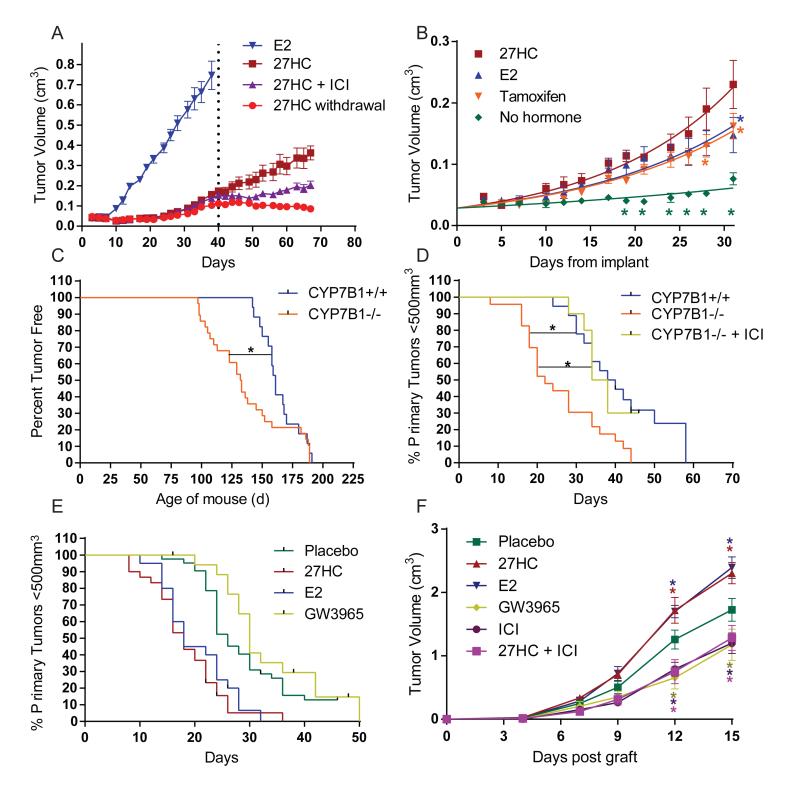
Fig. 1
Fig. 1. The oxysterol, 27-hydroxycholesterol, increases tumor growth in several animal models of estrogen receptor positive breast cancer
(A) The estrogenic activity of 27-hydroxycholesterol (27HC) is sufficient to support the growth of human MCF7 cell xenografts when propagated in ovariectomized mice. MCF7 cells were injected into the axial mammary pad of ovariectomized, immunocompromized mice and administered 27HC by daily injection or were given an E2 pellet as indicated. At day 40, the 27HC treated mice were randomized into three groups: continued 27HC, 27HC + the antiestrogen ICI 182,780 (ICI), or vehicle treatment (27HC withdrawal) (mean +/− SEM, n = 9-10). (B) 27HC supports the growth of tamoxifen resistant, MCF7 cell derived, breast tumors. Tamoxifen resistant MCF7 cells (TamR) were injected into ovariectomized, immunocompromized mice and treated for 30 days with E2 (pellet), tamoxifen (pellet), 27HC (injection) or without supplementation. Colored stars (*) indicate significant differences from 27HC treated tumors (mean +/− SEM, p<0.05, n = 5-9). The latency (C) and growth (D) of tumors in the MMTV-PyMT mouse model of breast cancer was evaluated in mice in which catabolism of 27HC is attenuated (CYP7B1−/− background). Significance between curves is indicated by a connecting black line and * (p<0.05, n = 10-28). (E) Tumor growth in MMTV-PyMT mice is increased by 27HC and attenuated by LXR agonists. MMTV-PyMT mice were injected daily with either 27HC, E2, GW3965 or vehicle as indicated. The growth of tumors in the 27HC and E2 treated mice were significantly different from those grown in Placebo and GW3965 treated animals (p<0.05, n = 110 total). (F) The growth of the ER-positive E0771 murine cell-derived xenografts was stimulated by 27HC when grown syngenically. Treatments were by injection as indicated. Colored stars indicate significant difference from placebo at the selected time point (mean +/− SEM, p<0.05, n = 7).
Fig. 2
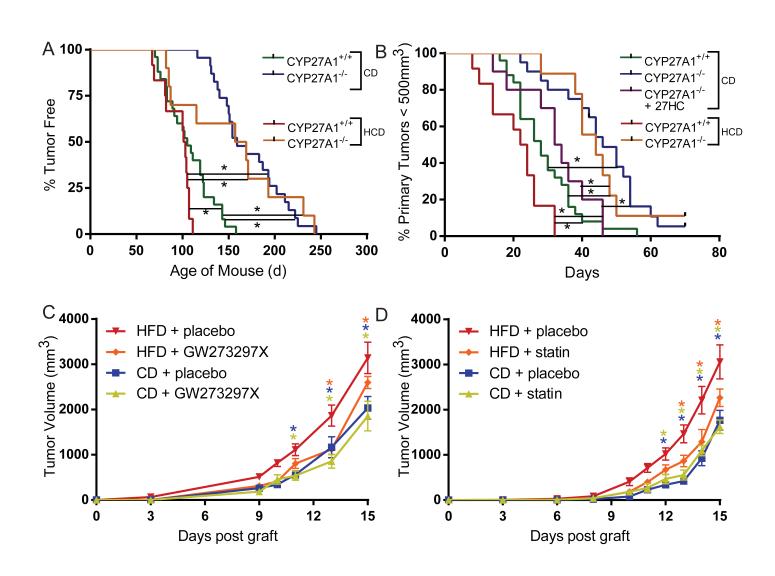
Fig. 2. Genetic or pharmacological inhibition of 27-hydroxycholesterol production attenuates hypercholesterolemia-promoted tumor growth in mice
The latency and growth of tumors in the MMTV-PyMT mouse model of breast cancer were evaluated in mice in which the conversion of cholesterol into 27HC was inhibited by disruption of the CYP27A1 gene (CYP27A1−/−). For this study, MMTV-PyMT mice were bred onto a CYP27A1+/+ or a −/− background and (A) tumor latency and (B) tumor growth were measured in mice on a control diet (CD) or on a high cholesterol diet (HCD) from weaning. Note that in the tumor growth studies daily injection of 27HC overcame the inhibitory effect of CYP27A1 deletion. Significance between curves is indicated by a connecting black line and * (p<0.05, n = 9-25). The growth of the ER-positive E0771 murine cell-derived grafts were evaluated when grown in syngeneic APOE3 mice fed a control diet or a HFD in following coadministration of (C) the CYP27A1 inhibitor GW273297X (or vehicle) or (D) the statin atorvastatin (or vehicle) as indicated. Stars (*) indicate statistically significant differences with the HFD + placebo group (mean +/− SEM, p<0.05, n = 6-12).
Fig. 3
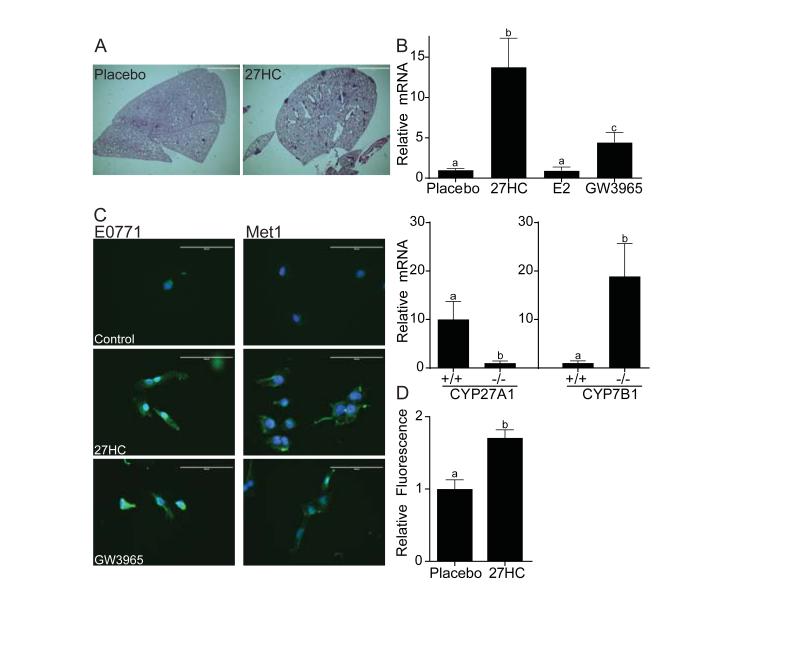
Fig. 3. Increased metastasis of breast cancer cells to lung is observed in mice in which circulating 27-hydroxycholesterol is elevated
(A) Representative lung sections from MMTV-PyMT mice reveals an increased number of metastatic lesions in mice following injection of 27HC or placebo. Metastasis was evaluated when total tumor burden had reached 2cm3. (B) Quantification of PyMT mRNA, a surrogate for mammary tumor cell metastasis, in MMTV-PyMT-mice in which circulating 27-hydroxycholesterol production is inhibited (CYP27A1−/− background) or increased (CYP7B1−/−). Different letters denote statistical significance (mean +/− SEM, p<0.05, n= 4-13). (C) Both 27HC and the LXR agonist GW3965 induce the expression of vimentin and induce EMT-like morphological changes in E0771 breast cancer cells in vitro. Overlaid images of green (vimentin) and blue (dapi nuclear stain). All images were adjusted to 90% brightness and 100% contrast. Scale bar = 100μm (D) Cell intrinsic effects of 27HC on metastatic potential of E0771 breast cancer cells. E0771 cells, tagged by expressing infrared florescence protein (IRFP), were treated in vitro for 72 hours with 27HC or vehicle and injected into the tail veins of syngeneic mice. Twenty-eight days later, lung colonization was evaluated by assessing fluorescence in harvested lungs (mean +/− SEM, p<0.05, n= 5).

Comment in

References

    1. Bianchini F, Kaaks R, Vainio H. Overweight, obesity, and cancer risk. Lancet Oncol. 2002;3:565. - PubMed
    1. Capasso I, et al. Metabolic syndrome affects breast cancer risk in postmenopausal women: National Cancer Institute of Naples experience. Cancer Biol Ther. 2011;10:1240. - PubMed
    1. Renehan AG, Roberts DL, Dive C. Obesity and cancer: pathophysiological and biological mechanisms. Arch Physiol Biochem. 2008;114:71. - PubMed
    1. Boyd NF, McGuire V. Evidence of association between plasma high-density lipoprotein cholesterol and risk factors for breast cancer. J Natl Cancer Inst. 1990;82:460. - PubMed
    1. Ferraroni M, et al. HDL-cholesterol and breast cancer: a joint study in northern Italy and southern France. Int J Epidemiol. 1993;22:772. - PubMed

Publication types

Associated data