. 2014 Jan;42(Database issue):D285-91.
doi: 10.1093/nar/gkt1180. Epub 2013 Nov 27.

PDBe: Protein Data Bank in Europe

Affiliations

PDBe: Protein Data Bank in Europe

Aleksandras Gutmanas et al. Nucleic Acids Res. 2014 Jan.

Abstract

The Protein Data Bank in Europe (pdbe.org) is a founding member of the Worldwide PDB consortium (wwPDB; wwpdb.org) and as such is actively engaged in the deposition, annotation, remediation and dissemination of macromolecular structure data through the single global archive for such data, the PDB. Similarly, PDBe is a member of the EMDataBank organisation (emdatabank.org), which manages the EMDB archive for electron microscopy data. PDBe also develops tools that help the biomedical science community to make effective use of the data in the PDB and EMDB for their research. Here we describe new or improved services, including updated SIFTS mappings to other bioinformatics resources, a new browser for the PDB archive based on Gene Ontology (GO) annotation, updates to the analysis of Nuclear Magnetic Resonance-derived structures, redesigned search and browse interfaces, and new or updated visualisation and validation tools for EMDB entries.


Figures
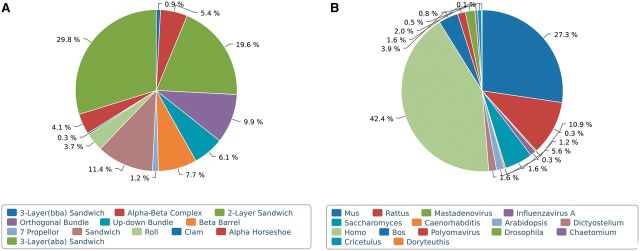
Figure 1.
Figure 1.
Examples of statistics available from the GO browser module of PDBeXplore (http://pdbe.org/go) for protein structures in PDB entries that have been annotated with the GO term for vesicle-mediated transport (GO identifier 0016192) or any of its children. (A) Domain architectures (CATH) (26) observed in the entries annotated with the above GO terms. Just over 50% of the observed proteins have either a 2- or 3-layer sandwich architecture. (B) Genera to which the source organisms of the selected proteins belong. About 80% of the studied proteins are from human, mouse or rat.
Figure 2.
Figure 2.
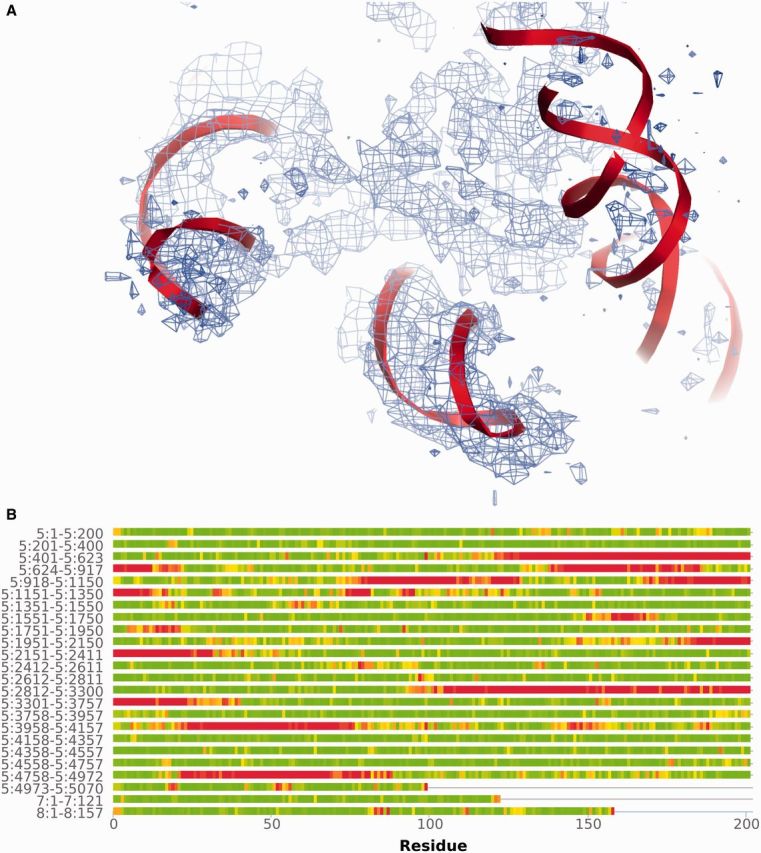
Salient features of the 3DEM volume viewer (A) and visual analysis pages (B) for human 80S ribosome, EMDB entry EMD-5592 (35) and fitted human 60S rRNA, PDB entry 3J3F (35). (A) Overlay of RNA model (chain 5) and 3DEM map showing regions of good fit (RNA structures on the bottom and left corresponding to nucleotides 2558–2760 and 4129–4157, respectively) and bad fit (RNA structure on the right corresponding to nucleotides 2940–3247). Correspondingly, in (B) we can see that nucleotides in the good fit regions are mainly green, whereas those in the bad fit region are mainly red. (B) Atom-inclusion graph for every residue in PDB entry 3J3F at the recommended contour level for EMDB entry EMD-5592. The colour of a residue denotes which fraction of its atoms fits the 3DEM map at the given contour level, varying from red (0%) to green (100%). The chain names in PDB entry 3J3F are numeric (5, 7 and 8).
Figure 3.
Figure 3.
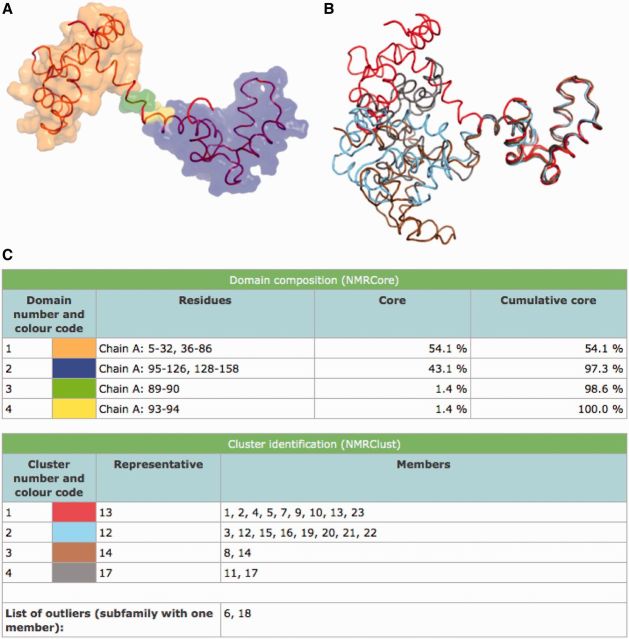
OLDERADO (38) analysis of the NMR ensemble for a skeletal troponin C, PDB entry 1TNW (39). (A) Rigid-body domains identified by OLDERADO. The two largest domains (orange and blue) form the two lobes of the protein, whereas the two smaller ones (green and yellow) cover the linker region. (B) OLDERADO identified four clusters in the ensemble, and the representative model of each cluster is shown here. (C) Summary table of the OLDERADO results. Domains and representative models are colour-coded in exactly the same way as in panels A and B, which facilitates the interpretation of the results.

References

    1. Bernstein FC, Koetzle TF, Williams GJ, Meyer EF, Jr, Brice MD, Rodgers JR, Kennard O, Shimanouchi T, Tasumi M. The Protein Data Bank: a computer-based archival file for macromolecular structures. J. Mol. Biol. 1977;112:535–542. - PubMed
    1. Berman HM, Kleywegt GJ, Nakamura H, Markley JL. The future of the protein data bank. Biopolymers. 2013;99:218–222. - PMC - PubMed
    1. Berman HM, Kleywegt GJ, Nakamura H, Markley JL. How community has shaped the protein data bank. Structure. 2013;21:1485–1491. - PMC - PubMed
    1. Berman H, Henrick K, Nakamura H. Announcing the worldwide Protein Data Bank. Nat. Struct. Biol. 2003;10:980. - PubMed
    1. Berman H, Henrick K, Nakamura H, Markley JL. The worldwide Protein Data Bank (wwPDB): ensuring a single, uniform archive of PDB data. Nucleic Acids Res. 2007;35:D301–D303. - PMC - PubMed

Publication types