Review
. 2014 Feb;15(2):127-40.
doi: 10.1111/tra.12137. Epub 2013 Dec 2.

Viral subversion of nucleocytoplasmic trafficking

Affiliations
Review

Viral subversion of nucleocytoplasmic trafficking

Melanie L Yarbrough et al. Traffic. 2014 Feb.

Abstract

Trafficking of proteins and RNA into and out of the nucleus occurs through the nuclear pore complex (NPC). Because of its critical function in many cellular processes, the NPC and transport factors are common targets of several viruses that disrupt key constituents of the machinery to facilitate viral replication. Many viruses such as poliovirus and severe acute respiratory syndrome (SARS) virus inhibit protein import into the nucleus, whereas viruses such as influenza A virus target and disrupt host mRNA nuclear export. Current evidence indicates that these viruses may employ such strategies to avert the host immune response. Conversely, many viruses co-opt nucleocytoplasmic trafficking to facilitate transport of viral RNAs. As viral proteins interact with key regulators of the host nuclear transport machinery, viruses have served as invaluable tools of discovery that led to the identification of novel constituents of nuclear transport pathways. This review explores the importance of nucleocytoplasmic trafficking to viral pathogenesis as these studies revealed new antiviral therapeutic strategies and exposed previously unknown cellular mechanisms. Further understanding of nuclear transport pathways will determine whether such therapeutics will be useful treatments for important human pathogens.

Keywords: mRNA export; nuclear import; nuclear pore complex; nuclear transport; nucleocytoplasmic trafficking; virus.


Figures

Figure 1
Figure 1
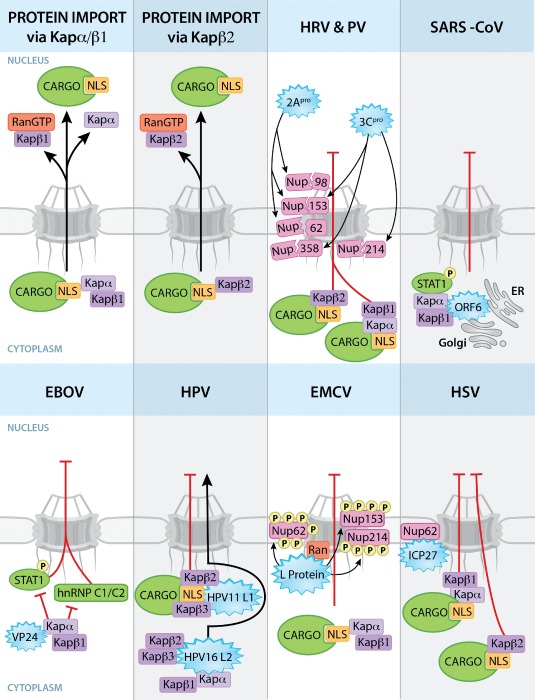
Viral strategies to disrupt nucleocytoplasmic trafficking of proteins. Nuclear import pathways mediated by Kapα/Kapβ1 or Kapβ2 are shown. Kapα and Kapβ2 bind proteins or cargos with specific NLSs. Kapβ1 and β2 translocate the import complexes through the NPC via interactions with Nups. The import complexes are dissociated by RanGTP at the nucleoplasmic side of the NPC. Viral proteins (blue starbursts) interact with the depicted host factors to disrupt nuclear transport pathways. 2Apro and 3Cpro of HRV and PV degrade Nups and block nuclear import of proteins via the Kapα/β1 and Kapβ2 pathways. SARS‐CoV ORF6 protein effectively disrupts nuclear import of phosphorylated STAT1 by tethering PY‐STAT1–Kapα/Kapβ complex to ER/Golgi membranes. Alternatively, EBOV‐VP24 binds Kapα preventing its interaction with phosphorylated STAT1 and hnRNP C1/C2, which accumulate in the cytoplasm. In HPV, while HPV11 L1 binds Kapβ2/β3 and disrupts cargo import, the viral HPV16 L2 protein gets imported into nucleus by binding to Kapβ2, Kapβ3 and Kapα/Kapβ1 complex. To inhibit protein import, L protein of EMCV hyperphosphorylates Nups and binds Ran. ICP27 protein of HSV interacts with Nup62 and blocks nuclear import of proteins via Kapα/Kapβ1 and Kapβ2 pathways. Disruption of nuclear import of proteins by other viruses is discussed in the text.
Figure 2
Figure 2
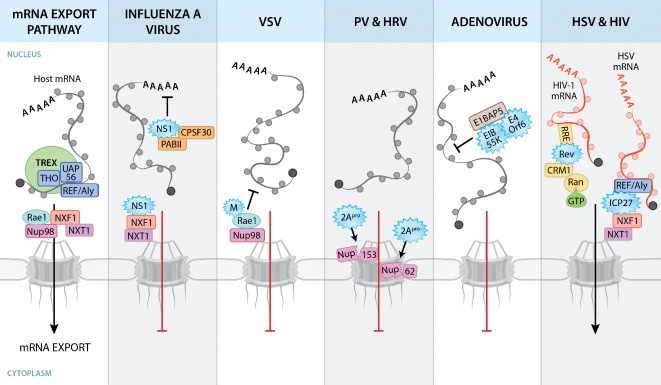
Viral disruption of host mRNA nuclear export pathways. Host mRNA export is coordinated by the TREX complex, which consists of THO, UAP56 and REF/Aly. The association of REF with mRNA recruits the mRNA export receptor heterodimer NXF1‐NXT1, which mediates export of mRNAs by interacting with Nups at the NPC. Circles surrounding mRNAs depict RNA‐binding proteins. Viral proteins (depicted as blue starbursts) disrupt mRNA nuclear export by interacting with host factors. IAV NS1 binds and disrupts factors involved in cellular mRNA processing and export. VSV M protein interacts with Rae1 and Nup98, resulting in mRNA nuclear export block. 2Apro of PV and HRV cleaves Nups to disrupt NPC architecture. AdV E1B 55K and E4orf6 proteins disrupt NXF1‐mediated host mRNA export by binding to E1B‐AP5. Other viruses, such as herpesviruses and HIV, utilize cellular transport pathways to promote viral mRNA export. The herpesvirus protein ICP27 facilitates preferential export of viral mRNAs through interaction with REF/Aly and NXF1. The HIV‐1 Rev protein facilitates nuclear export of unspliced or partially spliced viral mRNAs through the Rev‐responsive element (RRE), an RNA signature on these viral mRNAs. Rev‐bound viral RNA binds CRM1 and RanGTP and is translocated through the NPC.

References

    1. Wente SR, Rout MP. The nuclear pore complex and nuclear transport. Cold Spring Harb Perspect Biol 2010;2:a000562. - PMC - PubMed
    1. Cronshaw JM, Krutchinsky AN, Zhang W, Chait BT, Matunis MJ. Proteomic analysis of the mammalian nuclear pore complex. J Cell Biol 2002;158:915–927. - PMC - PubMed
    1. Rout MP, Aitchison JD, Suprapto A, Hjertaas K, Zhao Y, Chait BT. The yeast nuclear pore complex: composition, architecture, and transport mechanism. J Cell Biol 2000;148:635–651. - PMC - PubMed
    1. Raices M, D'Angelo MA. Nuclear pore complex composition: a new regulator of tissue‐specific and developmental functions. Nat Rev Mol Cell Biol 2012;13:687–699. - PubMed
    1. Suntharalingam M, Wente SR. Peering through the pore: nuclear pore complex structure, assembly, and function. Dev Cell 2003;4:775–789. - PubMed

Publication types

LinkOut - more resources