


The Massachusetts BMI letter: a qualitative study of responses from parents of obese children
- PMID: 24290240
- PMCID: PMC4553945
- DOI: 10.1016/j.pec.2013.10.016
The Massachusetts BMI letter: a qualitative study of responses from parents of obese children
Abstract
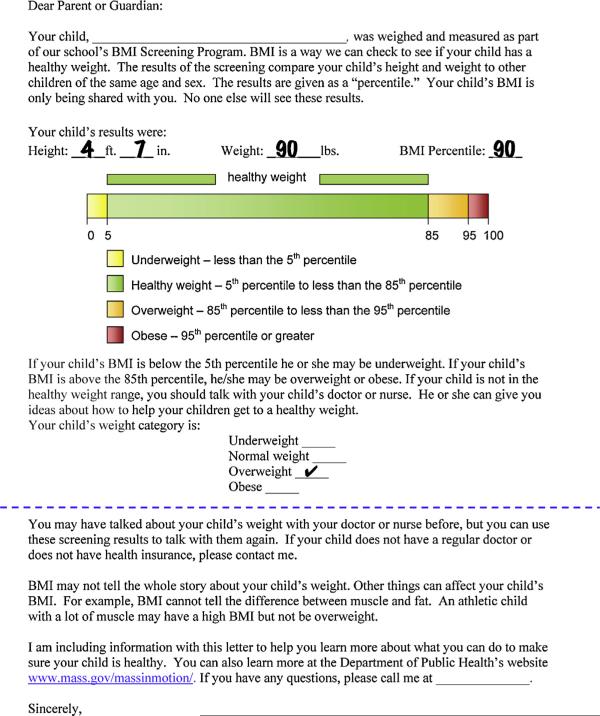
Objectives: Massachusetts (MA) public schools conduct mandated body-mass index (BMI) screening and until recently, communicated results in a letter to parents/caregivers, to encourage primary care visits and provide aggregate data to the state Department of Public Health. This study assessed the letter's readability and qualitatively explored parents' responses to it.
Methods: Readability of the BMI letter was calculated. Audio-taped 1-h focus groups were conducted with parents/caregivers of 8- to 14-year-old obese (≥95th BMI-for-age percentile) children. A semi-structured interview guide was used to elicit responses. Qualitative content analysis was conducted on transcripts to identify emergent themes.
Results: Readability analysis showed higher grade levels than recommended. Eight focus groups consisting of two to six parents each were conducted (n=29); 83% were female, mean age 41±9years, and 65% self-identified as Hispanic/Latino. Key themes identified included usefulness of the BMI letter, concerns about utility of BMI for screening, concerns about impacting self-esteem, and failure to understand the letter.
Conclusions: The MA BMI letter may not have been achieving its desired goal with some parents.
Practice implications: Emergent themes from this study could be used to test effectiveness of similar BMI letters nationwide and develop strategies to improve communication to parents.
Keywords: BMI; Body mass index screening; Health literacy; Patient–provider communication; Weight communication.
Copyright © 2013 Elsevier Ireland Ltd. All rights reserved.
Figures
References
-
- Massachusetts Department of Public Health [08.05.13];BMI screening guidelines for schools. 2009 http://www.mass.gov/eohhs/docs/dph/com-health/school/bmi-screening-guide....
-
- Nihiser AJ, Lee SM, Wechsler H, McKenna M, Odom E, Reinold C, et al. Body mass index measurement in schools. J Sch Health. 2007;77:651–71. - PubMed
-
- Chomitz VR, Collins J, Kim J, Kramer E, McGowan R. Promoting healthy weight among elementary school children via a health report card approach. Arch Pediatr Adolesc Med. 2003;157:765–72. - PubMed
Publication types
MeSH terms
Grants and funding
LinkOut - more resources
Full Text Sources
Other Literature Sources
Medical
