


Driving habits in older patients with central vision loss
- PMID: 24290805
- PMCID: PMC3943660
- DOI: 10.1016/j.ophtha.2013.09.042
Driving habits in older patients with central vision loss
Abstract
Objective: To determine if central visual loss is associated with driving cessation, driving restriction, or other-driver preference.
Design: Cross-sectional study.
Participants: Sixty-four subjects with bilateral visual loss (<20/32 in better eye) or severe unilateral visual loss (<20/200) from age-related macular degeneration (AMD) and 58 normally sighted controls between 60 and 80 years of age.
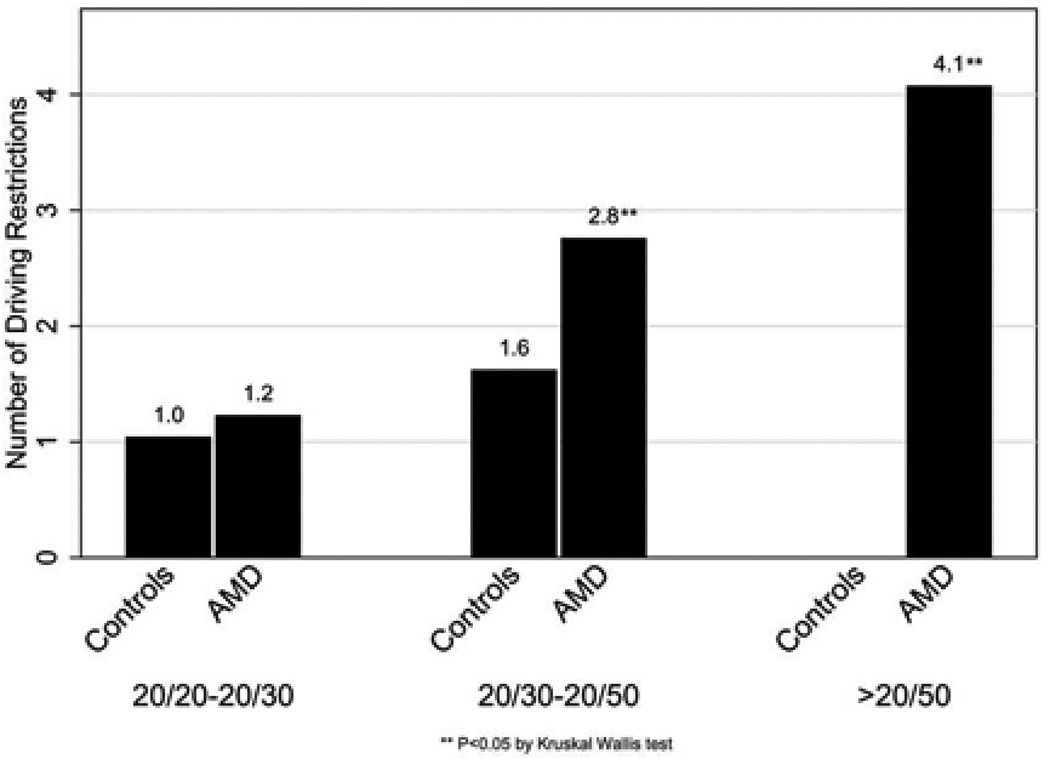
Methods: Participants self-reported driving habits. Other-driver preference was defined as preferring that another drive when there is more than 1 driver in the car. Subjects reporting 2 or more driving limitations were considered to have restricted their driving.
Main outcome measures: Self-reported driving cessation, other-driver preference, and driving restriction.
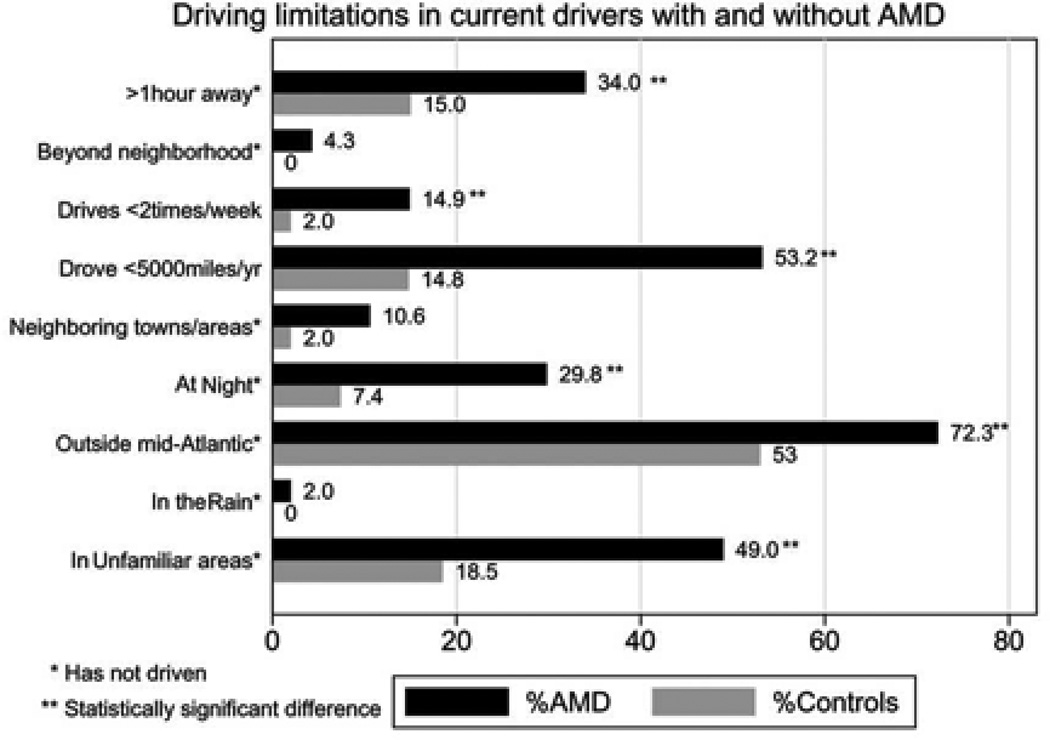
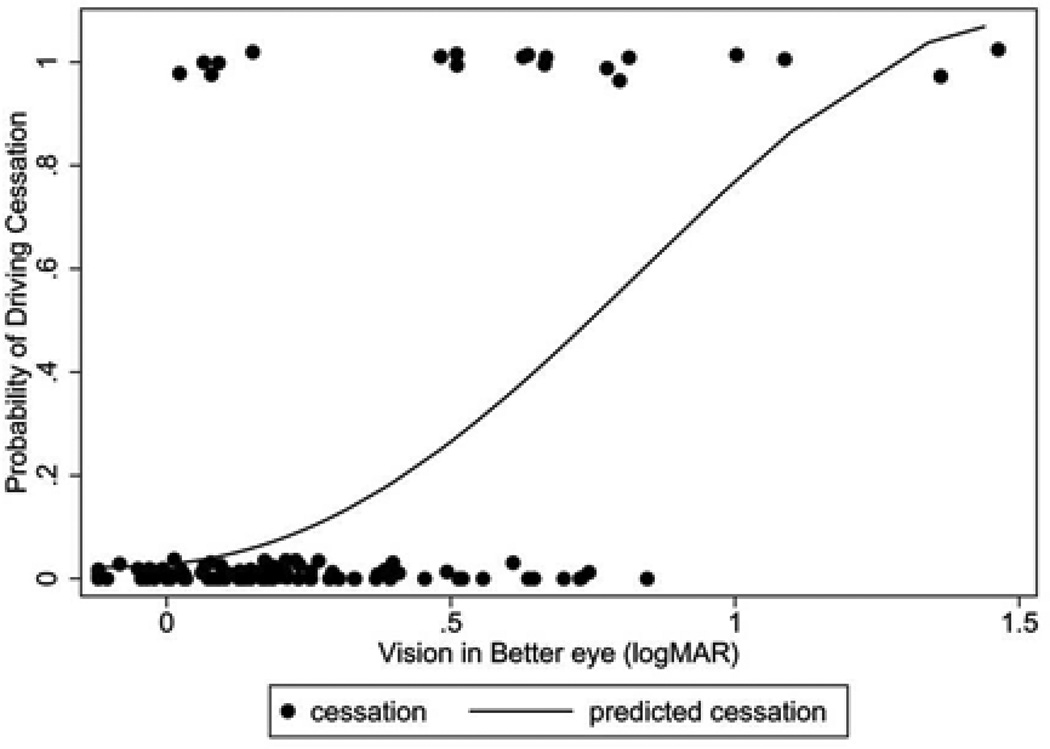
Results: Age-related macular degeneration subjects were older (74.7 vs. 69.7 years), had worse visual acuity (VA; mean better-eye VA, 0.43 vs. 0.08 logarithm of minimum angle of resolution [logMAR]) and contrast sensitivity (CS; 1.4 vs. 1.9 log units of CS [logCS]), and were more likely to be white when compared with controls (P<0.001 for all). Drivers with AMD-related vision loss were more likely to avoid driving over longer distances, beyond 1 hour, at night, and in unfamiliar conditions (P < 0.05 for all). In multivariate models, driving cessation was associated with worse better-eye VA (odds ratio [OR], 1.5 per 1-line decrement in VA; P<0.001) and worse binocular CS (OR, 1.36 per 0.1 logCS increment; P = 0.005); however, AMD group status was not associated with driving cessation (OR, 1.9; P = 0.35). Factors predicting driving restriction were AMD (OR, 9.0; P = 0.004), worse vision (OR, 2.5 per line of VA loss; P<0.001), lower CS (OR, 2.2 per 0.1-logCS increment; P<0.001), and female gender (OR, 27.9; P = 0.002). Other-driver preference was more common with worse vision (OR, 1.6 per 0.1-logMAR increment; P = 0.003), female gender (OR, 4.5; P = 0.02), and being married (OR, 3.8; P = 0.04).
Conclusions: Most patients with AMD-related central vision loss continue to drive, but demonstrate significant driving restrictions, especially with more severe VA and CS loss. Future work should determine which driving adaptations the visually impaired best balance safety and independence.
Copyright © 2014 American Academy of Ophthalmology. Published by Elsevier Inc. All rights reserved.
Conflict of interest statement
Figures
References
-
- Klein R, Klein BE, Linton KL. Prevalence of age-related maculopathy. The Beaver Dam Eye Study. Ophthalmology. 1992;99:933–943. - PubMed
-
- Kahn HA, Leibowitz HM, Ganley JP, et al. The Framingham Eye Study. I. Outline and major prevalence findings. Am J Epidemiol. 1977;106:17–32. - PubMed
-
- Eye Diseases Prevalence Research Group. Prevalence of age-related macular degeneration in the United States. Arch Ophthalmol. 2004;122:564–572. - PubMed
-
- Eye Diseases Prevalence Research Group. Causes and prevalence of visual impairment among adults in the United States. Arch Ophthalmol. 2004;122:477–485. - PubMed
-
- Popescu ML, Boisjoly H, Schmaltz H, et al. Age-related eye disease and mobility limitations in older adults. Invest Ophthalmol Vis Sci. 2011;52:7168–7174. - PubMed
Publication types
MeSH terms
Grants and funding
LinkOut - more resources
Full Text Sources
Other Literature Sources
Medical
