


Frailty assessment in the cardiovascular care of older adults
- PMID: 24291279
- PMCID: PMC4571179
- DOI: 10.1016/j.jacc.2013.09.070
Frailty assessment in the cardiovascular care of older adults
Abstract
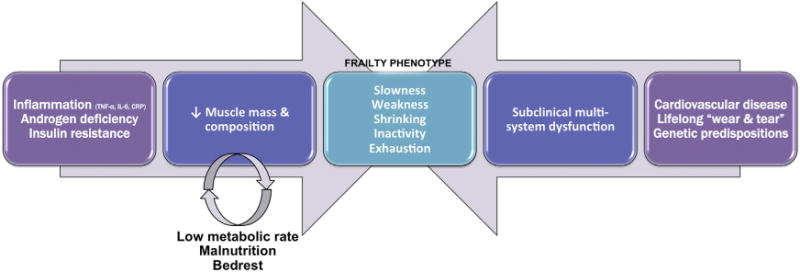
Due to the aging and increasingly complex nature of our patients, frailty has become a high-priority theme in cardiovascular medicine. Despite the recognition of frailty as a pivotal element in the evaluation of older adults with cardiovascular disease (CVD), there has yet to be a road map to facilitate its adoption in routine clinical practice. Thus, we sought to synthesize the existing body of evidence and offer a perspective on how to integrate frailty into clinical practice. Frailty is a biological syndrome that reflects a state of decreased physiological reserve and vulnerability to stressors. Upward of 20 frailty assessment tools have been developed, with most tools revolving around the core phenotypic domains of frailty-slow walking speed, weakness, inactivity, exhaustion, and shrinking-as measured by physical performance tests and questionnaires. The prevalence of frailty ranges from 10% to 60%, depending on the CVD burden, as well as the tool and cutoff chosen to define frailty. Epidemiological studies have consistently demonstrated that frailty carries a relative risk of >2 for mortality and morbidity across a spectrum of stable CVD, acute coronary syndromes, heart failure, and surgical and transcatheter interventions. Frailty contributes valuable prognostic insights incremental to existing risk models and assists clinicians in defining optimal care pathways for their patients. Interventions designed to improve outcomes in frail elders with CVD such as multidisciplinary cardiac rehabilitation are being actively tested. Ultimately, frailty should not be viewed as a reason to withhold care but rather as a means of delivering it in a more patient-centered fashion.
Keywords: cardiovascular disease; elderly; frailty.
Copyright © 2014 American College of Cardiology Foundation. Published by Elsevier Inc. All rights reserved.
Figures
References
-
- Shamliyan T, Talley KMC, Ramakrishnan R, Kane RL. Association of frailty with survival: a systematic literature review. Ageing Res Rev. 2012;12:719–36. - PubMed
Publication types
MeSH terms
Grants and funding
LinkOut - more resources
Full Text Sources
Other Literature Sources
Medical
