


Aging and individual differences in binding during sentence understanding: evidence from temporary and global syntactic attachment ambiguities
- PMID: 24291806
- PMCID: PMC3883357
- DOI: 10.1016/j.cognition.2013.10.005
Aging and individual differences in binding during sentence understanding: evidence from temporary and global syntactic attachment ambiguities
Abstract
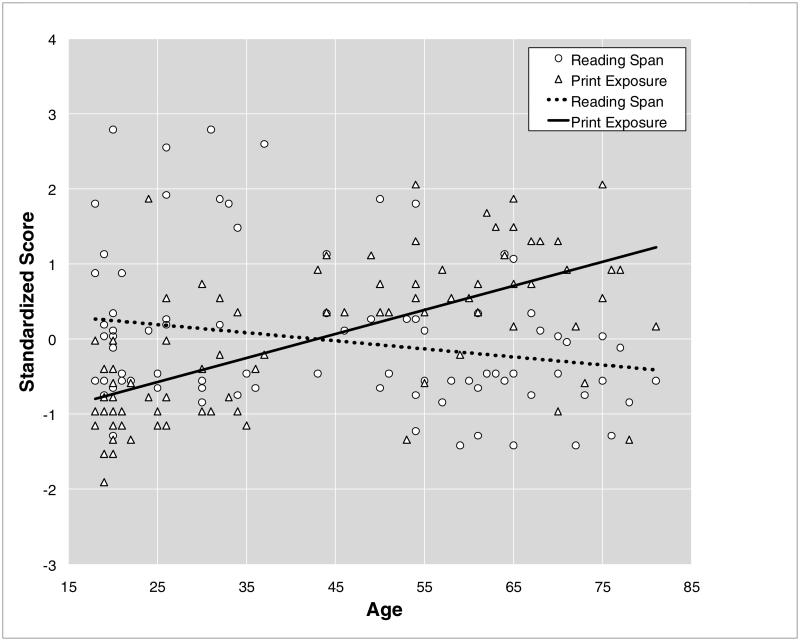
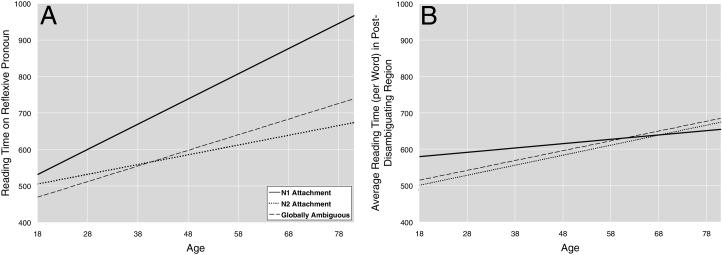
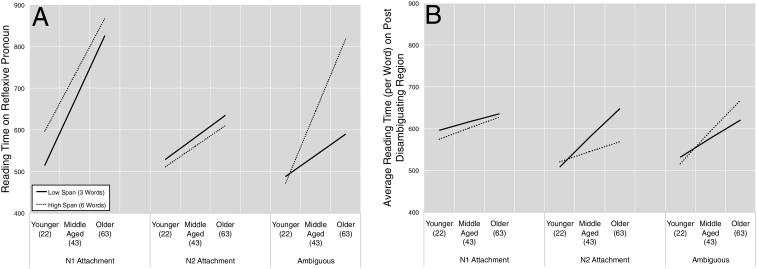
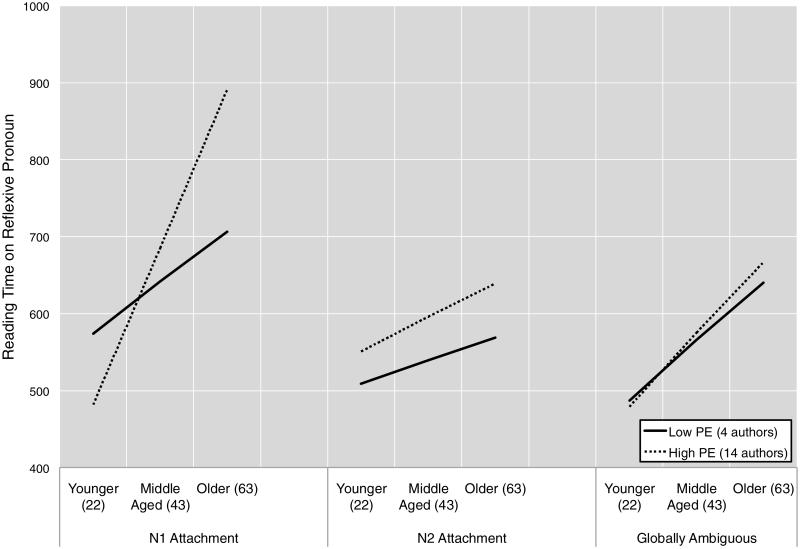
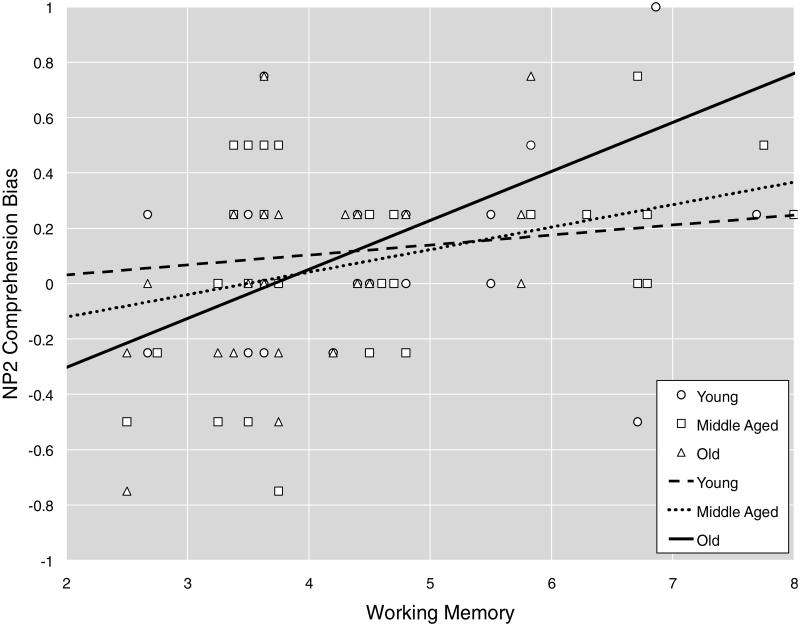
We report an investigation of aging and individual differences in binding information during sentence understanding. An age-continuous sample of adults (N=91), ranging from 18 to 81 years of age, read sentences in which a relative clause could be attached high to a head noun NP1, attached low to its modifying prepositional phrase NP2 (e.g., The son of the princess who scratched himself/herself in public was humiliated), or in which the attachment site of the relative clause was ultimately indeterminate (e.g., The maid of the princess who scratched herself in public was humiliated). Word-by-word reading times and comprehension (e.g., who scratched?) were measured. A series of mixed-effects models were fit to the data, revealing: (1) that, on average, NP1-attached sentences were harder to process and comprehend than NP2-attached sentences; (2) that these average effects were independently moderated by verbal working memory capacity and reading experience, with effects that were most pronounced in the oldest participants and; (3) that readers on average did not allocate extra time to resolve global ambiguities, though older adults with higher working memory span did. Findings are discussed in relation to current models of lifespan cognitive development, working memory, language experience, and the role of prosodic segmentation strategies in reading. Collectively, these data suggest that aging brings differences in sentence understanding, and these differences may depend on independent influences of verbal working memory capacity and reading experience.
Keywords: Aging; Print exposure; Reading; Relative clause attachment; Sentence processing; Working memory.
Copyright © 2013 Elsevier B.V. All rights reserved.
Figures
References
-
- Aaronson D, Ferres S. The word-by-word reading paradigm: An experimental and theoretical approach. In: Kieras DE, Just MA, editors. New methods in reading comprehension research. Erlbaum; Hillsdale, NJ: 1984. pp. 31–68.
-
- Baayen RH, Davidson DJ, Bates DM. Mixed-effects modeling with crossed random effects for subjects and items. Journal of Memory and Language. 2008;59:390–412.
-
- Biber D. Spoken and written textual dimensions in English: Resolving the contradictory findings. Language. 1986;62:384–414.
-
- Bopp KL, Verhaeghen P. Aging and verbal memory span: A meta-analysis. Journal of Gerontology: Psychological Sciences. 2005;60:223–233. - PubMed
Publication types
MeSH terms
Grants and funding
LinkOut - more resources
Full Text Sources
Other Literature Sources
Medical
