


Review
doi: 10.1055/s-0032-1329393.
Current treatment of lower gastrointestinal hemorrhage
Affiliations
- PMID: 24294124
- PMCID: PMC3577609
- DOI: 10.1055/s-0032-1329393
Item in Clipboard
Review
Current treatment of lower gastrointestinal hemorrhage
Clin Colon Rectal Surg.
2012 Dec.
Abstract
Massive lower gastrointestinal bleeding is a significant and expensive problem that requires methodical evaluation, management, and treatment. After initial resuscitation, care should be taken to localize the site of bleeding. Once localized, lesions can then be treated with endoscopic or angiographic interventions, reserving surgery for ongoing or recurrent bleeding.
Keywords: angiography; colonoscopy; gastrointestinal hemorrhage: surgery; lower gastrointestinal hemorrhage; radionuclide scintigraphy.
Figures
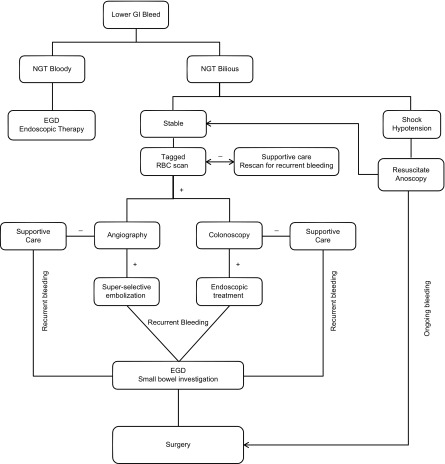
Algorithm for the diagnosis and treatment of acute lower gastrointestinal bleeding.
References
-
- Parker D R, Luo X, Jalbert J J, Assaf A R. Impact of upper and lower gastrointestinal blood loss on healthcare utilization and costs: a systematic review. J Media Econ. 2011;14(3):279–287. - PubMed
-
- Whelan C T, Chen C, Kaboli P, Siddique J, Prochaska M, Meltzer D O. Upper versus lower gastrointestinal bleeding: a direct comparison of clinical presentation, outcomes, and resource utilization. J Hosp Med. 2010;5(3):141–147. - PubMed
-
- Prakash C, Zuckerman G R. Acute small bowel bleeding: a distinct entity with significantly different economic implications compared with GI bleeding from other locations. Gastrointest Endosc. 2003;58(3):330–335. - PubMed
-
- Zhao Y, Encinosa W. Rockville, MD: Agency for Healthcare Research and Quality; 2008. Hospitalizations for gastrointestinal bleeding in 1998 and 2006. Healthcare Cost and Utilization Project (HCUP) Statistical Brief #5. - PubMed
-
- Farrell J J Friedman L S Gastrointestinal bleeding in the elderly Gastroenterol Clin North Am 2001302377–407., viii. - PubMed
