Mindfulness-based cognitive therapy for preventing relapse in recurrent depression: a randomized dismantling trial
- PMID: 24294837
- PMCID: PMC3964149
- DOI: 10.1037/a0035036
Mindfulness-based cognitive therapy for preventing relapse in recurrent depression: a randomized dismantling trial
Abstract
Objective: We compared mindfulness-based cognitive therapy (MBCT) with both cognitive psychological education (CPE) and treatment as usual (TAU) in preventing relapse to major depressive disorder (MDD) in people currently in remission following at least 3 previous episodes.
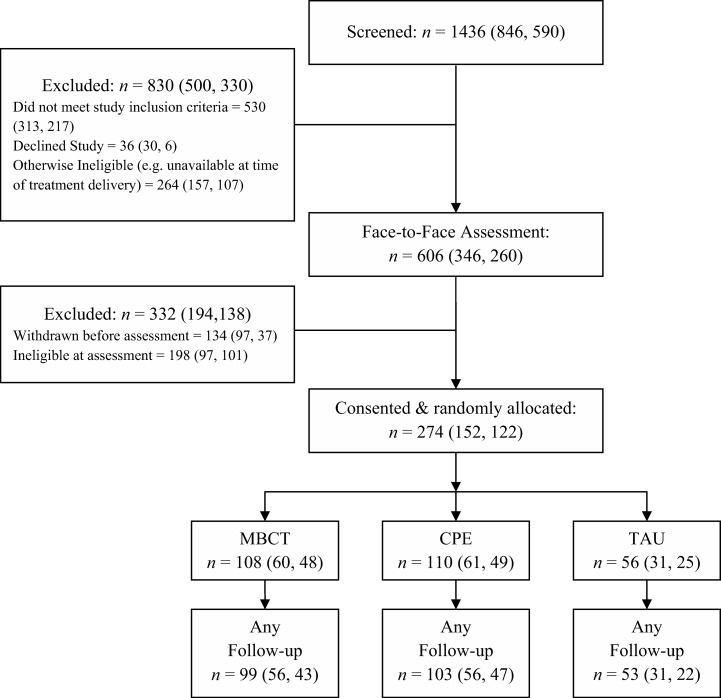
Method: A randomized controlled trial in which 274 participants were allocated in the ratio 2:2:1 to MBCT plus TAU, CPE plus TAU, and TAU alone, and data were analyzed for the 255 (93%; MBCT = 99, CPE = 103, TAU = 53) retained to follow-up. MBCT was delivered in accordance with its published manual, modified to address suicidal cognitions; CPE was modeled on MBCT, but without training in meditation. Both treatments were delivered through 8 weekly classes.
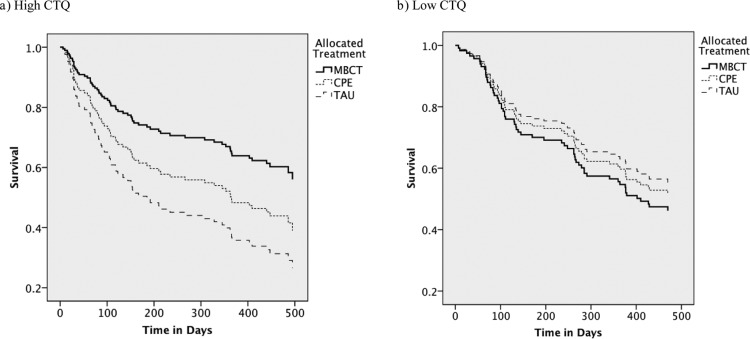
Results: Allocated treatment had no significant effect on risk of relapse to MDD over 12 months follow-up, hazard ratio for MBCT vs. CPE = 0.88, 95% CI [0.58, 1.35]; for MBCT vs. TAU = 0.69, 95% CI [0.42, 1.12]. However, severity of childhood trauma affected relapse, hazard ratio for increase of 1 standard deviation = 1.26 (95% CI [1.05, 1.50]), and significantly interacted with allocated treatment. Among participants above median severity, the hazard ratio was 0.61, 95% CI [0.34, 1.09], for MBCT vs. CPE, and 0.43, 95% CI [0.22, 0.87], for MBCT vs. TAU. For those below median severity, there were no such differences between treatment groups.
Conclusion: MBCT provided significant protection against relapse for participants with increased vulnerability due to history of childhood trauma, but showed no significant advantage in comparison to an active control treatment and usual care over the whole group of patients with recurrent depression.
Figures
Comment in
-
Dismantling mindfulness-based cognitive therapy for recurrent depression implicates lack of differential efficacy for mindfulness training.Evid Based Ment Health. 2014 Aug;17(3):94. doi: 10.1136/eb-2014-101856. Evid Based Ment Health. 2014. PMID: 25043437 No abstract available.
References
-
- American Psychiatric Association (2000). Diagnostic and statistical manual of mental disorders (4th ed., text rev.). Washington, DC: Author
-
- Beck A. T., & Steer R. A. (1993). Manual for the Beck Scale for Suicide Ideation. San Antonio, TX: Psychological Corporation
-
- Beck A. T., Steer R. A., & Brown G. K. (1996). Manual for the BDI-II. San Antonio, TX: Psychological Corporation
-
- Bernstein D. P., & Fink L. (1997). Childhood Trauma Questionnaire. San Antonio, TX: Psychological Corporation
-
- Bernstein D. P., Fink C., Handelsman L., Foote J., Lovejoy M., Wenzel K., et al. Ruggiero J. (1994). Initial reliability and validity of a new retrospective measure of child abuse and neglect. American Journal of Psychiatry, 151, 1132–1136 - PubMed
Publication types
MeSH terms
Associated data
Grants and funding
LinkOut - more resources
Full Text Sources
Other Literature Sources
Medical
Research Materials
Miscellaneous