


Hepatocyte-like cells derived from human amniotic epithelial cells can be encapsulated without loss of viability or function in vitro
- PMID: 24295364
- PMCID: PMC3992005
- DOI: 10.1089/scd.2013.0485
Hepatocyte-like cells derived from human amniotic epithelial cells can be encapsulated without loss of viability or function in vitro
Abstract
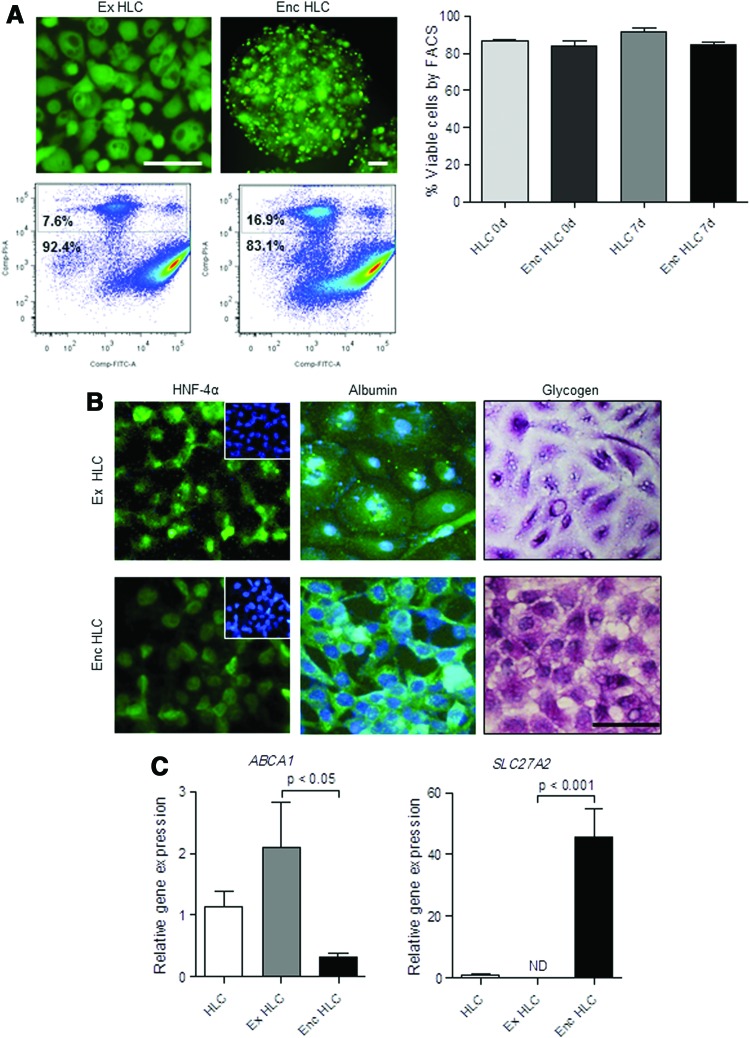
Placenta derived human amniotic epithelial cells (hAEC) are an attractive source of stem cells for the generation of hepatocyte-like cells (HLC) for therapeutic applications to treat liver diseases. During hAEC differentiation into HLC, they become increasingly immunogenic, which may result in immune cell-mediated rejection upon transplantation into allogeneic recipients. Placing cells within devices such as alginate microcapsules can prevent immune cell-mediated rejection. The aim of this study was to investigate the characteristics of HLC generated from hAEC and to examine the effects of encapsulation on HLC viability, gene expression, and function. hAEC were differentiated for 4 weeks and evaluated for hepatocyte-specific gene expression and function. Differentiated cells were encapsulated in barium alginate microcapsules and cultured for 7 days and the effect of encapsulation on cell viability, function, and hepatocyte related gene expression was determined. Differentiated cells performed key functions of hepatocytes including urea synthesis, drug-metabolizing cytochrome P450 (CYP)3A4 activity, indocyanine green (ICG) uptake, low-density lipoprotein (LDL) uptake, and exhibited glutathione antioxidant capacity. A number of hepatocyte-related genes involved in fat, cholesterol, bile acid synthesis, and xenobiotic metabolism were also expressed showing that the hAEC had differentiated into HLC. Upon encapsulation, the HLC remained viable for at least 7 days in culture, continued to express genes involved in fat, cholesterol, bile acid, and xenobiotic metabolism and had glutathione antioxidant capacity. CYP3A4 activity and urea synthesis by the encapsulated HLC were higher than that of monolayer HLC cultures. Functional HLC can be derived from hAEC, and HLC can be encapsulated within alginate microcapsules without losing viability or function in vitro.
Figures



References
-
- Lee WM. (2012). Acute liver failure. Semin Respir Crit Care Med 33:36–45 - PubMed
-
- Hansen K. and Horslen S. (2008). Metabolic liver disease in children. Liver Transpl 14:713–733 - PubMed
-
- Bilir BM, Guinette D, Karrer F, Kumpe DA, Krysl J, Stephens J, McGavran L, Ostrowska A. and Durham J. (2000). Hepatocyte transplantation in acute liver failure. Liver Transpl 6:32–40 - PubMed
-
- Strom SC, Chowdhury JR. and Fox IJ. (1999). Hepatocyte transplantation for the treatment of human disease. Semin Liver Dis 19:39–48 - PubMed
-
- Habibullah CM, Syed IH, Qamar A. and Taher-Uz Z. (1994). Human fetal hepatocyte transplantation in patients with fulminant hepatic failure. Transplantation 58:951–952 - PubMed
Publication types
MeSH terms
Substances
LinkOut - more resources
Full Text Sources
Other Literature Sources
