. 2014 Feb 7;14(3):569-576.
doi: 10.1039/c3lc51022k.

Measuring single cell mass, volume, and density with dual suspended microchannel resonators

Affiliations

Measuring single cell mass, volume, and density with dual suspended microchannel resonators

Andrea K Bryan et al. Lab Chip. .

Abstract

Cell size, measured as either volume or mass, is a fundamental indicator of cell state. Far more tightly regulated than size is density, the ratio between mass and volume, which can be used to distinguish between cell populations even when volume and mass appear to remain constant. Here we expand upon a previous method for measuring cell density involving a suspended microchannel resonator (SMR). We introduce a new device, the dual SMR, as a high-precision instrument for measuring single-cell mass, volume, and density using two resonators connected by a serpentine fluidic channel. The dual SMR designs considered herein demonstrate the critical role of channel geometry in ensuring proper mixing and damping of pressure fluctuations in microfluidic systems designed for precision measurement. We use the dual SMR to compare the physical properties of two well-known cancer cell lines: human lung cancer cell H1650 and mouse lymphoblastic leukemia cell line L1210.


Figures

Figure 1
Figure 1
A Calculating single cell mass, volume, and density. Cell buoyant mass is measured in two fluids of different densities (red dots) to determine the linear relationship between buoyant mass and fluid density. The absolute mass (y-intercept), volume (slope), and density (x-intercept) of the cell can then be calculated. B Buoyant mass measurements of a cell population measured in two different fluids. Cell-to-cell variations in mass, density, and volume are directly observed from the intercepts and slopes created by the pairs of buoyant mass measurements.
Figure 2
Figure 2
Dual SMR schematic and measurement. A A single cell flows from the sample bypass channel into the first SMR (SMR1) for a buoyant mass measurement in the cell's culture media (fluid 1, blue). The cell then continues to a cross-junction where a high density fluid (light red) is introduced and mixes with fluid 1 via diffusion in the serpentine channel. The second buoyant mass measurement is recorded as the particle flows through the second SMR (SMR2) in this mixed fluid (fluid 2, dark red). B SMR buoyant mass measurements are determined by the change in resonance frequency (Δfr) from the baseline as a cell traverses the cantilever channel. The direction of this frequency change depends on the density of the cell relative to the surrounding fluid. A slope in the baseline of SMR2 is observed due to a ~0.01% change in density of the fluid along the length of the cantilever microchannel.
Figure 3
Figure 3
A Fluid density calibration for SMR1 and SMR2. The baseline frequency for different density fluids is measured to determine each SMR's fluid density calibration factor (kHz/g mL−1). B Distribution of peak heights of a population of nominal 10 μm beads measured in SMR1 and SMR2. The mean peak height is used in determining each SMR's point mass calibration factor. The dark black curve is a simulated bead population based on CV reported by manufacturer (1.2%; Duke Scientific).
Figure 4
Figure 4
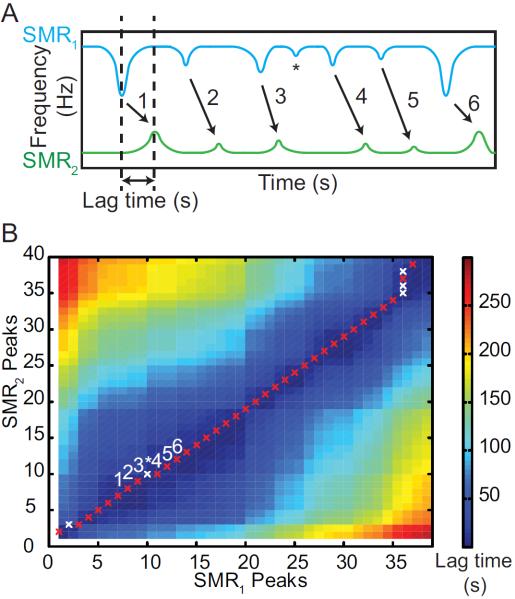
A Sample frequency reading for a population of cells. Peak heights in each dataset are identified and the time at which each peak occurs is recorded. Lag time reflects the amount of time required for a single cell to travel from the first cantilever, through the serpentine channel, to the second cantilever. The asterisk indicates an SMR1 measurement that does not have a match in SMR2, as would occur if debris stuck within the serpentine channel. B A heat map representing the implementation of the Needleman-Wunsch algorithm for pairing peaks. The X and Y axes indicate the ordinal peak number recorded from SMR1 and SMR2, respectively, and the colors reflect absolute lag time calculated between a given peak in SMR1 with one in SMR2. Red Xs represent peaks paired by their optimal lag time. White Xs correspond to a pairing that has been rejected based on the lag time. Labeled Xs refer to the example peaks shown in Fig. 4A.
Figure 5
Figure 5
Measurement uncertainty of cell density (blue) and cell volume (green) as a function of fluid 2 density, assuming no uncertainty in measuring fluid density. The simulation is calculated using fixed values for buoyant mass in Fluid 1, average L1210 cell density, and Fluid 1 density, along with a range of experimentally relevant values for Fluid 2 density, which correspond to a range of buoyant masses in Fluid 2. Multiplicative error was applied to the simulated measurements using the variation in buoyant masses of polystyrene beads, and additive error was applied using the magnitude of the baseline noise in each cantilever. The fluid 2 density of a typical experiment was adjusted to approximately 1.07 g/mL. The pink asterisk indicates the cell density, and the black circle corresponds to the point of minimum uncertainty in the density measurement.
Figure 6
Figure 6
A Density versus mass of H1650 (n = 148) and L1210 (n = 136) cells. Although these homogeneous cell populations exhibit large variation in mass (~50%), density is a much more tightly regulated parameter. B Dual SMR volume distribution compared to results from a Coulter counter. A small aliquot of cells was measured on the Coulter counter prior to the SMR measurement.

References

    1. Alberts B, Bray D, Johnson A, Lewis J, Raff M, Roberts K, Walter P. Essential Cell Biology: An Introduction to the Molecular Biology of the Cell. Vol. 27. Garland Publishing, Inc; New York: 1998.
    1. Grover WH, Bryan AK, Diez-Silva M, Suresh S, Higgins JM, Manalis SR. Proceedings of the National Academy of Sciences of the United States of America. 2011;108:10992–6. - PMC - PubMed
    1. Park J-M, Lee J-Y, Lee J-G, Jeong H, Oh J-M, Kim YJ, Park D, Kim MS, Lee HJ, Oh JH, Lee SS, Lee W-Y, Huh N. Analytical chemistry. 2012;84:7400–7. - PubMed
    1. Friedman SL, Roll FJ. Analytical biochemistry. 1987;161:207–18. - PubMed
    1. Mir M, Wang Z, Shen Z, Bednarz M, Bashir R, Golding I, Prasanth SG, Popescu G. Proceedings of the National Academy of Sciences of the United States of America. 2011;108:13124–9. - PMC - PubMed

Publication types