. 2013 Dec 19;117(50):16141-7.
doi: 10.1021/jp411261g. Epub 2013 Dec 6.

Xenon and other volatile anesthetics change domain structure in model lipid raft membranes

Affiliations

Xenon and other volatile anesthetics change domain structure in model lipid raft membranes

Michael Weinrich et al. J Phys Chem B. .

Abstract

Inhalation anesthetics have been in clinical use for over 160 years, but the molecular mechanisms of action continue to be investigated. Direct interactions with ion channels received much attention after it was found that anesthetics do not change the structure of homogeneous model membranes. However, it was recently found that halothane, a prototypical anesthetic, changes domain structure of a binary lipid membrane. The noble gas xenon is an excellent anesthetic and provides a pivotal test of the generality of this finding, extended to ternary lipid raft mixtures. We report that xenon and conventional anesthetics change the domain equilibrium in two canonical ternary lipid raft mixtures. These findings demonstrate a membrane-mediated mechanism whereby inhalation anesthetics can affect the lipid environment of transmembrane proteins.


Figures

Figure 1
Figure 1
A. Neutron Diffraction. First order diffraction peaks for a multi-layered sample of deuterated d-62 DPPC/DOPC 1:1 with 20% cholesterol. The first peak is from the Lo phase, the second is from the Ld phase. Black trace is for helium at atmospheric pressure, red trace with is for xenon at 2 times atmospheric pressure (3.2 MAC), blue trace is for xenon at 4 times atmospheric pressure (6.4 MAC). Experiments performed at 28° C and 98% relative humidity. Traces are Gaussian fits to data. Q = 4πsinΘ/λ is the neutron momentum transfer. Bars indicate standard errors (1 atmosphere = 101 kPa). B. Neutron Diffraction. First order diffraction peaks for a multi-layered sample of deuterated d-31 palmitoyl sphingomyelin/DOPC 1:1 with 20% cholesterol. The first peak is from the Lo phase, the second is from the Ld phase. Black trace is for air, red trace is for xenon at 3 times atmospheric pressure (4.6 MAC). Experiments performed at 27° C and 98% relative humidity. Traces are Gaussian fits to data. Bars indicate standard errors (1 atmosphere = 101 kPa).
Figure 2
Figure 2
Change in ratio first order peak areas vs. MAC. Solid squares are for SPM/DOPC/cholesterol mixture with xenon, solid triangles are for SPM/DOPC/cholesterol mixture with nitrous oxide, open squares are for DPPC/DOPC/cholesterol mixture with xenon, and open triangles for DPPC/DOPC/cholesterol mixture with nitrous oxide. MAC used for xenon is 0.63 atmospheres (4), nitrous oxide 1.04 atmospheres (10). Dashed line represents least squares linear fit, adjusted r2 = 0.89. Bars represent standard errors.
Figure 3
Figure 3
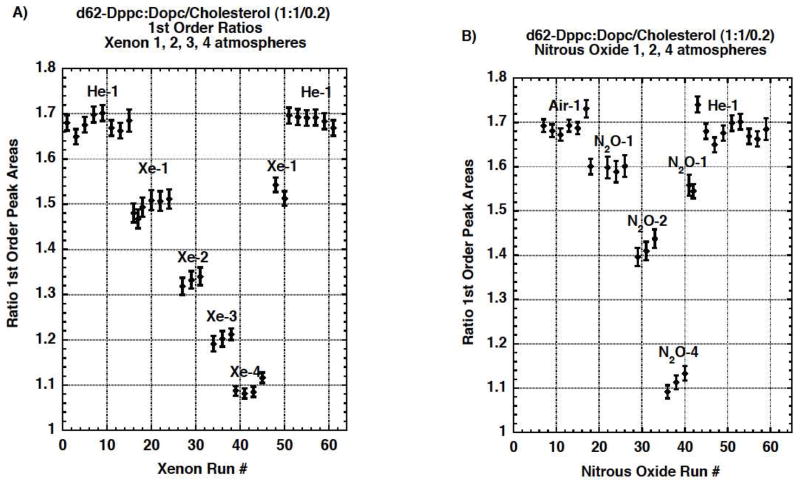
A. Neutron Diffraction Changes with Xenon. Graph plots the ratio of first order diffraction peak areas for the Lo and Ld phases during the course of an experiment on a sample of d62-DPPC/DOPC/cholesterol. First set of points was obtained in 100% helium at atmospheric pressure, T = 28° C, RH = 98%. Sets of points following are the ratios with xenon in the chamber at atmospheric pressure, twice, three, and four times atmospheric pressure, then again at one atmosphere. The last set was obtained at atmospheric pressure after flushing the chamber with helium. (1 atmosphere = 101 kPa). B. Neutron Diffraction Changes with Nitrous Oxide. Graph plots the ratio of first order diffraction peak areas for the Lo and Ld phases during the course of an experiment on a sample of d-DPPC/DOPC/cholesterol. First set of points was obtained in air at atmospheric pressure. Sets of points following are the ratios with nitrous oxide in the chamber at atmospheric pressure, twice, and four times atmospheric pressure, then again at one atmosphere. The last set was obtained at atmospheric pressure after flushing the chamber with helium. T = 28°C, RH = 98%.
Figure 4
Figure 4
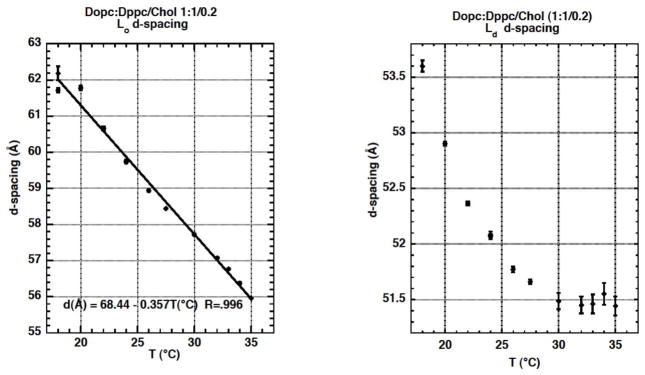
D-spacing changes for the Lo and Ld phases of the DOPC/DPPC/cholesterol mixture, as a function of temperature. The Lo phase demonstrates the usual linear relationship between membrane thickness and temperature (coefficient of thermal expansion), while the Ld phase demonstrates a non-linear effect due to the mixing of DPPC and cholesterol into this phase.
Figure 5
Figure 5
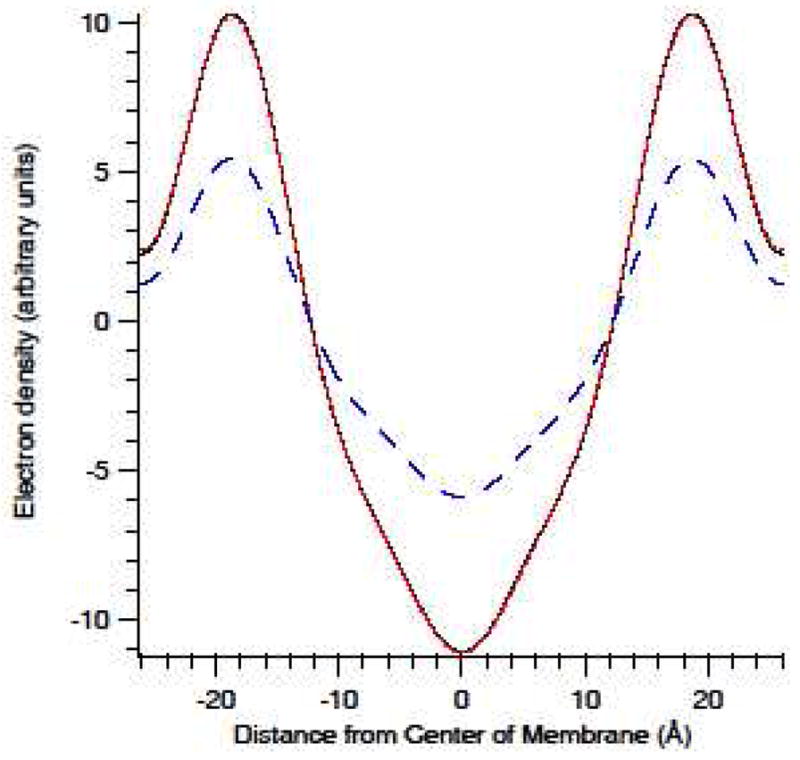
Effect of xenon on DOPC. Electron density plots derived by Fourier reconstruction from X-ray diffraction by DOPC multi-layers. Experiments performed at 27°C and 98% relative humidity. Solid black trace is for air, dashed blue trace is for xenon at atmospheric pressure, dotted red trace (overlaps black trace) is for xenon at atmospheric pressure with diffraction data scaled for X-ray absorption by xenon.

References

    1. Sanders RD, Franks NP, Maze M. Xenon: No Stranger To Anaesthesia. Br J Anaesth. 2003;91:709–17. - PubMed
    1. Dickinson R, Franks NP. Bench-To-Bedside Review: Molecular Pharmacology And Clinical Use Of Inert Gases In Anesthesia And Neuroprotection. Crit Care. 2010;14:229. - PMC - PubMed
    1. Franks NP, Dickinson R, de Sousa SL, Hall AC, Lieb WR. How does xenon produce anaesthesia? Nature. 1998;396:324. - PubMed
    1. Dickinson R, Peterson BK, Banks P, Simillis C, Martin JC, Valenzuela CA, Maze M, Franks NP. Competitive Inhibition At The Glycine Site Of The N-Methyl-D-Aspartate Receptor By The Anesthetics Xenon And Isoflurane: Evidence From Molecular Modeling And Electrophysiology. Anesthesiology. 2007;107:756–67. - PubMed
    1. Gruss M, Bushell TJ, Bright DP, Lieb WR, Mathie A, Franks NP. Two-Pore-Domain K+ Channels Are A Novel Target For The Anesthetic Gases Xenon, Nitrous Oxide, And Cyclopropane. Mol Pharmacol. 2004;65:443–52. - PubMed

Publication types

LinkOut - more resources