Meta-Analysis
. 2013 Dec 3;12(12):CD005431.
doi: 10.1002/14651858.CD005431.pub3.

Medical interventions for traumatic hyphema

Affiliations
Meta-Analysis

Medical interventions for traumatic hyphema

Almutez Gharaibeh et al. Cochrane Database Syst Rev. .

Update in

Abstract

Background: Traumatic hyphema is the entry of blood into the anterior chamber (the space between the cornea and iris) subsequent to a blow or a projectile striking the eye. Hyphema uncommonly causes permanent loss of vision. Associated trauma (e.g. corneal staining, traumatic cataract, angle recession glaucoma, optic atrophy, etc.) may seriously affect vision. Such complications may lead to permanent impairment of vision. Patients with sickle cell trait/disease may be particularly susceptible to increases of elevated intraocular pressure. If rebleeding occurs, the rates and severity of complications increase.

Objectives: To assess the effectiveness of various medical interventions in the management of traumatic hyphema.

Search methods: We searched CENTRAL (which contains the Cochrane Eyes and Vision Group Trials Register) (The Cochrane Library 2013, Issue 8), Ovid MEDLINE, Ovid MEDLINE In-Process and Other Non-Indexed Citations, Ovid MEDLINE Daily, Ovid OLDMEDLINE (January 1946 to August 2013), EMBASE (January 1980 to August 2013), the metaRegister of Controlled Trials (mRCT) (www.controlled-trials.com), ClinicalTrials.gov (www.clinicaltrials.gov) and the WHO International Clinical Trials Registry Platform (ICTRP) (www.who.int/ictrp/search/en). We did not use any date or language restrictions in the electronic searches for trials. We last searched the electronic databases on 30 August 2013.

Selection criteria: Two authors independently assessed the titles and abstracts of all reports identified by the electronic and manual searches. In this review, we included randomized and quasi-randomized trials that compared various medical interventions versus other medical interventions or control groups for the treatment of traumatic hyphema following closed globe trauma. We applied no restrictions regarding age, gender, severity of the closed globe trauma, or level of visual acuity at the time of enrolment.

Data collection and analysis: Two authors independently extracted the data for the primary and secondary outcomes. We entered and analyzed data using Review Manager 5. We performed meta-analyses using a fixed-effect model and reported dichotomous outcomes as odds ratios and continuous outcomes as mean differences.

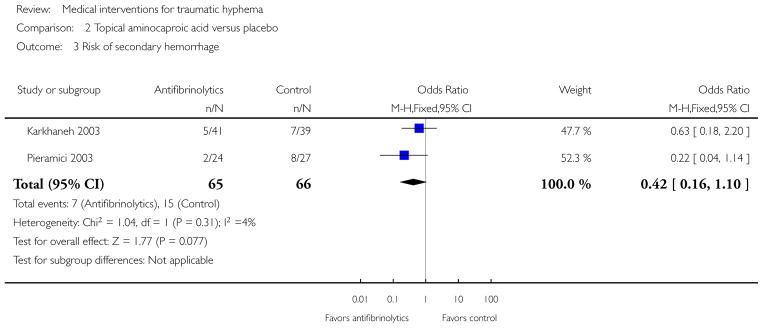
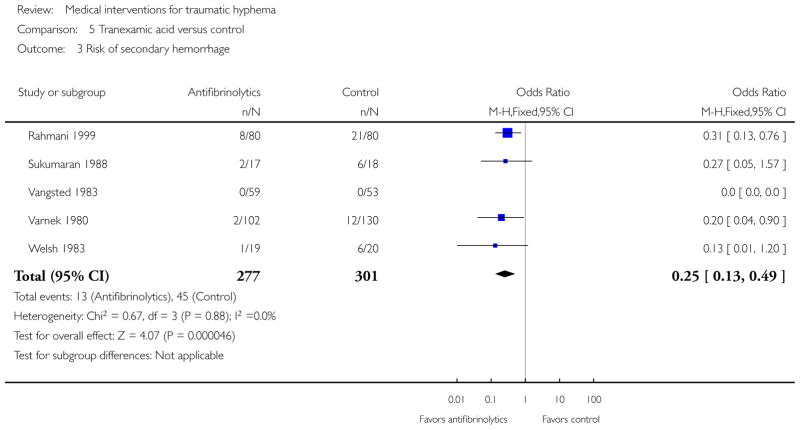
Main results: We included 20 randomized and seven quasi-randomized studies with 2643 participants in this review. Interventions included antifibrinolytic agents (oral and systemic aminocaproic acid, tranexamic acid, and aminomethylbenzoic acid), corticosteroids (systemic and topical), cycloplegics, miotics, aspirin, conjugated estrogens, traditional Chinese medicine, monocular versus bilateral patching, elevation of the head, and bed rest. No intervention had a significant effect on visual acuity whether measured at two weeks or less after the trauma or at longer time periods. The number of days for the primary hyphema to resolve appeared to be longer with the use of aminocaproic acid compared with no use, but was not altered by any other intervention.Systemic aminocaproic acid reduced the rate of recurrent hemorrhage (odds ratio (OR) 0.25, 95% confidence interval (CI) 0.11 to 0.57), but a sensitivity analysis omitting studies not using an intention-to-treat (ITT) analysis reduced the strength of the evidence (OR 0.41, 95% CI 0.16 to 1.09). We obtained similar results for topical aminocaproic acid (OR 0.42, 95% CI 0.16 to 1.10). We found tranexamic acid had a significant effect in reducing the rate of secondary hemorrhage (OR 0.25, 95% CI 0.13 to 0.49), as did aminomethylbenzoic acid as reported in one study (OR 0.07, 95% CI 0.01 to 0.32). The evidence to support an associated reduction in the risk of complications from secondary hemorrhage (i.e. corneal bloodstaining, peripheral anterior synechiae, elevated intraocular pressure, and development of optic atrophy) by antifibrinolytics was limited by the small number of these events. Use of aminocaproic acid was associated with increased nausea, vomiting, and other adverse events compared with placebo. We found no difference in the number of adverse events with the use of systemic versus topical aminocaproic acid or with standard versus lower drug dose. The available evidence on usage of corticosteroids, cycloplegics, or aspirin in traumatic hyphema was limited due to the small numbers of participants and events in the trials.We found no difference in effect between a single versus binocular patch or ambulation versus complete bed rest on the risk of secondary hemorrhage or time to rebleed.

Authors' conclusions: Traumatic hyphema in the absence of other intraocular injuries uncommonly leads to permanent loss of vision. Complications resulting from secondary hemorrhage could lead to permanent impairment of vision, especially in patients with sickle cell trait/disease. We found no evidence to show an effect on visual acuity by any of the interventions evaluated in this review. Although evidence was limited, it appears that patients with traumatic hyphema who receive aminocaproic acid or tranexamic acid are less likely to experience secondary hemorrhaging. However, hyphema in patients treated with aminocaproic acid take longer to clear.Other than the possible benefits of antifibrinolytic usage to reduce the rate of secondary hemorrhage, the decision to use corticosteroids, cycloplegics, or nondrug interventions (such as binocular patching, bed rest, or head elevation) should remain individualized because no solid scientific evidence supports a benefit. As these multiple interventions are rarely used in isolation, further research to assess the additive effect of these interventions might be of value.


Conflict of interest statement

DECLARATIONS OF INTEREST

A-MG, HS, RS, and KL: none known.

MG was an investigator for some of the trials included in this review, is a paid consultant for Panoptic Inc (not related to hyphema), and a non-paid board member for Eyetech Inc (not related to hyphema).

Figures
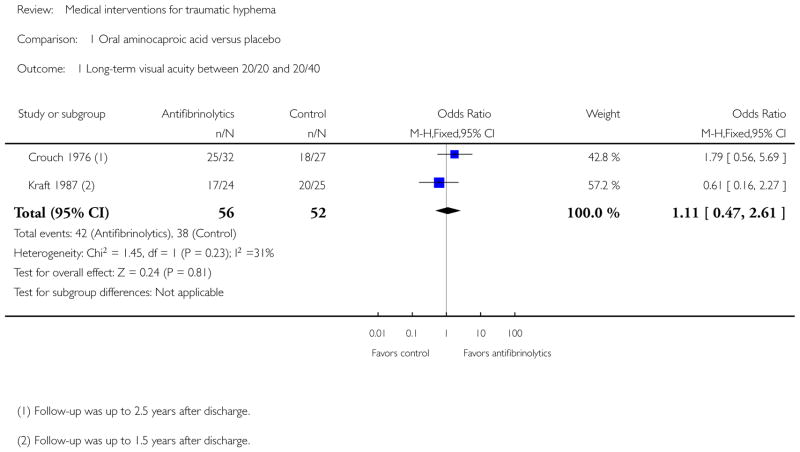
Analysis 1.1
Analysis 1.1
Comparison 1 Oral aminocaproic acid versus placebo, Outcome 1 Long-term visual acuity between 20/20 and 20/40.
Analysis 1.2
Analysis 1.2
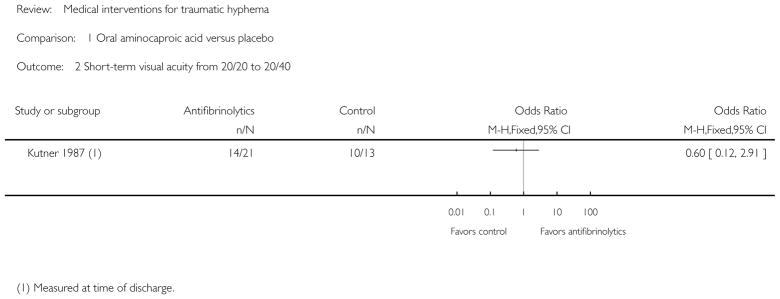
Comparison 1 Oral aminocaproic acid versus placebo, Outcome 2 Short-term visual acuity from 20/20 to 20/40.
Analysis 1.3
Analysis 1.3
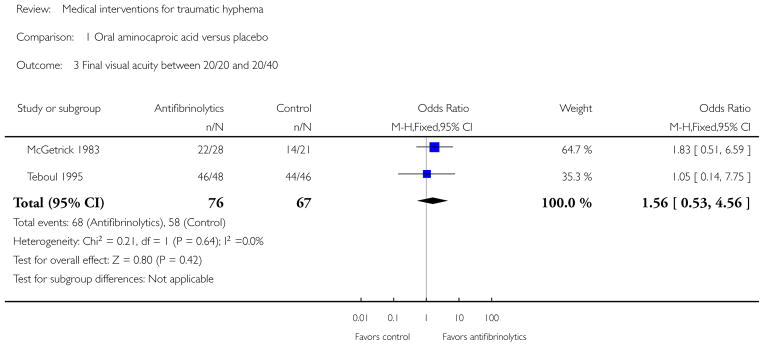
Comparison 1 Oral aminocaproic acid versus placebo, Outcome 3 Final visual acuity between 20/20 and 20/40.
Analysis 1.4
Analysis 1.4
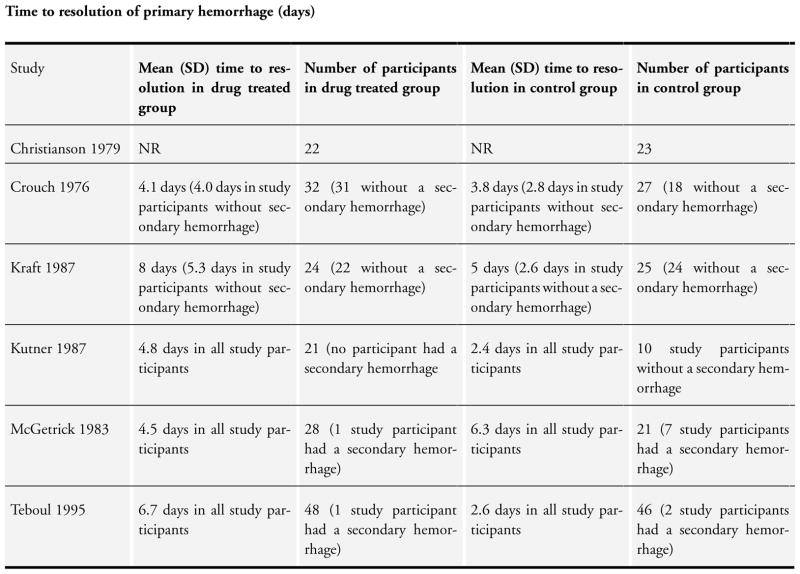
Comparison 1 Oral aminocaproic acid versus placebo, Outcome 4 Time to resolution of primary hemorrhage (days).
Analysis 1.5
Analysis 1.5
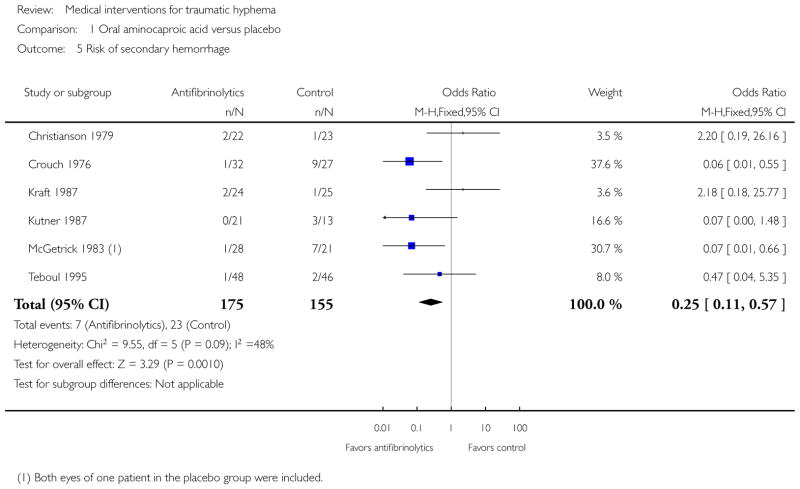
Comparison 1 Oral aminocaproic acid versus placebo, Outcome 5 Risk of secondary hemorrhage.
Analysis 1.6
Analysis 1.6
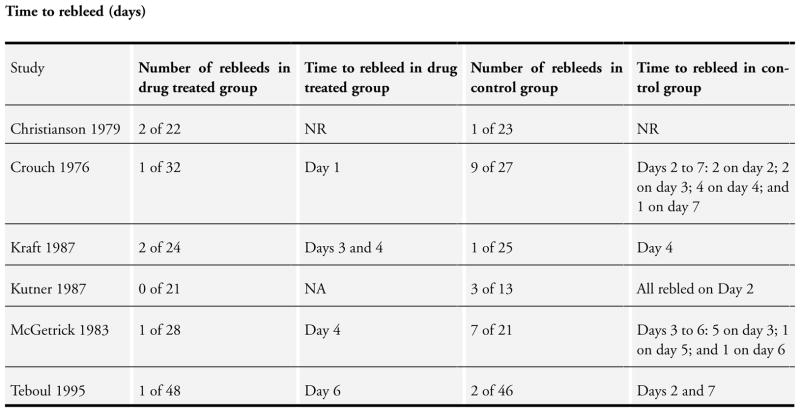
Comparison 1 Oral aminocaproic acid versus placebo, Outcome 6 Time to rebleed (days).
Analysis 1.7
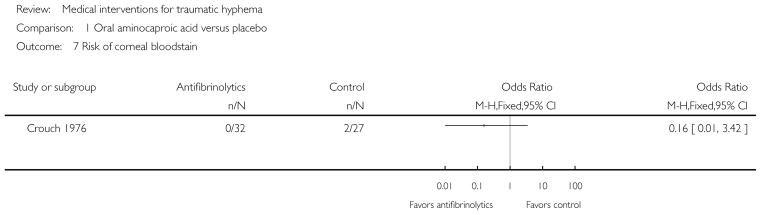
Analysis 1.7
Comparison 1 Oral aminocaproic acid versus placebo, Outcome 7 Risk of corneal blood stain.
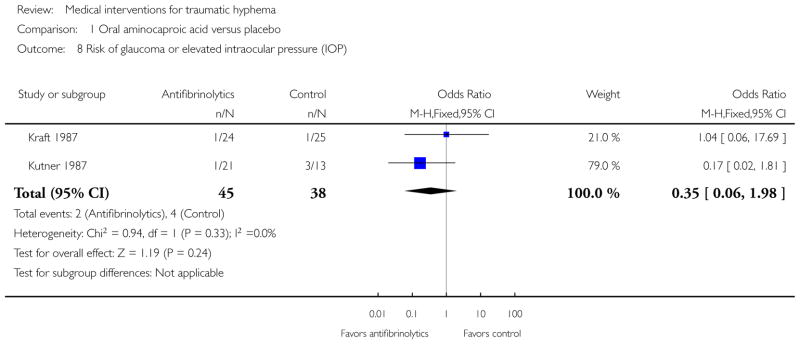
Analysis 1.8
Analysis 1.8
Comparison 1 Oral aminocaproic acid versus placebo, Outcome 8 Risk of glaucoma or elevated intraocular pressure (IOP).
Analysis 1.9
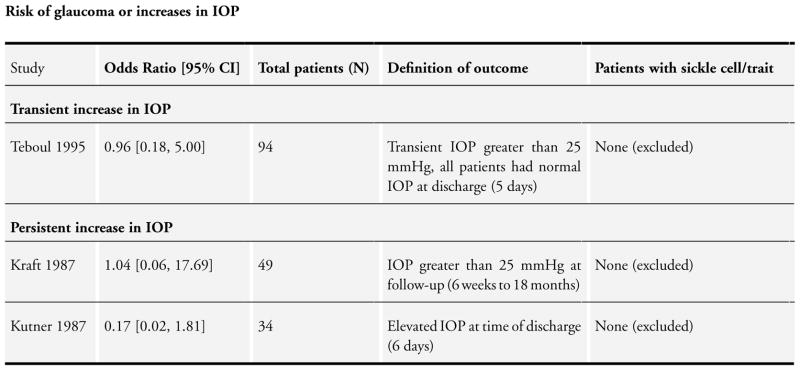
Analysis 1.9
Comparison 1 Oral aminocaproic acid versus placebo, Outcome 9 Risk of glaucoma or increases in IOP.
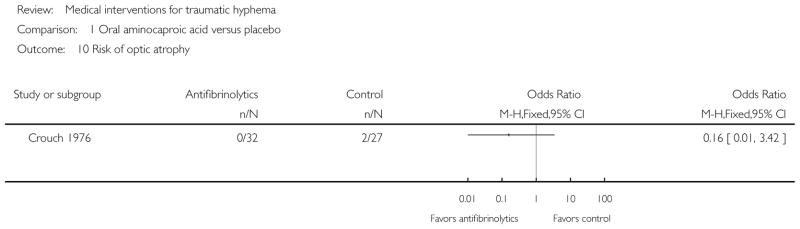
Analysis 1.10
Analysis 1.10
Comparison 1 Oral aminocaproic acid versus placebo, Outcome 10 Risk of optic atrophy.
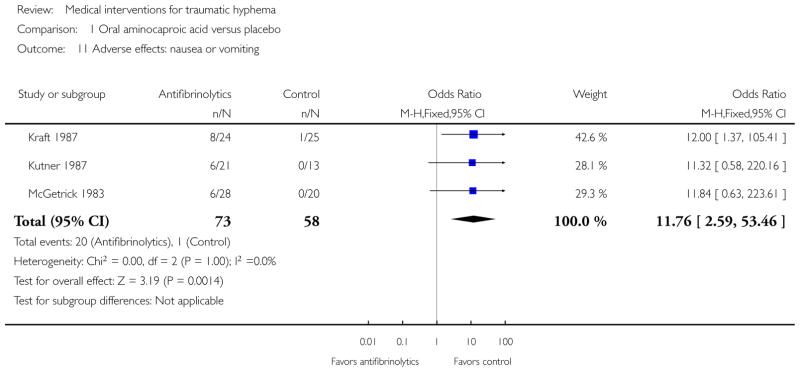
Analysis 1.11
Analysis 1.11
Comparison 1 Oral aminocaproic acid versus placebo, Outcome 11 Adverse effects: nausea or vomiting.
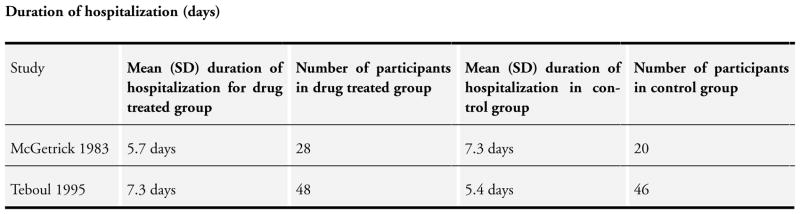
Analysis 1.12
Analysis 1.12
Comparison 1 Oral aminocaproic acid versus placebo, Outcome 12 Duration of hospitalization (days).
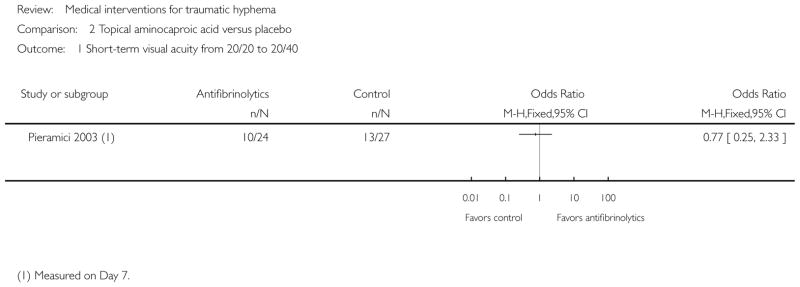
Analysis 2.1
Analysis 2.1
Comparison 2 Topical aminocaproic acid versus placebo, Outcome 1 Short-term visual acuity from 20/20 to 20/40.
Analysis 2.2
Analysis 2.2
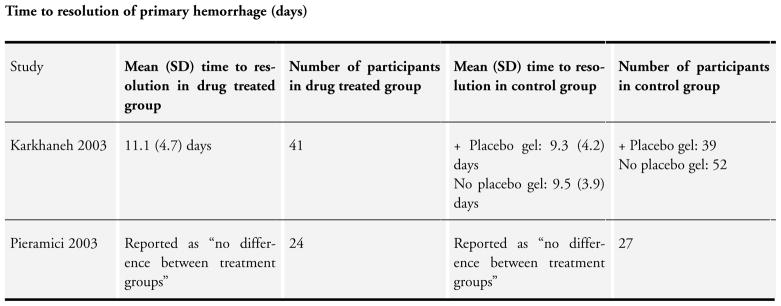
Comparison 2 Topical aminocaproic acid versus placebo, Outcome 2 Time to resolution of primary hemorrhage (days).
Analysis 2.3
Analysis 2.3
Comparison 2 Topical aminocaproic acid versus placebo, Outcome 3 Risk of secondary hemorrhage.
Analysis 2.4
Analysis 2.4
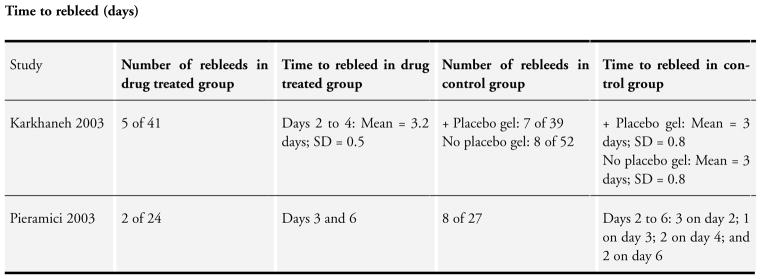
Comparison 2 Topical aminocaproic acid versus placebo, Outcome 4 Time to rebleed (days).
Analysis 2.5
Analysis 2.5
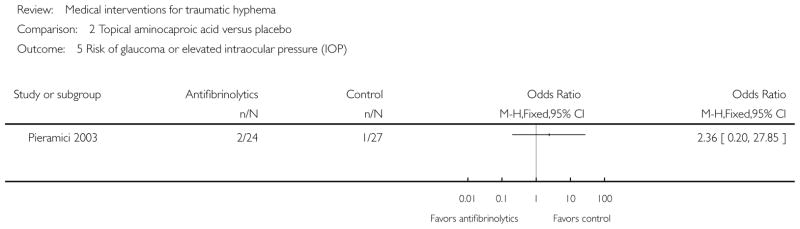
Comparison 2 Topical aminocaproic acid versus placebo, Outcome 5 Risk of glaucoma or elevated intraocular pressure (IOP).
Analysis 3.1
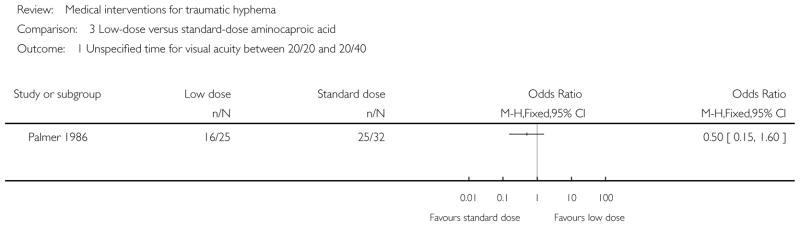
Analysis 3.1
Comparison 3 Low-dose versus standard-dose aminocaproic acid, Outcome 1 Unspecified time for visual acuity between 20/20 and 20/40.
Analysis 3.2
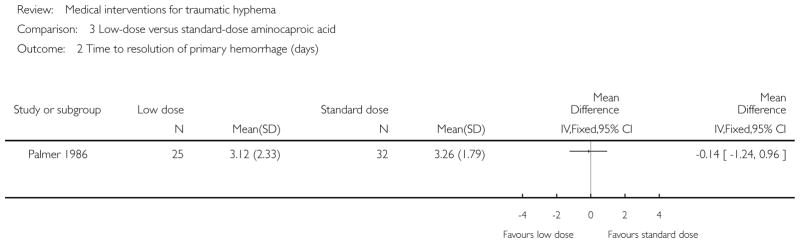
Analysis 3.2
Comparison 3 Low-dose versus standard-dose aminocaproic acid, Outcome 2 Time to resolution of primary hemorrhage (days).
Analysis 3.3
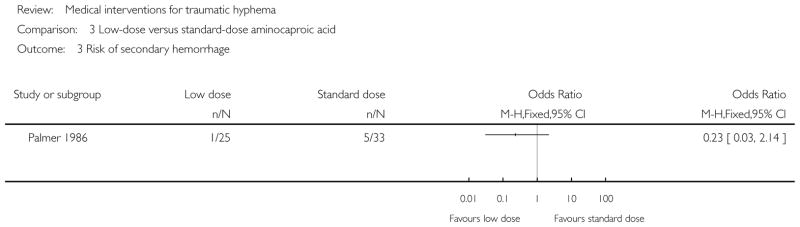
Analysis 3.3
Comparison 3 Low-dose versus standard-dose aminocaproic acid, Outcome 3 Risk of secondary hemorrhage.
Analysis 3.4
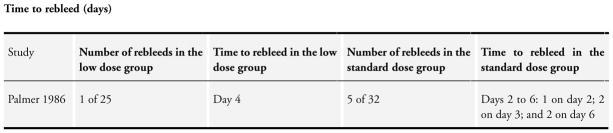
Analysis 3.4
Comparison 3 Low-dose versus standard-dose aminocaproic acid, Outcome 4 Time to rebleed (days).
Analysis 3.5
Analysis 3.5
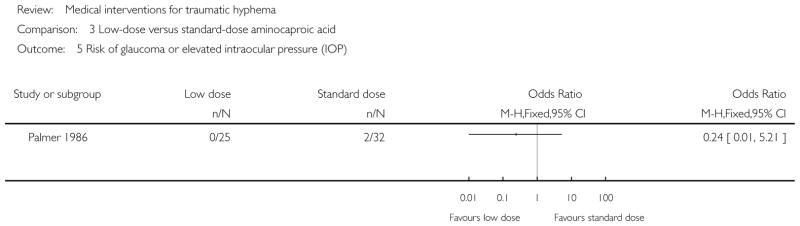
Comparison 3 Low-dose versus standard-dose aminocaproic acid, Outcome 5 Risk of glaucoma or elevated intraocular pressure (IOP).
Analysis 3.6
Analysis 3.6
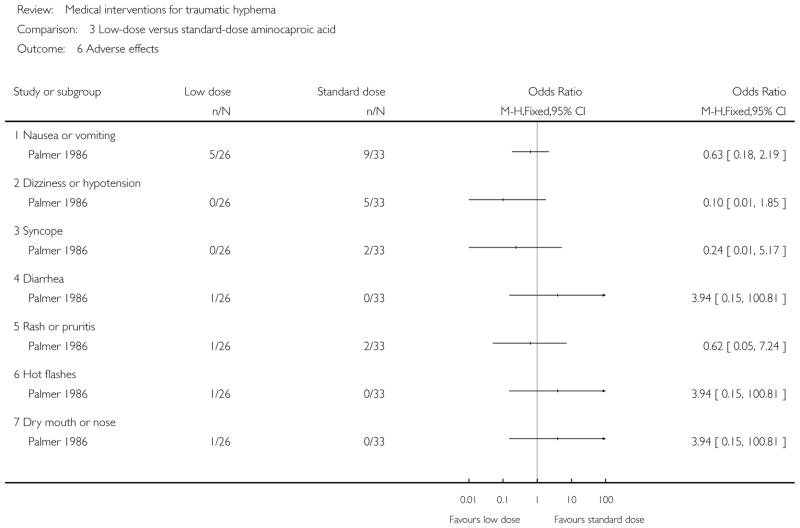
Comparison 3 Low-dose versus standard-dose aminocaproic acid, Outcome 6 Adverse effects.
Analysis 3.7
Analysis 3.7
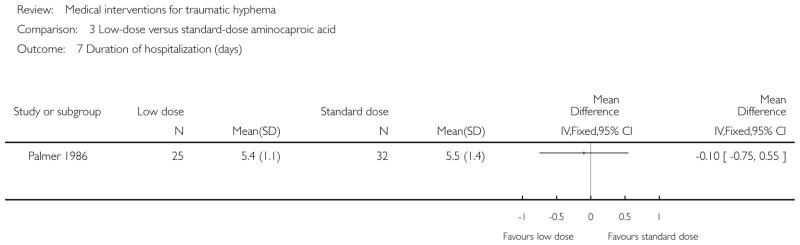
Comparison 3 Low-dose versus standard-dose aminocaproic acid, Outcome 7 Duration of hospitalization (days).
Analysis 4.1
Analysis 4.1
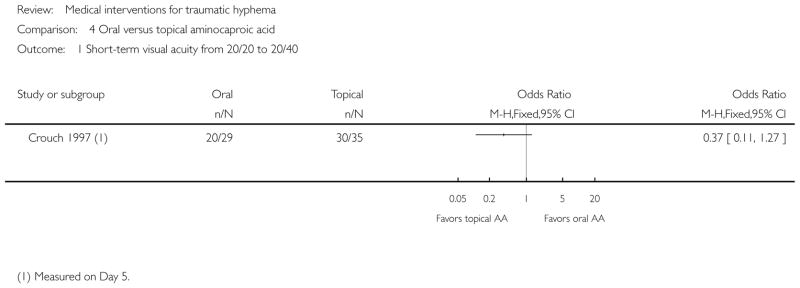
Comparison 4 Oral versus topical aminocaproic acid, Outcome 1 Short-term visual acuity from 20/20 to 20/40.
Analysis 4.2
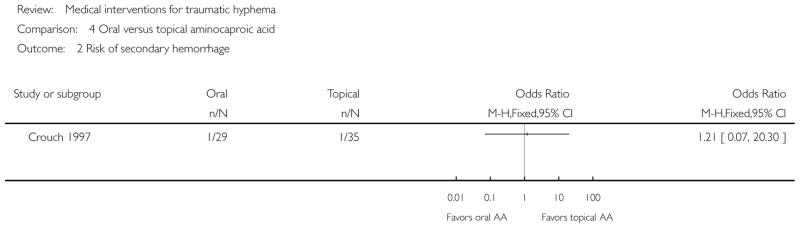
Analysis 4.2
Comparison 4 Oral versus topical aminocaproic acid, Outcome 2 Risk of secondary hemorrhage.
Analysis 4.3
Analysis 4.3
Comparison 4 Oral versus topical aminocaproic acid, Outcome 3 Time to rebleed (days).
Analysis 4.4
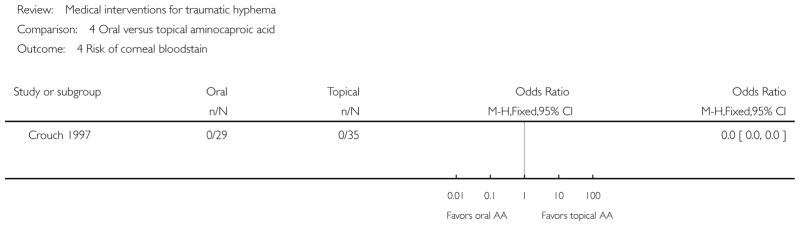
Analysis 4.4
Comparison 4 Oral versus topical aminocaproic acid, Outcome 4 Risk of corneal blood stain.
Analysis 4.5
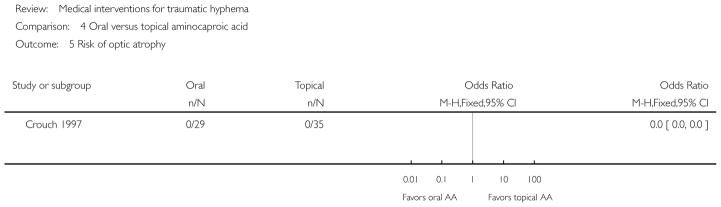
Analysis 4.5
Comparison 4 Oral versus topical aminocaproic acid, Outcome 5 Risk of optic atrophy.
Analysis 4.6
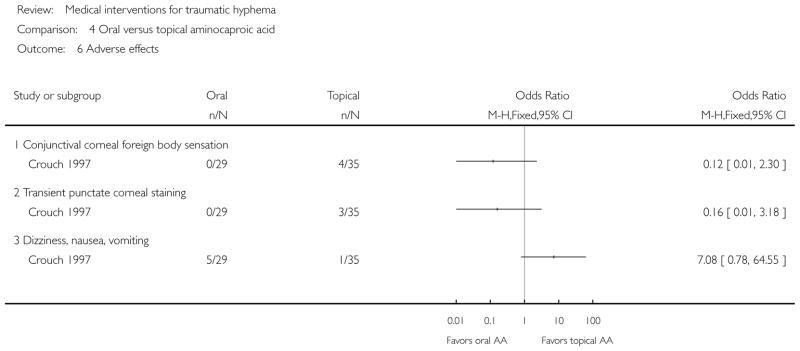
Analysis 4.6
Comparison 4 Oral versus topical aminocaproic acid, Outcome 6 Adverse effects.
Analysis 5.1
Analysis 5.1
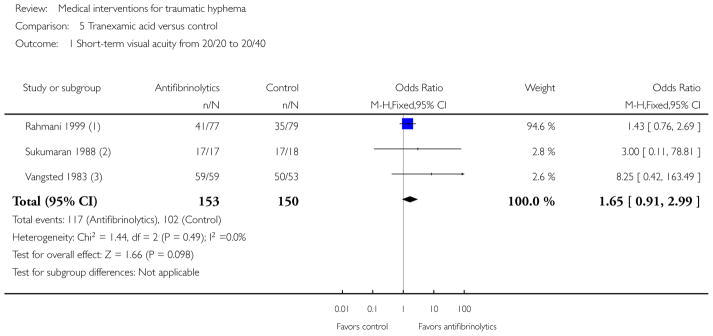
Comparison 5 Tranexamic acid versus control, Outcome 1 Short-term visual acuity from 20/20 to 20/40.
Analysis 5.2
Analysis 5.2
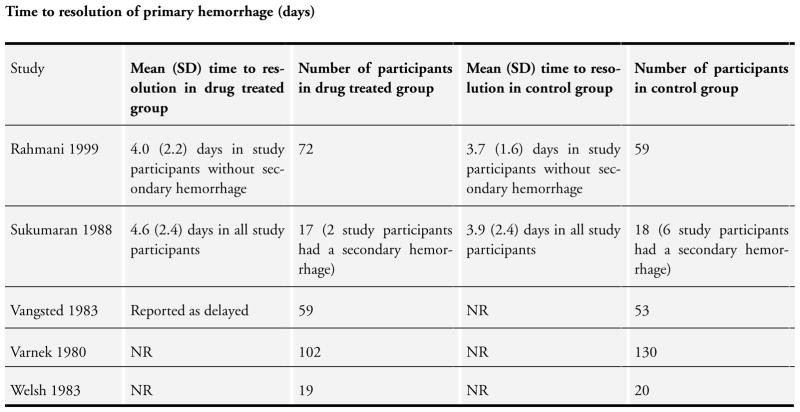
Comparison 5 Tranexamic acid versus control, Outcome 2 Time to resolution of primary hemorrhage (days).
Analysis 5.3
Analysis 5.3
Comparison 5 Tranexamic acid versus control, Outcome 3 Risk of secondary hemorrhage.
Analysis 5.4
Analysis 5.4
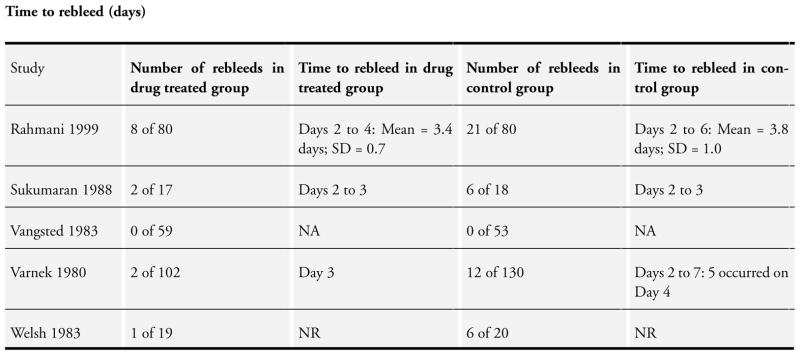
Comparison 5 Tranexamic acid versus control, Outcome 4 Time to rebleed (days).
Analysis 5.5
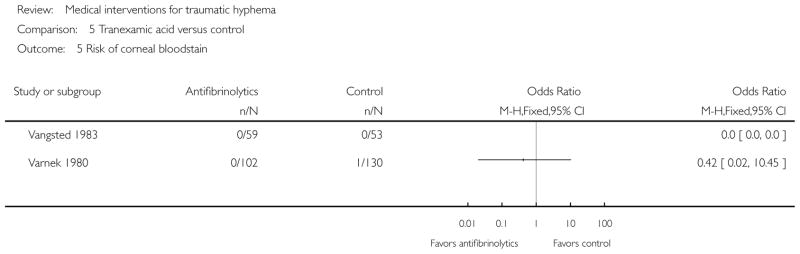
Analysis 5.5
Comparison 5 Tranexamic acid versus control, Outcome 5 Risk of corneal blood stain.
Analysis 5.6
Analysis 5.6
Comparison 5 Tranexamic acid versus control, Outcome 6 Risk of glaucoma or elevated intraocular pressure (IOP).
Analysis 5.7
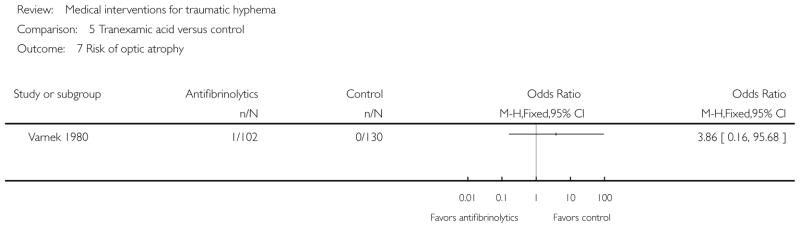
Analysis 5.7
Comparison 5 Tranexamic acid versus control, Outcome 7 Risk of optic atrophy.
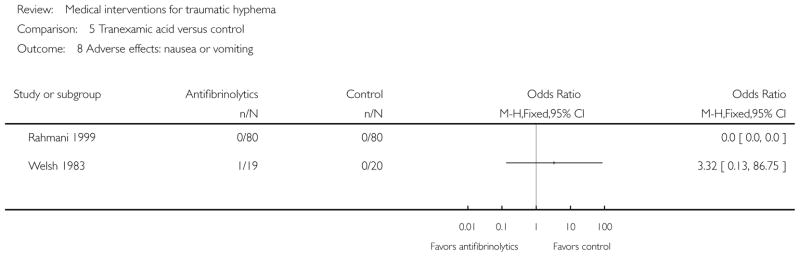
Analysis 5.8
Analysis 5.8
Comparison 5 Tranexamic acid versus control, Outcome 8 Adverse effects: nausea or vomiting.
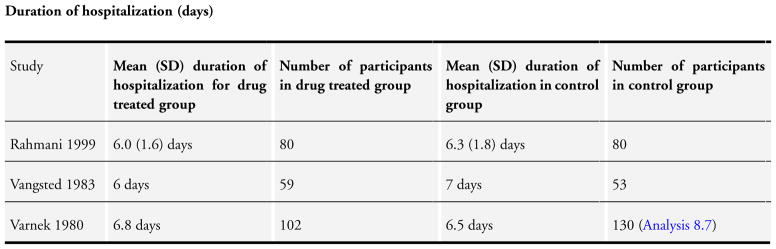
Analysis 5.9
Analysis 5.9
Comparison 5 Tranexamic acid versus control, Outcome 9 Duration of hospitalization (days).
Analysis 6.1
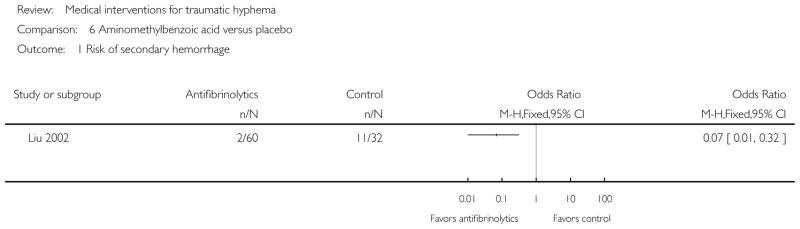
Analysis 6.1
Comparison 6 Aminomethylbenzoic acid versus placebo, Outcome 1 Risk of secondary hemorrhage.
Analysis 7.1
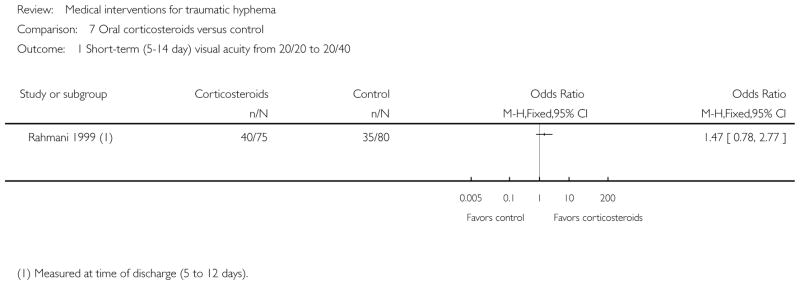
Analysis 7.1
Comparison 7 Oral corticosteroids versus control, Outcome 1 Short-term (5–14 day) visual acuity from 20/20 to 20/40.
Analysis 7.2
Analysis 7.2
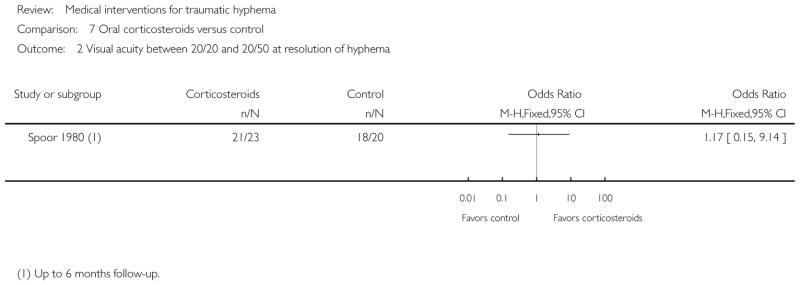
Comparison 7 Oral corticosteroids versus control, Outcome 2 Visual acuity between 20/20 and 20/50 at resolution of hyphema.
Analysis 7.3
Analysis 7.3
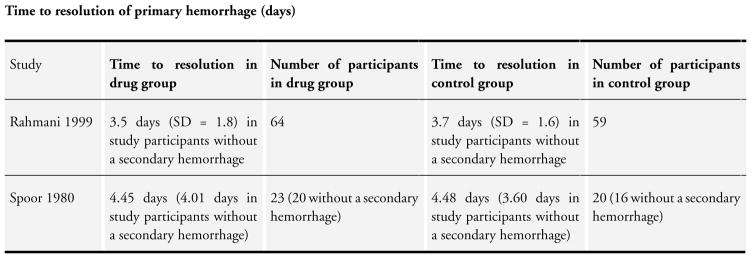
Comparison 7 Oral corticosteroids versus control, Outcome 3 Time to resolution of primary hemorrhage (days).
Analysis 7.4
Analysis 7.4
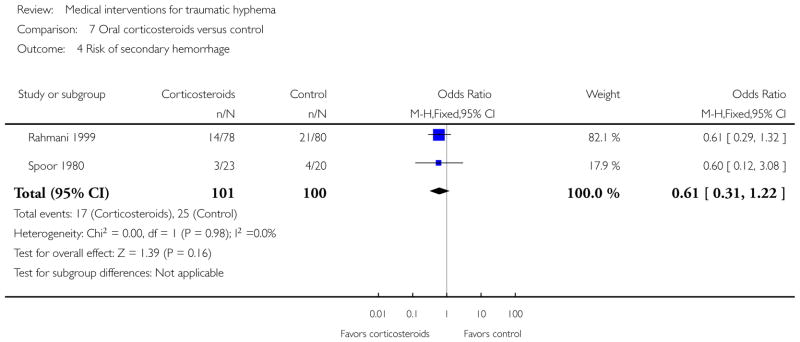
Comparison 7 Oral corticosteroids versus control, Outcome 4 Risk of secondary hemorrhage.
Analysis 7.5
Analysis 7.5
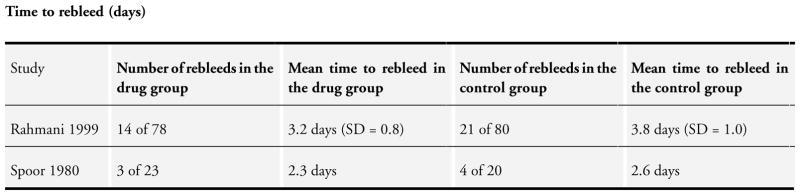
Comparison 7 Oral corticosteroids versus control, Outcome 5 Time to rebleed (days).
Analysis 7.6
Analysis 7.6
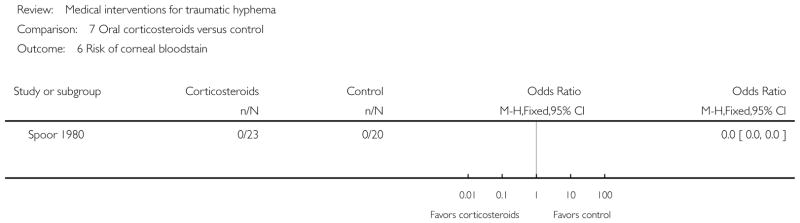
Comparison 7 Oral corticosteroids versus control, Outcome 6 Risk of corneal blood stain.
Analysis 7.7
Analysis 7.7
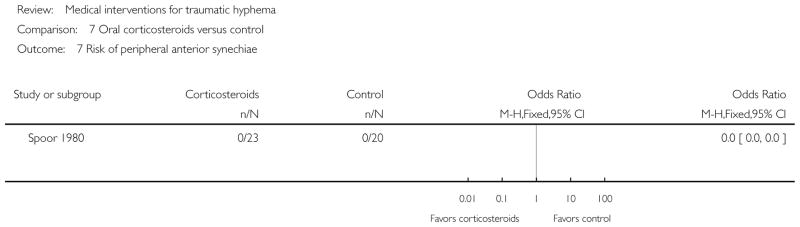
Comparison 7 Oral corticosteroids versus control, Outcome 7 Risk of peripheral anterior synechiae.
Analysis 7.8
Analysis 7.8
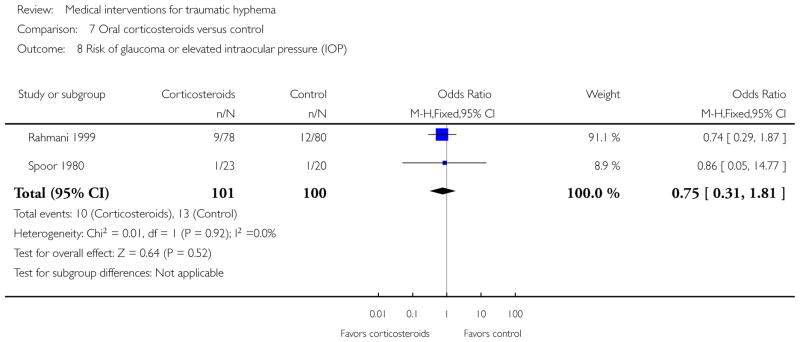
Comparison 7 Oral corticosteroids versus control, Outcome 8 Risk of glaucoma or elevated intraocular pressure (IOP).
Analysis 7.9
Analysis 7.9
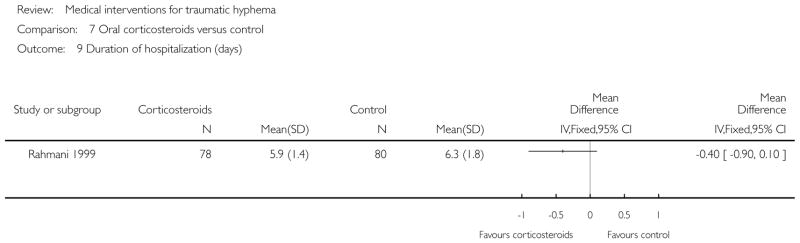
Comparison 7 Oral corticosteroids versus control, Outcome 9 Duration of hospitalization (days).
Analysis 8.1
Analysis 8.1
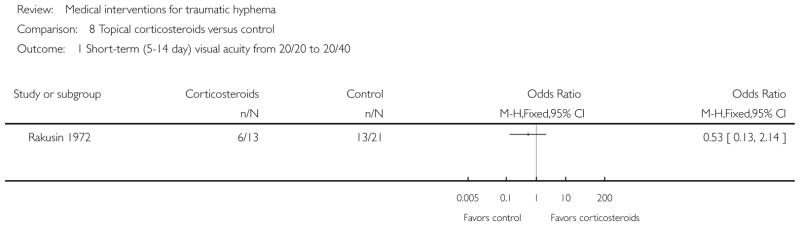
Comparison 8 Topical corticosteroids versus control, Outcome 1 Short-term (5–14 day) visual acuity from 20/20 to 20/40.
Analysis 8.2
Analysis 8.2
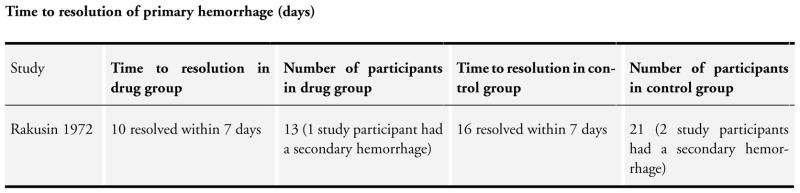
Comparison 8 Topical corticosteroids versus control, Outcome 2 Time to resolution of primary hemorrhage (days).
Analysis 8.3
Analysis 8.3
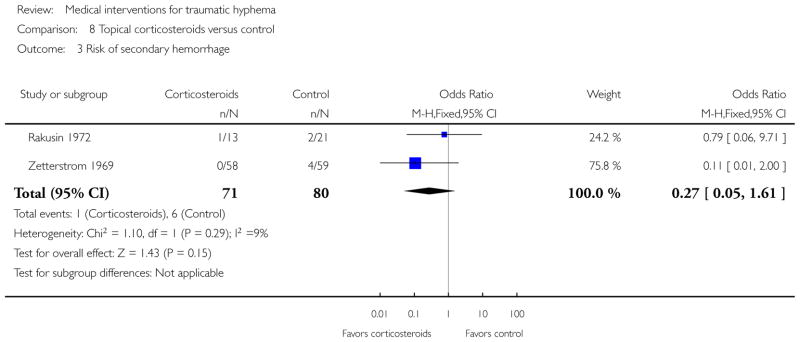
Comparison 8 Topical corticosteroids versus control, Outcome 3 Risk of secondary hemorrhage.
Analysis 8.4
Analysis 8.4
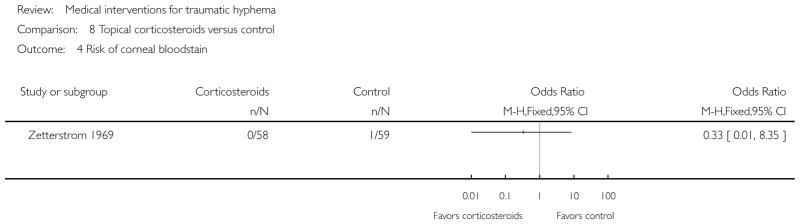
Comparison 8 Topical corticosteroids versus control, Outcome 4 Risk of corneal blood stain.
Analysis 8.5
Analysis 8.5
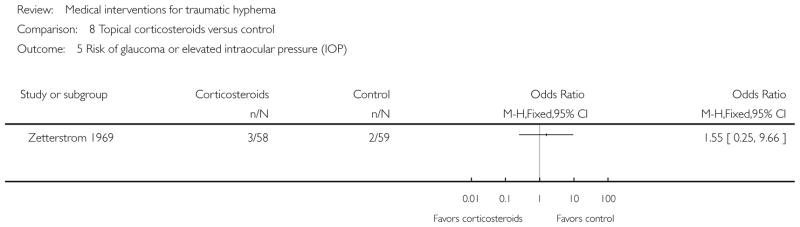
Comparison 8 Topical corticosteroids versus control, Outcome 5 Risk of glaucoma or elevated intraocular pressure (IOP).
Analysis 8.6
Analysis 8.6
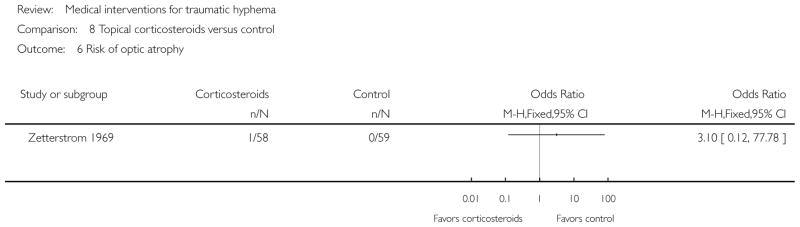
Comparison 8 Topical corticosteroids versus control, Outcome 6 Risk of optic atrophy.
Analysis 8.7
Analysis 8.7
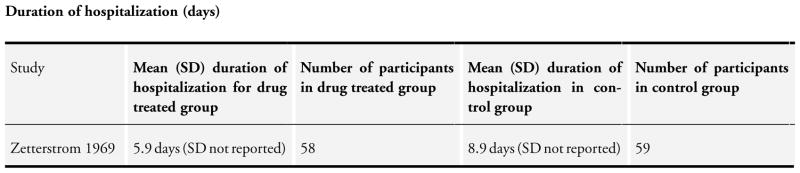
Comparison 8 Topical corticosteroids versus control, Outcome 7 Duration of hospitalization (days).
Analysis 9.1
Analysis 9.1
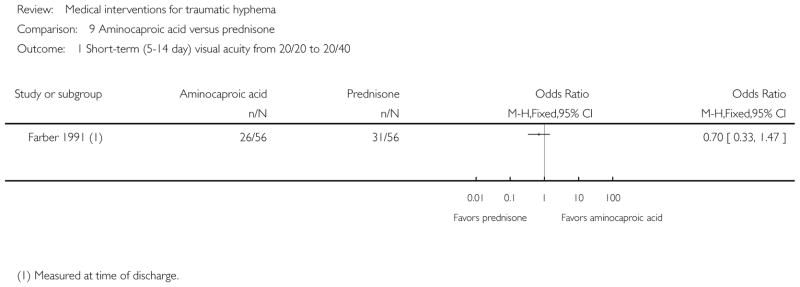
Comparison 9 Aminocaproic acid versus prednisone, Outcome 1 Short-term (5–14 day) visual acuity from 20/20 to 20/40.
Analysis 9.2
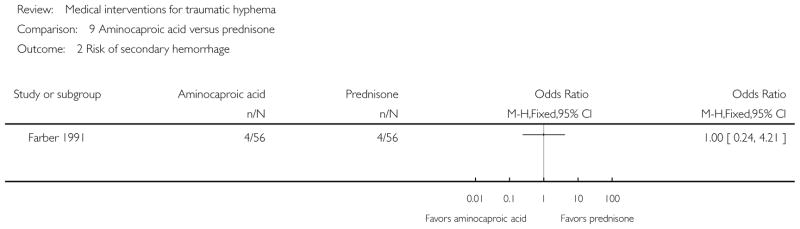
Analysis 9.2
Comparison 9 Aminocaproic acid versus prednisone, Outcome 2 Risk of secondary hemorrhage.
Analysis 9.3
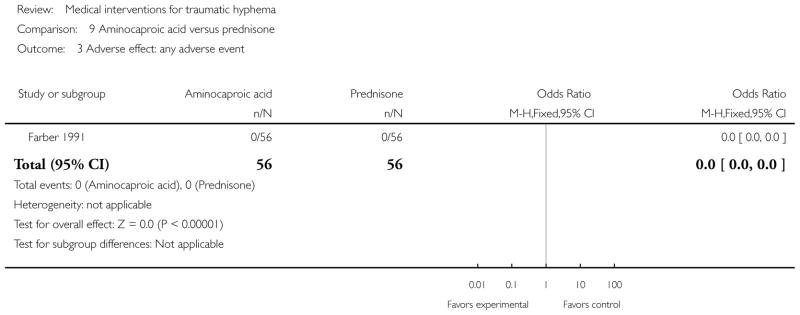
Analysis 9.3
Comparison 9 Aminocaproic acid versus prednisone, Outcome 3 Adverse effect: any adverse event.
Analysis 10.1
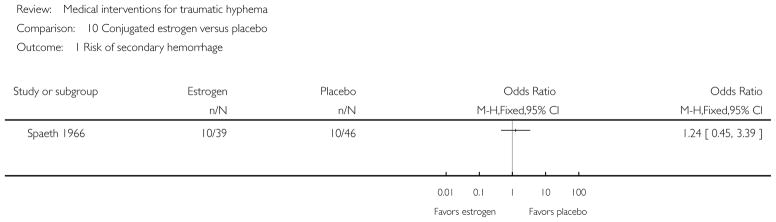
Analysis 10.1
Comparison 10 Conjugated estrogen versus placebo, Outcome 1 Risk of secondary hemorrhage.
Analysis 10.2
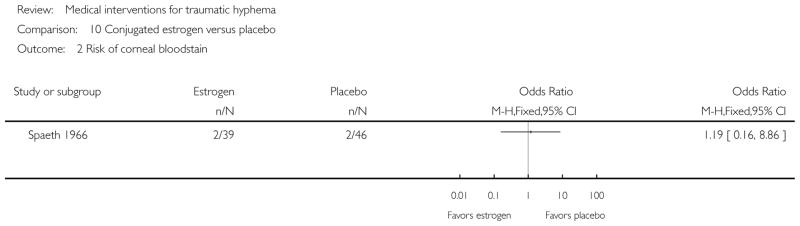
Analysis 10.2
Comparison 10 Conjugated estrogen versus placebo, Outcome 2 Risk of corneal blood stain.
Analysis 11.1
Analysis 11.1
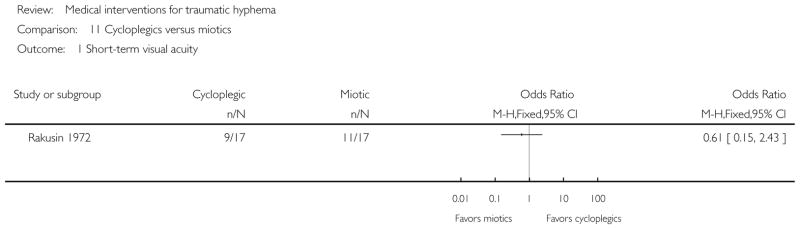
Comparison 11 Cycloplegics versus miotics, Outcome 1 Short-term visual acuity.
Analysis 11.2
Analysis 11.2
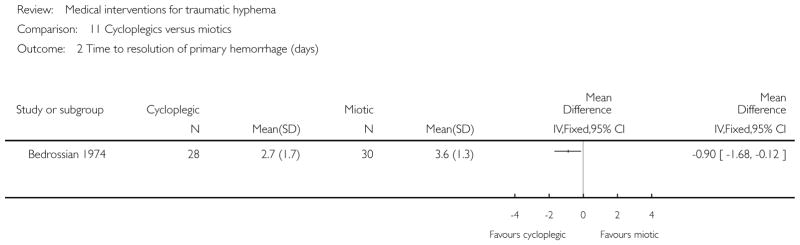
Comparison 11 Cycloplegics versus miotics, Outcome 2 Time to resolution of primary hemorrhage (days).
Analysis 11.3
Analysis 11.3
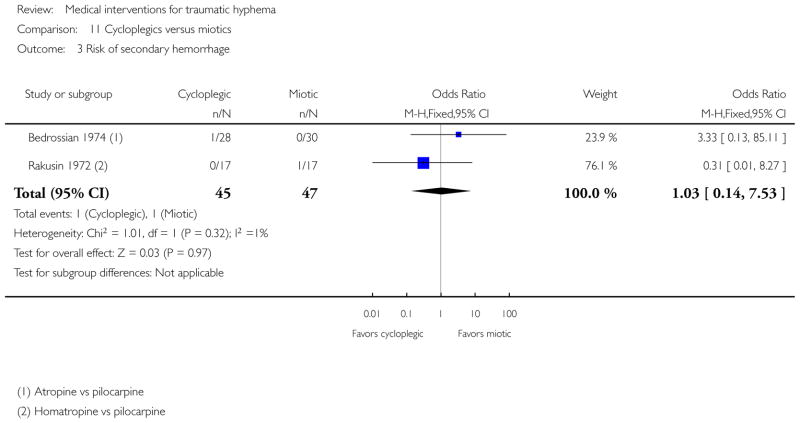
Comparison 11 Cycloplegics versus miotics, Outcome 3 Risk of secondary hemorrhage.
Analysis 11.4
Analysis 11.4
Comparison 11 Cycloplegics versus miotics, Outcome 4 Time to rebleed (days).
Analysis 12.1
Analysis 12.1
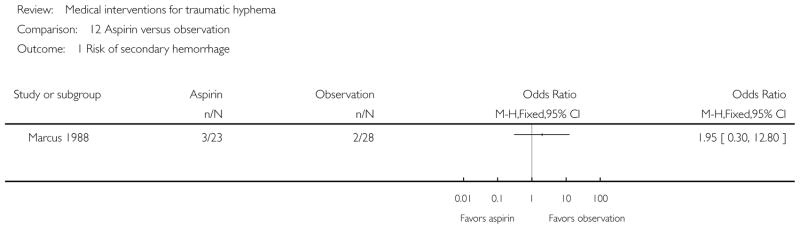
Comparison 12 Aspirin versus observation, Outcome 1 Risk of secondary hemorrhage.
Analysis 13.1
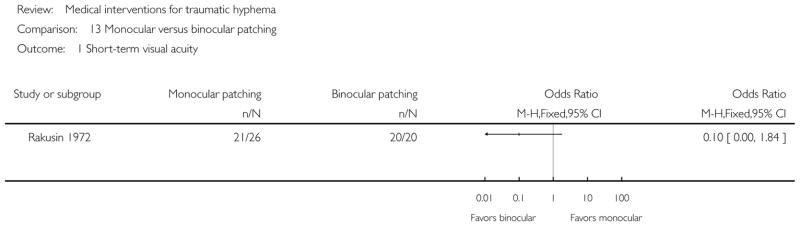
Analysis 13.1
Comparison 13 Monocular versus binocular patching, Outcome 1 Short-term visual acuity.
Analysis 13.2
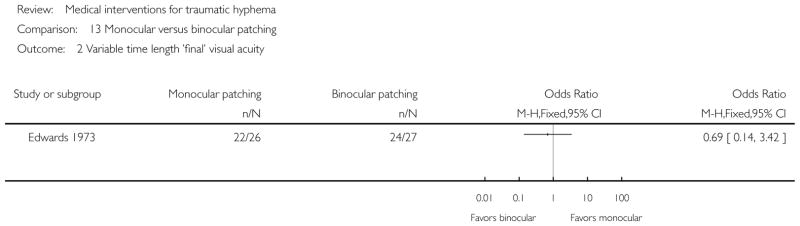
Analysis 13.2
Comparison 13 Monocular versus binocular patching, Outcome 2 Variable time length ’final’ visual acuity.
Analysis 13.3
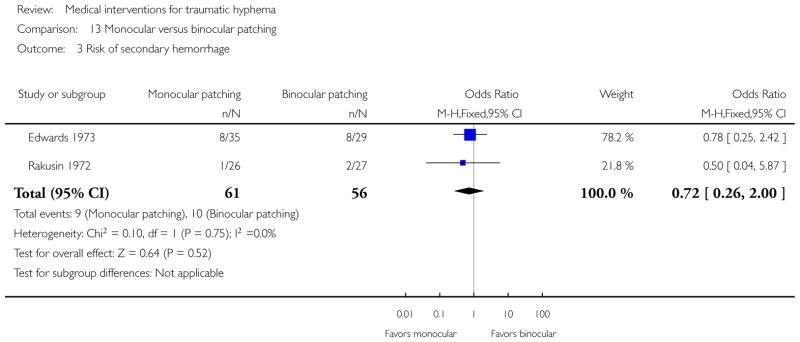
Analysis 13.3
Comparison 13 Monocular versus binocular patching, Outcome 3 Risk of secondary hemorrhage.
Analysis 13.4
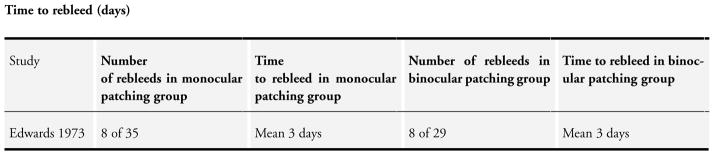
Analysis 13.4
Comparison 13 Monocular versus binocular patching, Outcome 4 Time to rebleed (days).
Analysis 13.5
Analysis 13.5
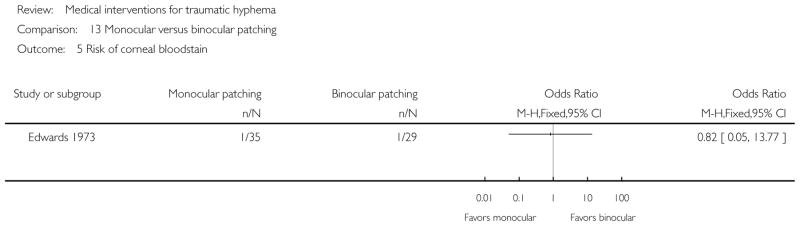
Comparison 13 Monocular versus binocular patching, Outcome 5 Risk of corneal blood stain.
Analysis 13.6
Analysis 13.6
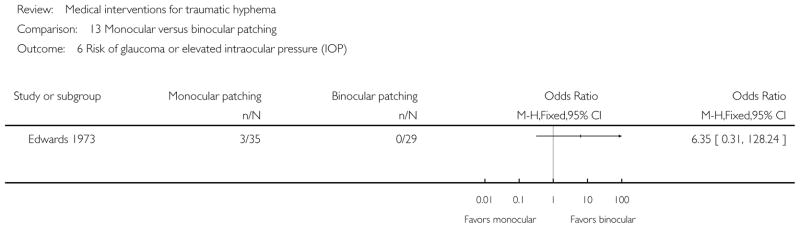
Comparison 13 Monocular versus binocular patching, Outcome 6 Risk of glaucoma or elevated intraocular pressure (IOP).
Analysis 14.1
Analysis 14.1
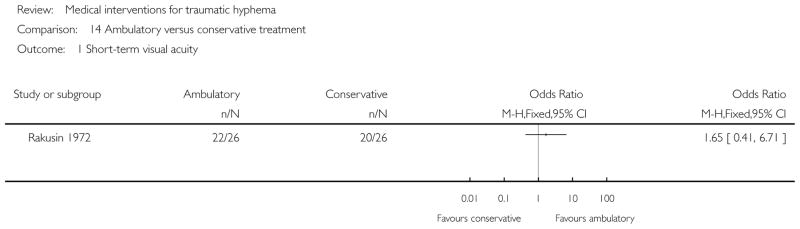
Comparison 14 Ambulatory versus conservative treatment, Outcome 1 Short-term visual acuity.
Analysis 14.2
Analysis 14.2
Comparison 14 Ambulatory versus conservative treatment, Outcome 2 Time to resolution of primary hemorrhage.
Analysis 14.3
Analysis 14.3
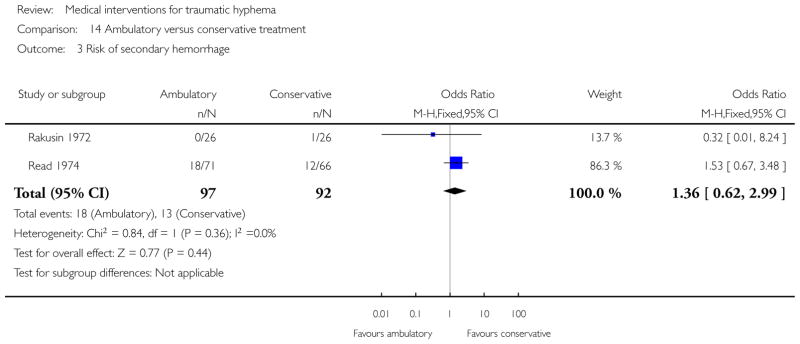
Comparison 14 Ambulatory versus conservative treatment, Outcome 3 Risk of secondary hemorrhage.
Analysis 14.4
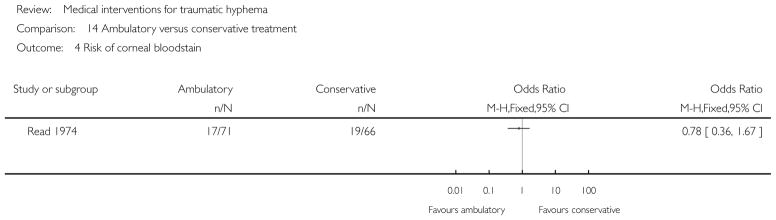
Analysis 14.4
Comparison 14 Ambulatory versus conservative treatment, Outcome 4 Risk of corneal blood stain.
Analysis 14.5
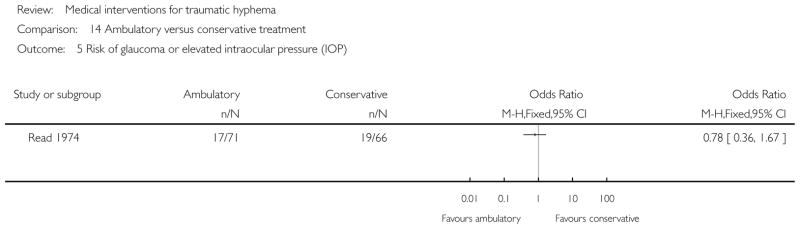
Analysis 14.5
Comparison 14 Ambulatory versus conservative treatment, Outcome 5 Risk of glaucoma or elevated intraocular pressure (IOP).
Figure 1
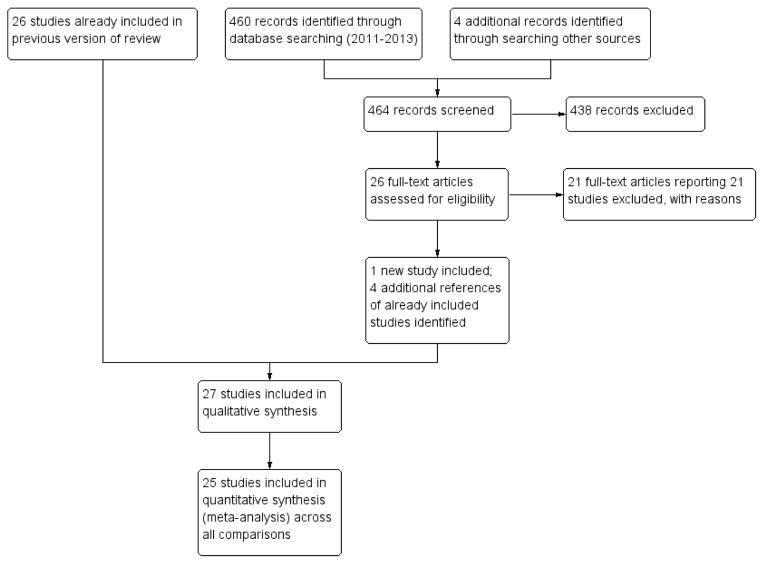
Figure 1
Study flow diagram for 2013 update of literature searches.
Figure 2
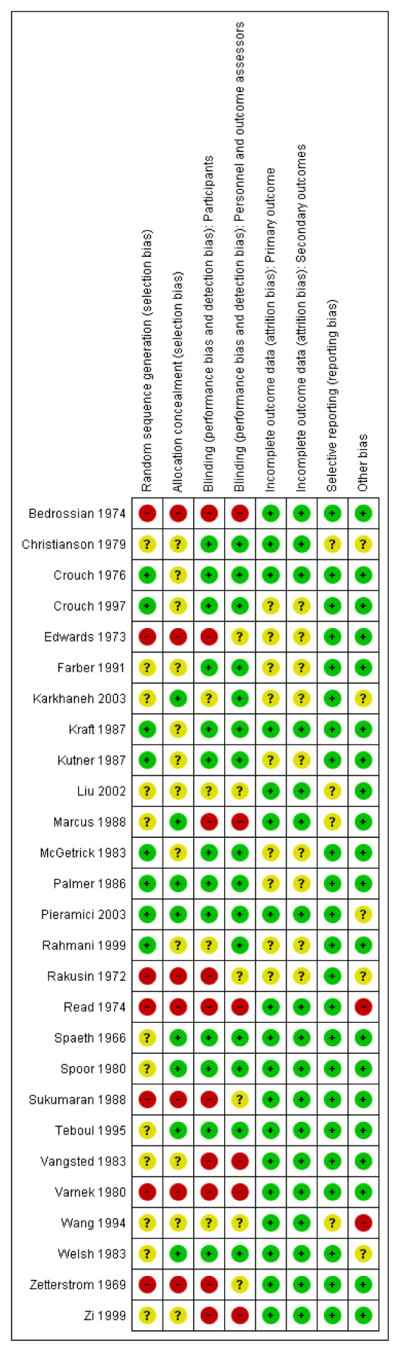
Figure 2
Methodologic quality summary: review authors’ judgments about each methodologic quality item for each included study. Green: low risk of bias; red: high risk of bias; yellow: unclear risk of bias.
Figure 3
Figure 3
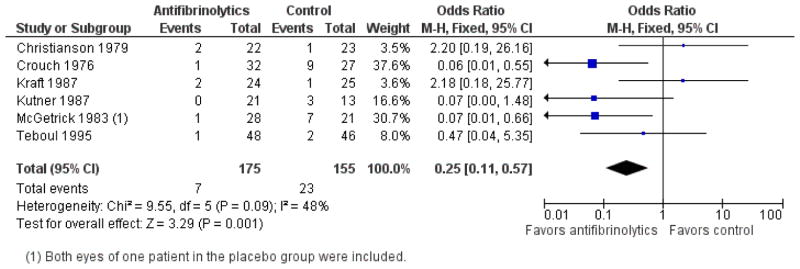
Forest plot of comparison: 1 Oral aminocaproic acid versus placebo, outcome: 1.5 Secondary hemorrhage.
Figure 4
Figure 4
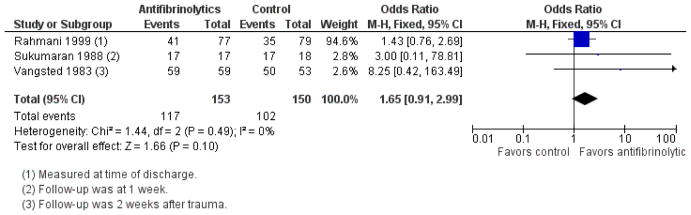
Forest plot of comparison: 5 Tranexamic acid versus control, outcome: 5.1 Short-term visual acuity from 20/20 to 20/40.
Figure 5
Figure 5
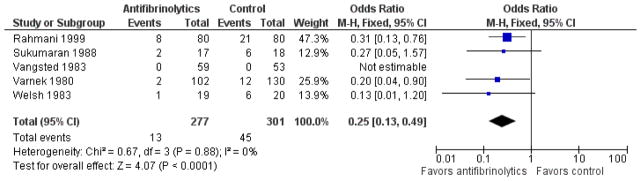
Forest plot of comparison: 5 Tranexamic acid versus control, outcome: 5.3 Secondary hemorrhage.
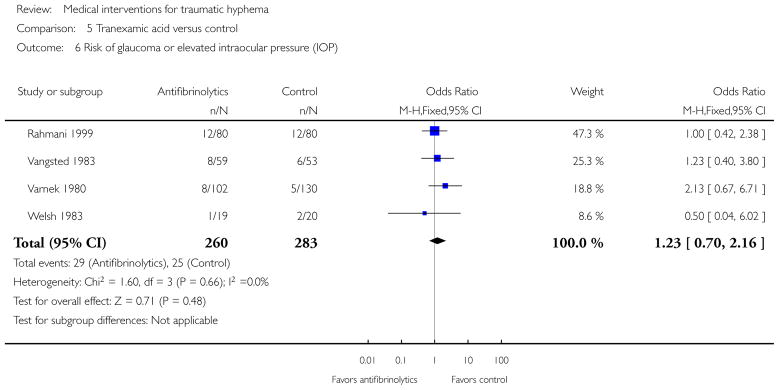
Figure 6
Figure 6
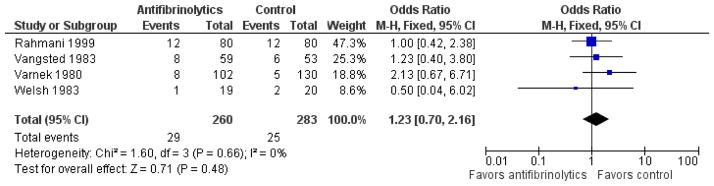
Forest plot of comparison: 5 Tranexamic acid versus control, outcome: 5.6 Incidence of glaucoma or increased intraocular pressure (IOP).

Update of

References

References to studies included in this review

    1. Bedrossian RH. The management of traumatic hyphema. Annals of Ophthalmology. 1974;6(10):1016–8. - PubMed
    1. Christianson MD, Crawford JS. Epsilon aminocaproic acid in the treatment of traumatic hyphema. American Journal of Ophthalmology. 1979;88(4):782.
    1. Crouch ER, Jr, Frenkel M. Aminocaproic acid in the treatment of traumatic hyphema. American Journal of Ophthalmology. 1976;81(3):355–60. - PubMed
    1. Crouch ER, Jr, Williams PB, Gray MK, Crouch ER, Chames M. Topical aminocaproic acid in the treatment of traumatic hyphema. Archives of Ophthalmology. 1997;115(9):1106–12. - PubMed
    2. Crouch ER, Williams PB. Topical aminocaproic acid in the treatment of patients with traumatic hyphema - reply. Archives of Ophthalmology. 1998;116(3):395–6. - PubMed
    1. Edwards WC, Layden WE. Monocular versus binocular patching in traumatic hyphema. American Journal of Ophthalmology. 1973;76(3):359–62. - PubMed

References to studies excluded from this review

    1. Amirova EKh, Dubilei OV. Experience in the use of streptodecase in the treatment of intraocular hemorrhage. Vestnik Oftalmologii. 1991;107(6):34–6. - PubMed
    1. Anderson TW. Treatment of hyphema with atropinization of contralateral eye. Eye, Ear, Nose & Throat Monthly. 1971;50(7):266–7. - PubMed
    1. Berrios RR, Dreyer EB. Traumatic hyphema. International Ophthalmology Clinics. 1995;35(1):93–103. - PubMed
    1. Bramsen T. Traumatic eye hemorrhage (hyphema) treated with the antifibrinolytic preparation tranexamic acid. Ugeskrift for Laeger. 1977;139(24):1422–4. - PubMed
    1. Bramsen T. The influence of antifibrinolytica on traumatic hyphaema and corneal oedema. Acta Ophthalmologica -Supplementum. 1980;(145):1–53. - PubMed

Additional references

    1. Crouch ER, Jr, Williams PB. Trauma: Ruptures and Bleeding. In: Tasman W, Jaeger EM, editors. Duane’s Clinical Ophthalmology. Vol. 4. Philadelphia, PA: JB Lippincott; 1993. pp. 1–18.
    1. Crouch ER, Jr, Crouch ER. Management of traumatic hyphema: therapeutic options. Journal of Pediatric Ophthalmology and Strabismus. 1999;36(5):238. - PubMed
    1. Deeks JJ, Higgins JPT, Altman DG, Green S, editors. Cochrane Handbook for Systematic Reviews of Interventions Version 5.1.0. The Cochrane Collaboration; 2011. Chapter 9: Analysing data and undertaking meta-analyses. (updated March 2011) Available from www.cochrane-handbook.org.
    1. Goldberg MF. Sickled erythrocytes, hyphema, and secondary glaucoma: I. The diagnosis and treatment of sickled erythrocytes in human hyphemas. Ophthalmic Surgery. 1979;10(4):17–31. - PubMed
    1. Goldberg MF, Dizon R, Moses VK. Sickled erythrocytes, hyphema, and secondary glaucoma: VI. The relationship between intracameral blood cells and aqueous humor pH, PO2, and PCO2. Ophthalmic Surgery. 1979;10(4):78–88. - PubMed
References to other published versions of this review

    1. Gharaibeh A, Savage HI, Scherer RW, Goldberg MF, Lindsley K. Medical interventions for traumatic hyphema. Cochrane Database of Systematic Reviews. 2011;(1) doi: 10.1002/14651858.CD005431.pub2. - DOI - PMC - PubMed
    1. Savage HI, Gharaibeh A-M, Mathew MC, Scherer R. Medical interventions for traumatic hyphema. Cochrane Database of Systematic Reviews. 2005;(3) doi: 10.1002/14651858.CD005431. - DOI - PMC - PubMed

Publication types

MeSH terms