


The multifunctional role of the pallilysin-associated Treponema pallidum protein, Tp0750, in promoting fibrinolysis and extracellular matrix component degradation
- PMID: 24303899
- PMCID: PMC3954913
- DOI: 10.1111/mmi.12482
The multifunctional role of the pallilysin-associated Treponema pallidum protein, Tp0750, in promoting fibrinolysis and extracellular matrix component degradation
Abstract
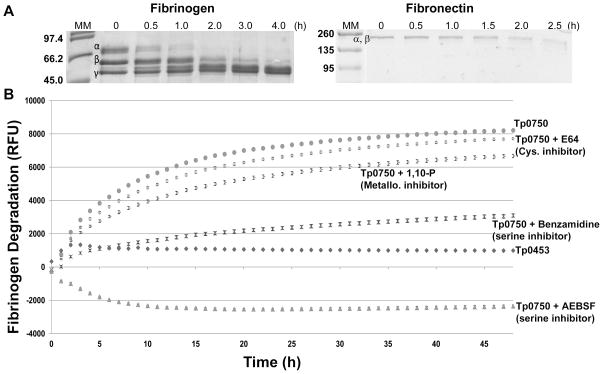
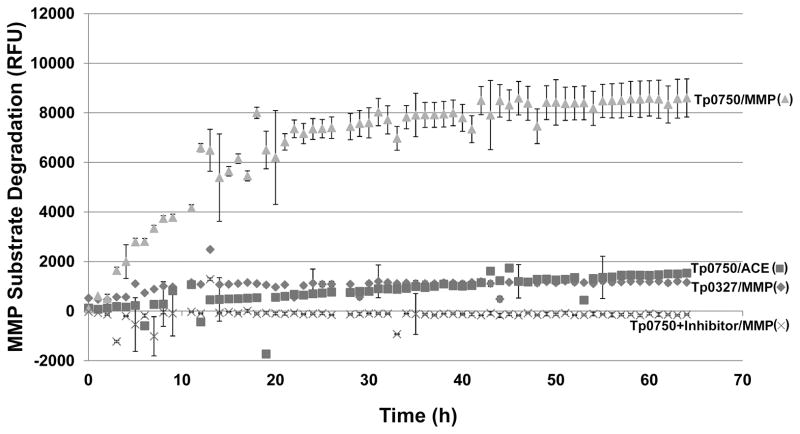
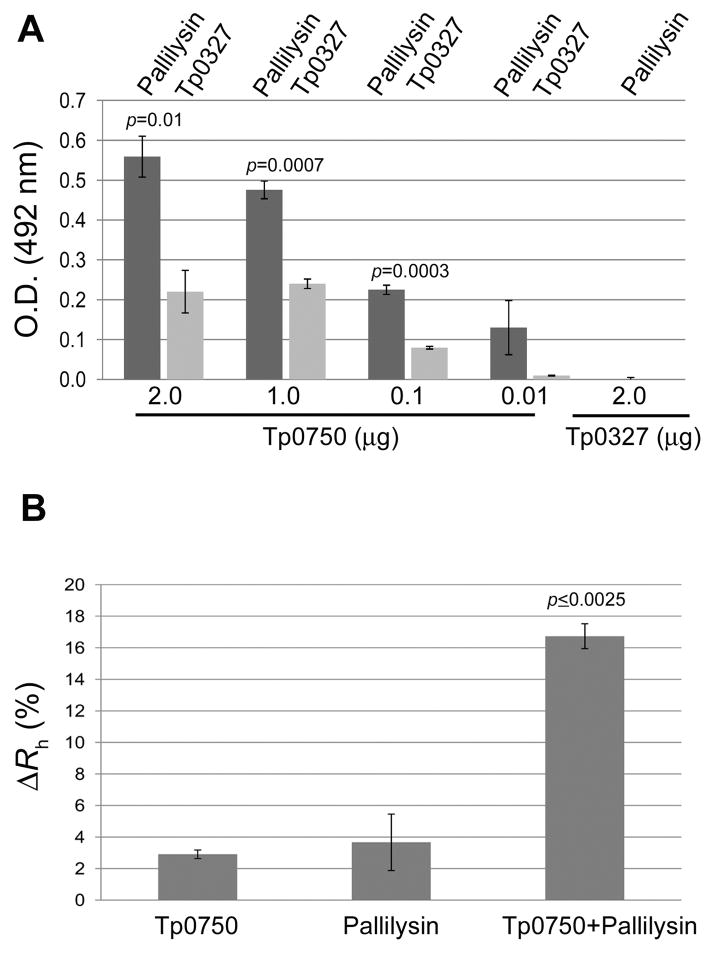
The mechanisms that facilitate dissemination of the highly invasive spirochaete, Treponema pallidum, are incompletely understood. Previous studies showed the treponemal metalloprotease pallilysin (Tp0751) possesses fibrin clot degradation capability, suggesting a role in treponemal dissemination. In the current study we report characterization of the functionally linked protein Tp0750. Structural modelling predicts Tp0750 contains a von Willebrand factor type A (vWFA) domain, a protein-protein interaction domain commonly observed in extracellular matrix (ECM)-binding proteins. We report Tp0750 is a serine protease that degrades the major clot components fibrinogen and fibronectin. We also demonstrate Tp0750 cleaves a matrix metalloprotease (MMP) peptide substrate that is targeted by several MMPs, enzymes central to ECM remodelling. Through proteomic analyses we show Tp0750 binds the endothelial fibrinolytic receptor, annexin A2, in a specific and dose-dependent manner. These results suggest Tp0750 constitutes a multifunctional protein that is able to (1) degrade infection-limiting clots by both inhibiting clot formation through degradation of host coagulation cascade proteins and promoting clot dissolution by complexing with host proteins involved in the fibrinolytic cascade and (2) facilitate ECM degradation via MMP-like proteolysis of host components. We propose that through these activities Tp0750 functions in concert with pallilysin to enable T. pallidum dissemination.
© 2013 John Wiley & Sons Ltd.
Figures
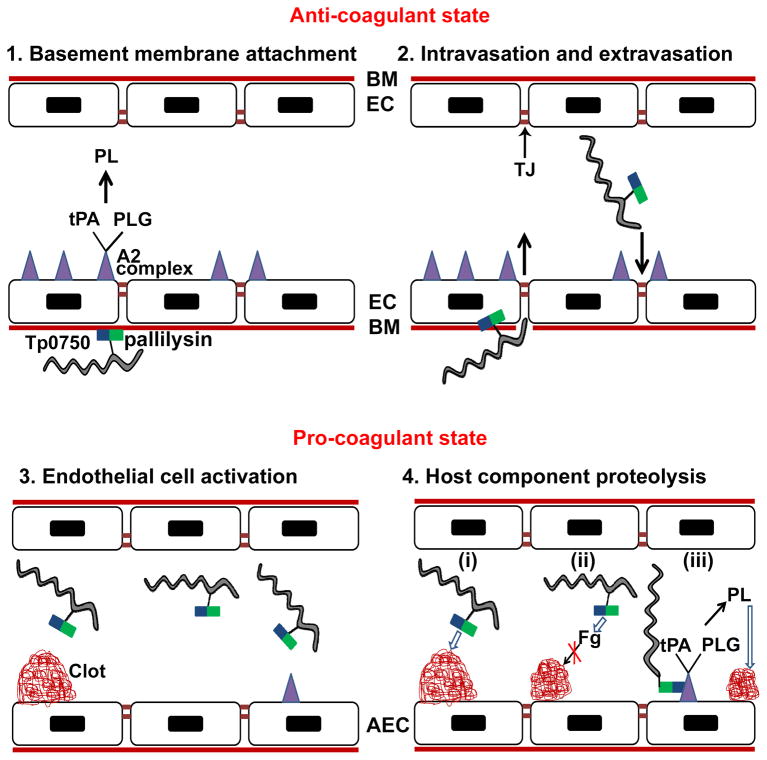
 ) mediates attachment of Treponema pallidum (
 ) to the laminin-rich basement membrane (BM) that underlies the endothelial cells (EC) of blood vessels. The unperturbed endothelium exists primarily in an anti-coagulant state due to the expression of profibrinolytic factors including the fibrinolytic complex comprising annexin A2 and S100A10 (
 ) which binds tissue plasminogen activator (tPA) and plasminogen (PLG) resulting in plasmin (PL)-mediated clot dissolution; (2) T. pallidum intravasation and extravasation: pallilysin degrades the basement membrane. Tp0750 (
 ), through interaction with annexin A2, localizes T. pallidum to areas of tight junction (TJ) remodeling; (3) Activation of endothelial cells occurs upon infection with T. pallidum leading to the formation of a pro-coagulant endothelial surface. On the surface of activated endothelial cells (AEC), the coagulation cascade is initiated resulting in the generation of vascular clots composed of fibrin, fibronectin, and platelets; (4) Tp0750/pallilysin-mediated host component proteolysis: (i) Direct clot degradation via pallilysin-mediated fibrinolysis and Tp0750-mediated fibronectinolysis, (ii) clot formation inhibition via Tp0750/pallilysin-mediated fibrinogen (Fg) degradation, and (iii) Tp0750-annexin A2 interaction localizes T. pallidum to the immediate vicinity of plasmin-mediated vascular fibrinolysis. Open arrows indicate direct proteolysis of host components. Closed arrows indicate an intermediate pro-protease activation step prior to direct proteolysis of host components.
References
-
- Abdallah AM, Verboom T, Hannes F, Safi M, Strong M, Eisenberg D, et al. A specific secretion system mediates PPE41 transport in pathogenic mycobacteria. Mol Microbiol. 2006;62:667–679. - PubMed
-
- Ait-Oufella H, Maury E, Lehoux S, Guidet B, Offenstadt G. The endothelium: physiological functions and role in microcirculatory failure during severe sepsis. Intensive Care Med. 2010;36:1286–1298. - PubMed
Publication types
MeSH terms
Substances
Grants and funding
LinkOut - more resources
Full Text Sources
Other Literature Sources
