


Prospective observational study on tracheal tube cuff pressures in emergency patients--is neglecting the problem the problem?
- PMID: 24304522
- PMCID: PMC4235018
- DOI: 10.1186/1757-7241-21-83
Prospective observational study on tracheal tube cuff pressures in emergency patients--is neglecting the problem the problem?
Abstract
Background: Inappropriately cuffed tracheal tubes can lead to inadequate ventilation or silent aspiration, or to serious tracheal damage. Cuff pressures are of particular importance during aeromedical transport as they increase due to decreased atmospheric pressure at flight level. We hypothesised, that cuff pressures are frequently too high in emergency and critically ill patients but are dependent on providers' professional background.
Methods: Tracheal cuff pressures in patients intubated before arrival of a helicopter-based rescue team were prospectively recorded during a 12-month period. Information about the method used for initial cuff pressure assessment, profession of provider and time since intubation was collected by interview during patient handover. Indications for helicopter missions were either Intensive Care Unit (ICU) transports or emergency transfers. ICU transports were between ICUs of two hospitals. Emergency transfers were either evacuation from the scene or transfer from an emergency department to a higher facility.
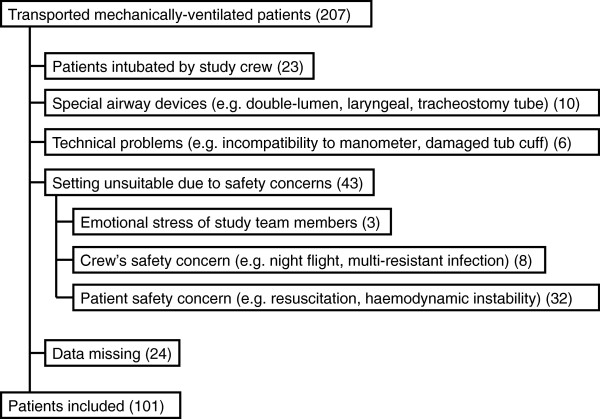
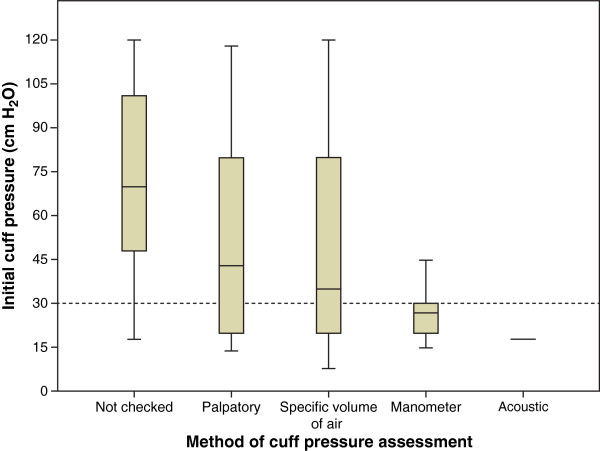
Results: This study included 101 patients scheduled for aeromedical transport. Median cuff pressure measured at handover was 45 (25.0/80.0) cmH2O; range, 8-120 cmH2O. There was no difference between patient characteristics and tracheal tube-size or whether anaesthesia personnel or non-anaesthesia personnel inflated the cuff (30 (24.8/70.0) cmH2O vs. 50 (28.0/90.0) cmH2O); p = 0.113.With regard to mission type (63 patients underwent an emergency transfer, 38 patients an ICU transport), median cuff pressure was different: 58 (30.0/100.0) cmH2O in emergency transfers vs. 30 (20.0/45.8) cmH2O in inter-ICU transports; p < 0.001. For cuff pressure assessment by the intubating team, a manometer had been applied in 2 of 59 emergency transfers and in 20 of 34 inter-ICU transports (method was unknown for 4 cases each). If a manometer was used, median cuff pressure was 27 (20.0/30.0) cmH2O, if not 70 (47.3/102.8) cmH2O; p < 0.001.
Conclusions: Cuff pressures in the pre-hospital setting and in intensive care units are often too high. Interestingly, there is no significant difference between non-anaesthesia and anaesthesia personnel. Acceptable cuff pressures are best achieved when a cuff pressure manometer has been used. This method seems to be the only feasible one and is recommended for general use.
Figures
References
Publication types
MeSH terms
LinkOut - more resources
Full Text Sources
Other Literature Sources
Medical
