Review
. 2013 Dec 4;14(12):23672-84.
doi: 10.3390/ijms141223672.

Tackling structures of long noncoding RNAs

Affiliations
Review

Tackling structures of long noncoding RNAs

Irina V Novikova et al. Int J Mol Sci. .

Abstract

RNAs are important catalytic machines and regulators at every level of gene expression. A new class of RNAs has emerged called long non-coding RNAs, providing new insights into evolution, development and disease. Long non-coding RNAs (lncRNAs) predominantly found in higher eukaryotes, have been implicated in the regulation of transcription factors, chromatin-remodeling, hormone receptors and many other processes. The structural versatility of RNA allows it to perform various functions, ranging from precise protein recognition to catalysis and metabolite sensing. While major housekeeping RNA molecules have long been the focus of structural studies, lncRNAs remain the least characterized class, both structurally and functionally. Here, we review common methodologies used to tackle RNA structure, emphasizing their potential application to lncRNAs. When considering the complexity of lncRNAs and lack of knowledge of their structure, chemical probing appears to be an indispensable tool, with few restrictions in terms of size, quantity and heterogeneity of the RNA molecule. Probing is not constrained to in vitro analysis and can be adapted to high-throughput sequencing platforms. Significant efforts have been applied to develop new in vivo chemical probing reagents, new library construction protocols for sequencing platforms and improved RNA prediction software based on the experimental evidence.


Figures
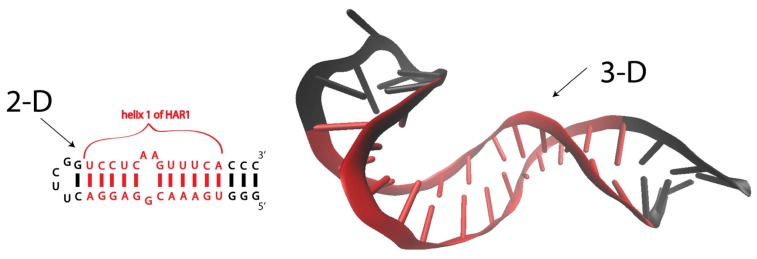
Figure 1.
Figure 1.
Secondary (2-D) and tertiary (3-D) folds of helix 1 of human HAR1 RNA. Nucleotides, denoted in red, belonging to a native helical region of HAR1 RNA. Nucleotides, denoted in black, are added in order to stabilize the entire construct for NMR. The NMR structure is adapted from Ziegeler et al. [26].
Figure 2.
Figure 2.
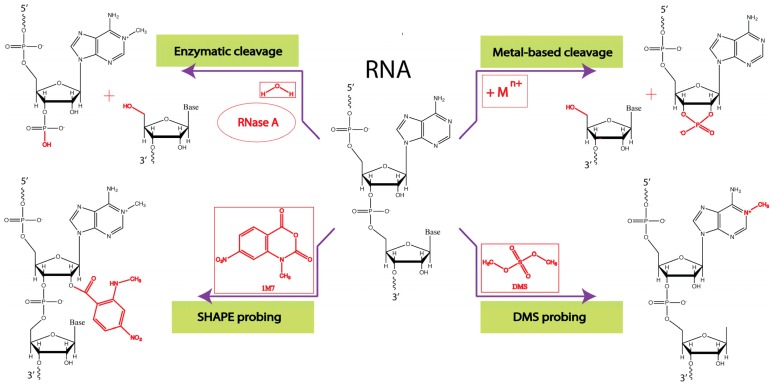
Mechanistic examples of enzymatic and chemical probing of RNA structure. These include: (i) RNase A cleavage of the RNA backbone; (ii) metal-assisted cleavage of the RNA backbone with the subsequent formation of a 2′,3′-cyclic phosphate product; (iii) the methylation of adenine by dimethylsulfate (DMS); and (iv) a 2′-adduct formation with the SHAPE reagent (1M7). Chemical groups important for each reaction are labeled.
Figure 3.
Figure 3.
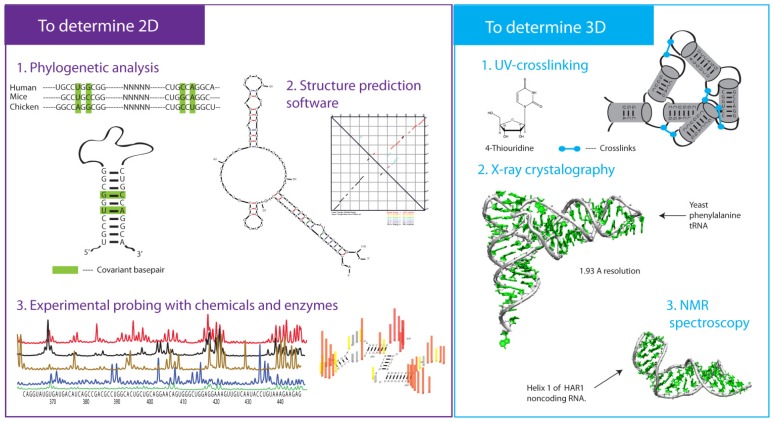
Summary of common strategies to tackle RNA structure. Left (purple), common approaches to determine the secondary fold of RNA. Right (blue), common methods to determine RNA tertiary fold. Adaptations of the crystal structure of tRNA and NMR structure of helix H1 of HAR1 are shown [26,44].

References

    1. Rinn J.L., Chang H.Y. Genome regulation by long noncoding RNAs. Annu. Rev. Biochem. 2012;81:145–166. - PMC - PubMed
    1. Will C.L., Luhrmann R. Spliceosome structure and function. Csh. Perspect. Biol. 2011 doi: 10.1101/cshperspect.a003707. - DOI - PMC - PubMed
    1. Steitz T.A. A structural understanding of the dynamic ribosome machine. Nat. Rev. Mol. Cell Biol. 2008;9:242–253. - PubMed
    1. Gong C., Maquat L.E. lncRNAs transactivate STAU1-mediated mRNA decay by duplexing with 3′ UTRs via Alu elements. Nature. 2011;470:284–288. - PMC - PubMed
    1. Swiezewski S., Liu F., Magusin A., Dean C. Cold-induced silencing by long antisense transcripts of an Arabidopsis Polycomb target. Nature. 2009;462:799–802. - PubMed

MeSH terms

Substances

LinkOut - more resources