


Design and test of a biosensor-based multisensorial system: a proof of concept study
- PMID: 24304640
- PMCID: PMC3892864
- DOI: 10.3390/s131216625
Design and test of a biosensor-based multisensorial system: a proof of concept study
Abstract
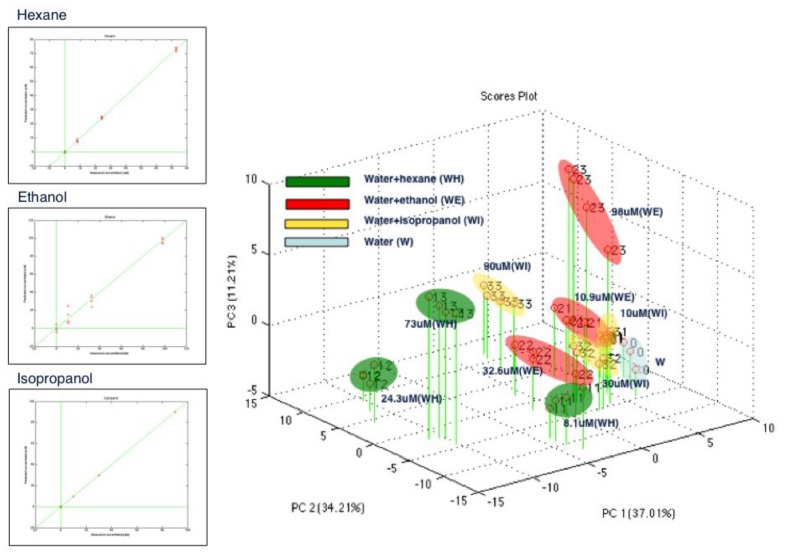
Sensors are often organized in multidimensional systems or networks for particular applications. This is facilitated by the large improvements in the miniaturization process, power consumption reduction and data analysis techniques nowadays possible. Such sensors are frequently organized in multidimensional arrays oriented to the realization of artificial sensorial systems mimicking the mechanisms of human senses. Instruments that make use of these sensors are frequently employed in the fields of medicine and food science. Among them, the so-called electronic nose and tongue are becoming more and more popular. In this paper an innovative multisensorial system based on sensing materials of biological origin is illustrated. Anthocyanins are exploited here as chemical interactive materials for both quartz microbalance (QMB) transducers used as gas sensors and for electrodes used as liquid electrochemical sensors. The optical properties of anthocyanins are well established and widely used, but they have never been exploited as sensing materials for both gas and liquid sensors in non-optical applications. By using the same set of selected anthocyanins an integrated system has been realized, which includes a gas sensor array based on QMB and a sensor array for liquids made up of suitable Ion Sensitive Electrodes (ISEs). The arrays are also monitored from an optical point of view. This embedded system, is intended to mimic the working principles of the nose, tongue and eyes. We call this setup BIONOTE (for BIOsensor-based multisensorial system for mimicking NOse, Tongue and Eyes). The complete design, fabrication and calibration processes of the BIONOTE system are described herein, and a number of preliminary results are discussed. These results are relative to: (a) the characterization of the optical properties of the tested materials; (b) the performance of the whole system as gas sensor array with respect to ethanol, hexane and isopropyl alcohol detection (concentration range 0.1-7 ppm) and as a liquid sensor array (concentration range 73-98 μM).
Figures
References
-
- Vlasov Y.G., Ermolenko Y.E., Legin A.V., Rudnitskaya A.M., Kolodnikov V.V. Chemical sensors and their systems. J. Anal. Chem. 2010;65:890–898.
-
- Moscato M., Schena E., Saccomandi P., Francomano M., Accoto D., Guglielmelli E., Silvestri S. A Micromachined Intensity-Modulated Fiber Optic Sensor for Strain Measurements: Working Principle and Static Calibration. Proceedings of the Annual International Conference of the IEEE Engineering in Medicine and Biology Society (EMBS 2012); San Diego, CA, USA. 28 August–1 September 2012. - PubMed
-
- Depari A., Flammini A., Rinaldi S., Vezzoli A. Multi-sensor system with Bluetooth connectivity for non-invasive measurements of human body physical parameters. Sens. Actuators A Phys. 2013 doi: 10.1016/j.sna.2013.05.001. - DOI
-
- Luo R.C., Chang C.C., Lai C.C. Multisensor fusion and integration: Theories, applications, and its perspectives. IEEE Sens. J. 2011;11:3122–3138.
Publication types
MeSH terms
LinkOut - more resources
Full Text Sources
Other Literature Sources
Miscellaneous
