. 2014 May;8(5):1041-54.
doi: 10.1038/ismej.2013.208. Epub 2013 Dec 5.

Eco-evolutionary feedbacks drive species interactions

Affiliations

Eco-evolutionary feedbacks drive species interactions

Andrés Andrade-Domínguez et al. ISME J. 2014 May.

Abstract

In the biosphere, many species live in close proximity and can thus interact in many different ways. Such interactions are dynamic and fall along a continuum between antagonism and cooperation. Because interspecies interactions are the key to understanding biological communities, it is important to know how species interactions arise and evolve. Here, we show that the feedback between ecological and evolutionary processes has a fundamental role in the emergence and dynamics of species interaction. Using a two-species artificial community, we demonstrate that ecological processes and rapid evolution interact to influence the dynamics of the symbiosis between a eukaryote (Saccharomyces cerevisiae) and a bacterium (Rhizobium etli). The simplicity of our experimental design enables an explicit statement of causality. The niche-constructing activities of the fungus were the key ecological process: it allowed the establishment of a commensal relationship that switched to ammensalism and provided the selective conditions necessary for the adaptive evolution of the bacteria. In this latter state, the bacterial population radiates into more than five genotypes that vary with respect to nutrient transport, metabolic strategies and global regulation. Evolutionary diversification of the bacterial populations has strong effects on the community; the nature of interaction subsequently switches from ammensalism to antagonism where bacteria promote yeast extinction. Our results demonstrate the importance of the evolution-to-ecology pathway in the persistence of interactions and the stability of communities. Thus, eco-evolutionary dynamics have the potential to transform the structure and functioning of ecosystems. Our results suggest that these dynamics should be considered to improve our understanding of beneficial and detrimental host-microbe interactions.


Figures
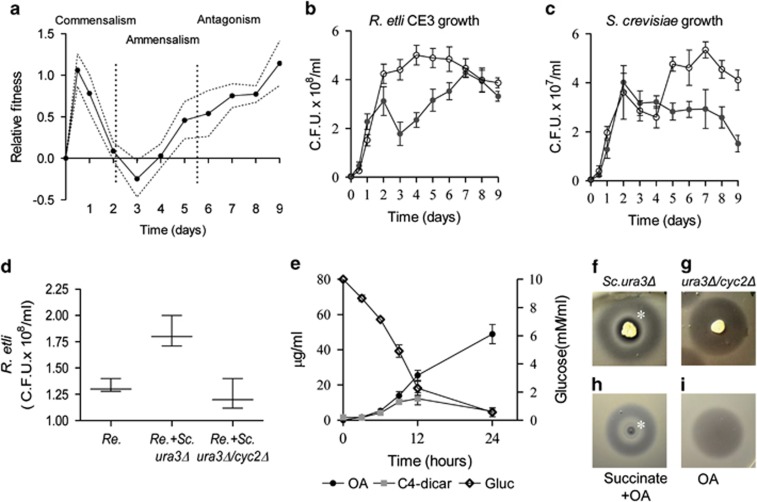
Figure 1
Figure 1
Temporal dynamics of the fungal–bacterial interaction and niche construction by yeast. (a) The fitness of R. etli CE3 relative to S. cerevisiae Σ1278h ura3Δ. Fitness is given as the difference in Malthusian parameters (m). A fitness of zero indicates that the two species are equally fit. Dotted lines indicate ±s.e.m. (n=3). (b, c) Individual growth curves of R. etli and S. cerevisiae in coculture (filled symbols) and pure culture (open symbols). (di) C4-dicarboxylate production by yeast is required for the establishment of commensalism. (d) Population density of R. etli at 24 h in monoculture (Re.), coculture with S. cerevisiae ura3Δ (Re.+Sc.ura3Δ) and coculture with the S. cerevisiae cyc2 mutant (Re.+Sc. ura3Δ/cyc2Δ), in the BY4741 background. (e) The environmental changes in coculture through the course of the evolution experiment. Left y-axis: concentrations of OA and C4-dicarboxylates (plotted as the sum of succinate, fumarate and α-ketoglutarate). Right y-axis: concentrations of Glucose. (f, g) The experiments demonstrate the capacity of yeast strains to modify the environment and determine the community structure on solid media. (f) R. etli CE3 grow as a commensal organism inside the inhibition zone (asterisk) surrounding the ura3Δ S. cerevisiae colony. (d) cyc2Δ/ura3Δ S. cerevisiae cells, which do not accumulate C4-dicarboxylates, do not promote bacterial growth. (h, i) Experiments to mimic community structure generated by yeast strains. (h) OA and succinate (50 μg each) were placed together on the plate. Succinate promoted bacterial growth inside the inhibition zone (asterisk). (i) Bacterial growth inhibition by OA (50 μg). All panels show the mean±s.e.m. (n=3).
Figure 2
Figure 2
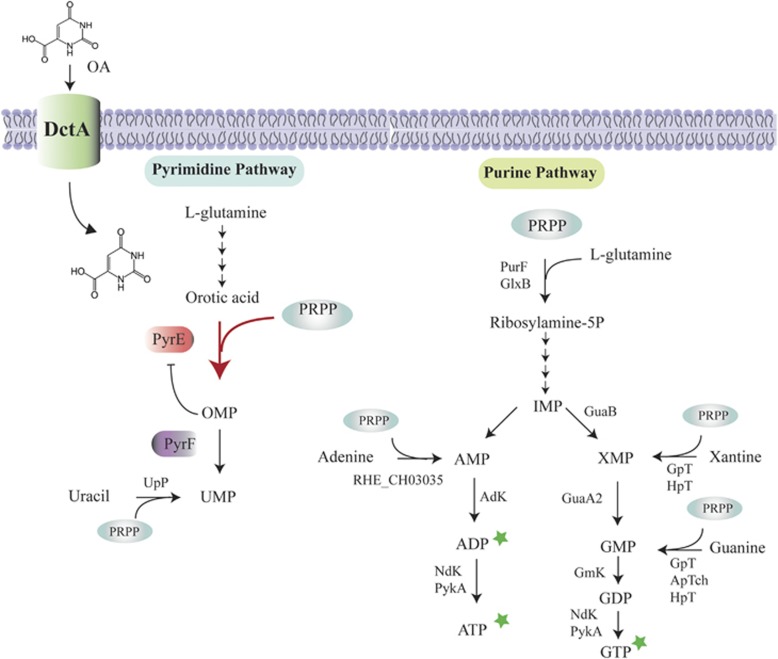
A proposed mechanism for the inhibitory effect of OA on the growth of R. etli CE3. OA is transported into cells by DctA permease (Reid and Poole, 1998; Yurgel and Kahn, 2005). Inside the cell, OA causes an increase in the rate of de novo pyrimidine synthesis at the orotate phosphoribosyl transferase (PyrE) step (thick arrow). Because this step consumes PRPP (5′-phosphoribosyl-1′-pyrophosphate), we propose that the intracellular level of this metabolite was diminished by the exogenously supplied OA and caused retardation of the de novo purine synthesis. This notion is supported by the reversal of the inhibitory effect of OA by the simultaneous addition of purine derivatives (stars). We found that mutants lacking orotidine-5'-phosphate decarboxylase activity (PyrE) did not consume PRPP and were not affected by OA (Supplementary Figure S5). Furthermore, mutants lacking orotidine5′-phosphate decarboxylase activity (PyrF) were OA-resistant (Supplementary Figure S5). Our hypothesis is that pyrF mutants accumulate orotidine5′-monophosphate (OMP) and that this metabolite inhibits the activity of PyrE and therefore reduces the consumption of PRPP. The image shows the simplified purine and pyrimidine pathways and indicates the PRPP-requiring reactions. Only the intermediates relevant to this study are shown.
Figure 3
Figure 3
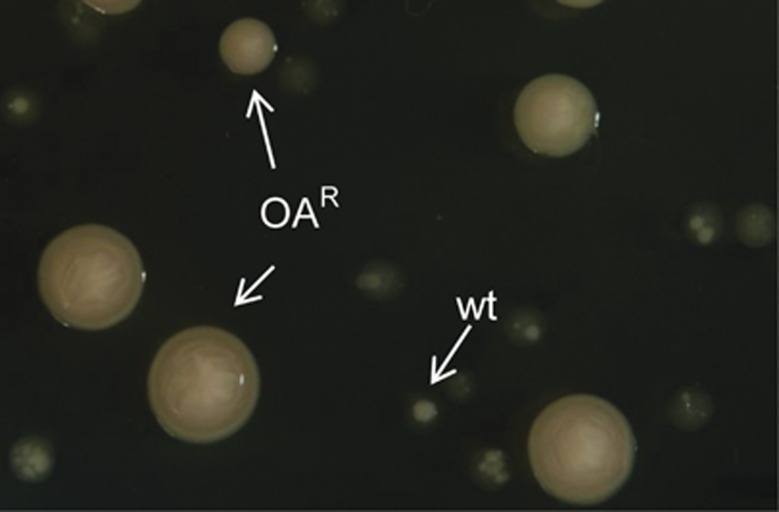
The characteristic phenotypes of the ancestral and the derived variants of R. etli CE3 on PYD100 agar (96 h of growth). OAR cells develop large colonies and wild-type (wt) cells and translucent small colonies. The inset shows a wt colony with opaque sectors that arise after 3 days of incubation. These sectors are OAR variants that evolved in the colony.
Figure 4
Figure 4
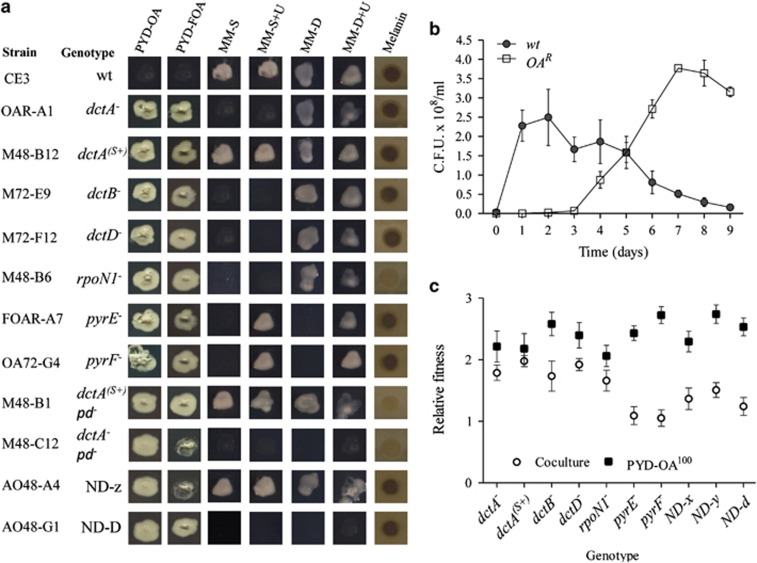
Adaptive radiation of R. etli CE3 in ammensal–enemy interaction. (a) The traits and genotypes of the representative OAR variants that evolved in coculture. Each column shows the growth on different culture media and melanin production. Culture media are as follows: PYD-OA (complete medium with 100 μg ml−1 OA), PYD-FOA (complete medium with 50 μg ml−1 FOA), MM-S (succinate minimal medium), MM-S+U (succinate minimal medium with uridine), MM-D (dextrose minimal medium) and MM-D+U (dextrose minimal medium with uridine). The genotypes were determined by Sanger sequencing (Table 1). The dctA(s+) mutants retained some capacity to transport succinate but not OA and FOA. M48-B1 and M48-C12 strains lacked the symbiotic plasmid (pd). This plasmid contains the genes necessary for melanin synthesis; therefore, these strains do not produce the pigment. ND-z and ND-D indicate that the genetic change was not identified. (b) The rapid fixation of OAR variants in coculture. The population dynamics of wt and OAR cell populations. (c) The competitive fitness of OAR variants. The fitness was determined relative to ancestral R. etli CE3 (initial ratio 1:1) in the presence of S. cerevisiae Σ1278h (open symbols) and in monoculture with 100 μg ml−1 OA (filled symbols). Competitive fitness was determined in monoculture and coculture at 24 and 48 h, respectively. All panels show the mean±s.e.m. (n=3).
Figure 5
Figure 5
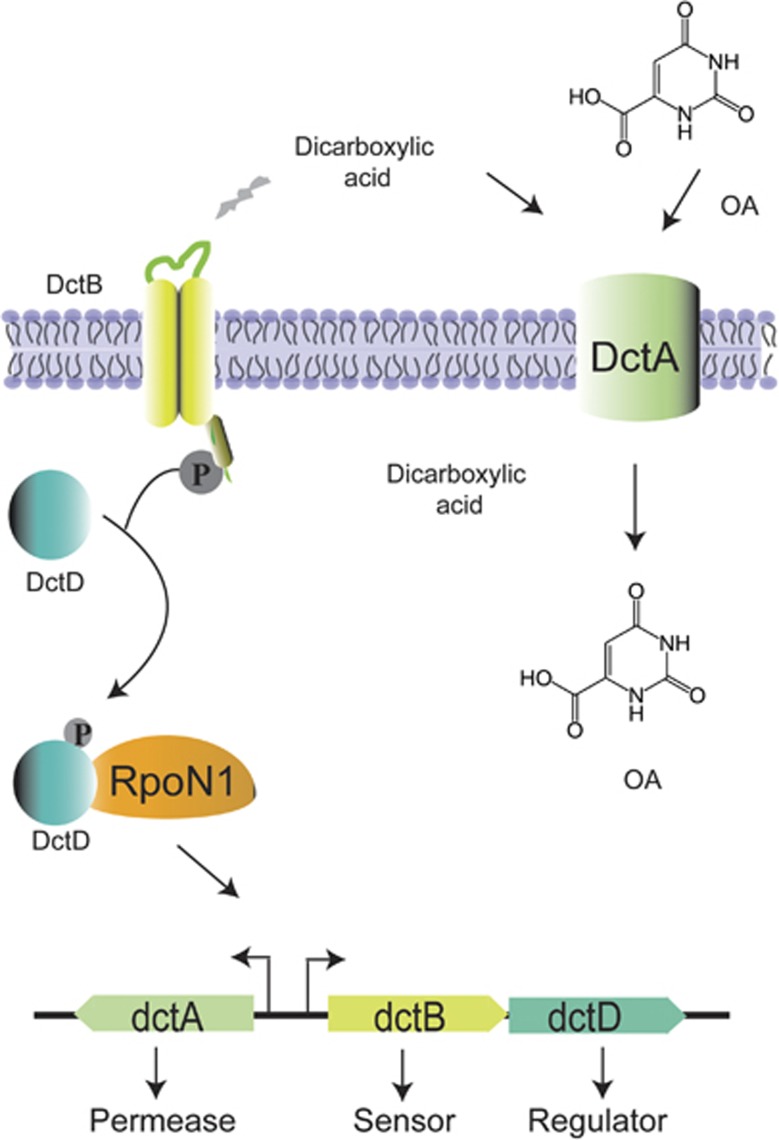
Transport of OA via the C4-dicarboxylic transport (Dct) system. In Rhizobium, the transport of L-malate, fumarate and succinate occurs via the Dct system (Reid and Poole, 1998; Yurgel and Kahn, 2005). This system consists of three genes: dctA, which codes for the transport protein, and two divergently transcribed genes, dctB and dctD, which activate the transcription of dctA in response to the presence of dicarboxylates (Reid and Poole, 1998). DctB and DctD are well characterized as a two-component sensor-regulator pair. In free-living cultures, mutations in any of the three dct genes result in the loss of the capacity to transport and grow on C4-dicarboxylates. Transcription from dctA is RpoN1 sigma factor-dependent (Meyer et al., 2001), which binds to a site located 93-bp upstream from the dctA start codon in R. leguminosarum and a similar position in R. etli (Ronson et al., 1987). In addition to dicarboxylates, DctA can transport compounds that are not dicarboxylates, such as OA and FOA, a toxic analog of OA (Yurgel and Kahn, 2005).
Figure 6
Figure 6
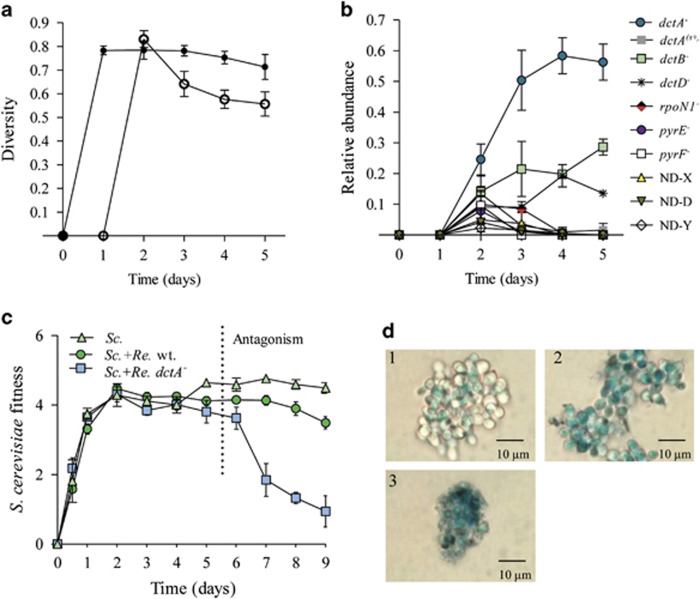
The ecological consequences of rapid adaptative evolution. (a) The diversity over time for OAR populations evolving with S. cerevisiae Σ1278h ura3 mutant (open symbols) and in monoculture with 100 μg ml−1 OA (filled symbols). Diversity was calculated as the complement of Simpson's index (1−λ). (b) The relative abundance of different OAR genotypes along the symbiosis continuum. (c) Yeast fitness declined after the bacteria evolved. Yeast fitness in monoculture (Sc.), coculture with R. etli (Sc.+Re.) and coculture with R. etli dctA (Sc.+Re. dctA). Fitness was measured using a growth rate or Malthusian parameter (m) based on colony counts. (d) The assay of yeast strain viability confirmed that yeast cells lost viability after 5 and 8 days of coculture with R. etli wt and R. etli dctA, respectively. Cell viability was assayed using methylene blue after 8 days of culturing: stained cells were dead, and live cells remained white. Representative light microscopy images: (1) S. cerevisiae monoculture, (2) S. cerevisiae-R. etli coculture and (3) S. cerevisiae-R. etli dctA coculture. All panels show the mean±s.e.m. (n=3).
Figure 7
Figure 7
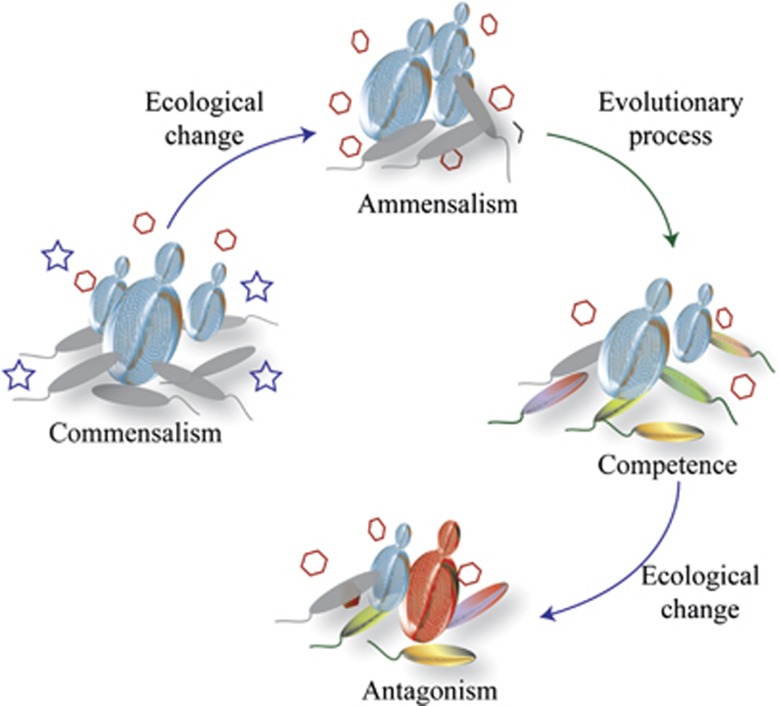
An abstract model delineates how ecological change and evolutionary processes drive the fungal–bacterial interaction. In our system, at the beginning of the interaction, yeast simultaneously secreted an inhibitor of bacterial growth (OA, hexagons) and growth promoters (C4-dicarboxylates, stars) that blocked the effect of the inhibitor and it allowed the establishment of a commensal relationship. When the growth promoters became depleted (ecological change), the interaction shifted from commensalism to ammensalism. During ammensalism, the bacterial population radiated into more than five phenotypes, with multiple variations in nutrient transport (dct system mutations), global regulation (rpoN1 mutations) and metabolic strategies (pyrE and pyrF mutations). The interaction between species affected the diversity and determined the phenotypic composition of the bacteria population. Adaptive evolution allowed the bacteria growth, which modified the environment and created competition for nutrients with the yeast. The ecological consequence of evolutionary diversification of the bacteria is a new change in the community: the interaction switch from ammensalism to antagonism.

References

    1. Almeida T, Marques M, Mojzita D, Amorim MA, Silva RD, Almeida B, et al. Isc1p plays a key role in hydrogen peroxide resistance and chronological lifespan through modulation of iron levels and apoptosis. Mol Biol Cell. 2008;19:865–876. - PMC - PubMed
    1. Azam F, Malfatti F. Microbial structuring of marine ecosystems. Nat Rev Microbiol. 2007;5:782–791. - PubMed
    1. Bell G, Collins S. Adaptation, extinction and global change. Evol Appl. 2008;1:3–16. - PMC - PubMed
    1. Bell G, Gonzalez A. Adaptation and evolutionary rescue in metapopulations experiencing environmental deterioration. Science. 2011;332:1327–1330. - PubMed
    1. Buckling A, Rainey PB. The role of parasites in sympatric and allopatric host diversification. Nature. 2002;420:496–499. - PubMed

Publication types

Associated data