. 2014 Feb 1;306(3):C221-9.
doi: 10.1152/ajpcell.00140.2013. Epub 2013 Dec 4.

Mitochondrial 8-oxoguanine glycosylase decreases mitochondrial fragmentation and improves mitochondrial function in H9C2 cells under oxidative stress conditions

Affiliations

Mitochondrial 8-oxoguanine glycosylase decreases mitochondrial fragmentation and improves mitochondrial function in H9C2 cells under oxidative stress conditions

Moises Torres-Gonzalez et al. Am J Physiol Cell Physiol. .

Abstract

The mitochondrial DNA base modification 8-hydroxy 2'-deoxyguanine (8-OHdG) is one of the most common DNA lesions induced by reactive oxygen species (ROS) and is considered an index of DNA damage. High levels of mitochondrial 8-OHdG have been correlated with increased mutation, deletion, and loss of mitochondrial (mt) DNA, as well as apoptosis. 8-Oxoguanosine DNA glycosylase-1 (OGG1) recognizes and removes 8-OHdG to prevent further DNA damage. We evaluated the effects of OGG1 on mtDNA damage, mitochondrial function, and apoptotic events induced by oxidative stress using H9C2 cardiac cells treated with menadione and transduced with either Adv-Ogg1 or Adv-Control (empty vector). The levels of mtDNA 8-OHdG and the presence of apurinic/apyrimidinic (AP) sites were decreased by 30% and 35%, respectively, in Adv-Ogg1 transduced cells (P < 0.0001 and P < 0.005, respectively). In addition, the expression of base excision repair (BER) pathway members APE1 and DNA polymerase γ was upregulated by Adv-Ogg1 transduction. Cells overexpressing Ogg1 had increased membrane potential (P < 0.05) and decreased mitochondrial fragmentation (P < 0.005). The mtDNA content was found to be higher in cells with increased OGG1 (P < 0.005). The protein levels of fission and apoptotic factors such as DRP1, FIS1, cytoplasmic cytochrome c, activated caspase-3, and activated caspase-9 were lower in Adv-Ogg1 transduced cells. These observations suggest that Ogg1 overexpression may be an important mechanism to protect cardiac cells against oxidative stress damage.

Keywords: 8-oxoguanine glycosylase; apoptosis; mitochondrial DNA damage; mitochondrial function; oxidative stress.


Figures
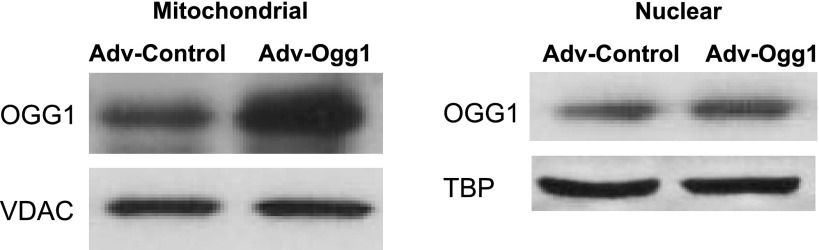
Fig. 1.
Fig. 1.
Representative Western blots of mitochondrial and nuclear OGG1 protein levels. Cells transduced with either an empty vector (Adv-Control) or a vector carrying the sequence of mitochondrial Ogg1 (Adv-Ogg1) were treated with menadione (50 μM) for 1 h. After menadione treatment, cells were washed with 1× PBS and incubated in fresh DMEM for 2 h at 37°C and 5% CO2. Mitochondrial and nuclear proteins were isolated and used for Western blot analysis. The results demonstrated increased mitochondrial and nuclear Ogg1 expression in H9C2 cells and are representative of 3 independent experiments.
Fig. 2.
Fig. 2.
Markers of DNA damage and mRNA levels of the base excision repair (BER) pathway enzymes were measured in cells exposed to oxidative stress. Ogg1-transduced cells showed significantly reduced mitochondrial DNA (mtDNA) damage and increased expression of BER pathway enzymes. A: mitochondrial 8-OHdG levels normalized to total mtDNA. B: frequency of abasic (AP) sites in mtDNA. C and D: fold changes in the mRNA levels of APE1 and DNA γ polymerase compared with control. Bars represent means ± SE. Experiments were repeated 3 times, and assays were done in triplicate. *P < 0.001, **P < 0.005, #P < 0.0001.
Fig. 3.
Fig. 3.
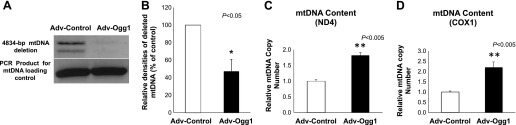
mtDNA deletions and mtDNA content. A: PCR products amplified from mtDNA with a 4,834-bp deletion. PCR products representing a 4,834-bp deletion (top bands) and PCR product of the control primers (bottom bands). B: levels of the 4,834-deleted mtDNA were determined as the ratio of the signal intensity relative to that for the control mtDNA and were expressed as a percentage of levels measured in Adv-Control-treated mtDNA. Ogg1 overexpression significantly reduced mtDNA deletions under oxidative stress conditions. C: mtDNA content was determined by measuring the levels of two genes encoded by mtDNA, (ND4 and COXI) relative to the levels of a nuclear DNA gene (PGC1α), and found to be significantly more abundant in Adv-Ogg1-transduced cells. Graph represents the fold change of mtDNA content relative to control. Bars represent means ± SE. Experiments were repeated 3 times, and assays were done in triplicate. *P < 0.05, **P < 0.005.
Fig. 4.
Fig. 4.
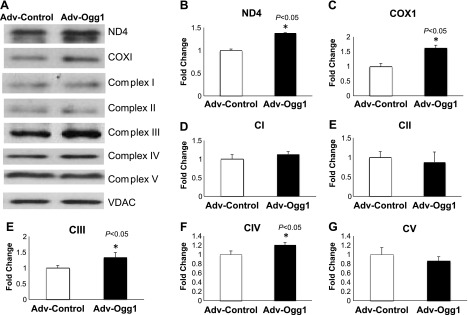
Mitochondrial Ogg1 overexpression prevents loss of mitochondrial DNA-encoded proteins under oxidative stress conditions. A: representative Western blots of ND4 and COX1 mtDNA-encoded subunits and total OXPHOS proteins [from electron transport chain (ETC) complexes I–V]. B–G: graphs represent the fold change of protein levels relative to control. Bars indicated means ± SE. Experiments were repeated 3 times, and assays were done in triplicate. Signal intensities were normalized to VDAC. *P < 0.05 vs. control.
Fig. 5.
Fig. 5.
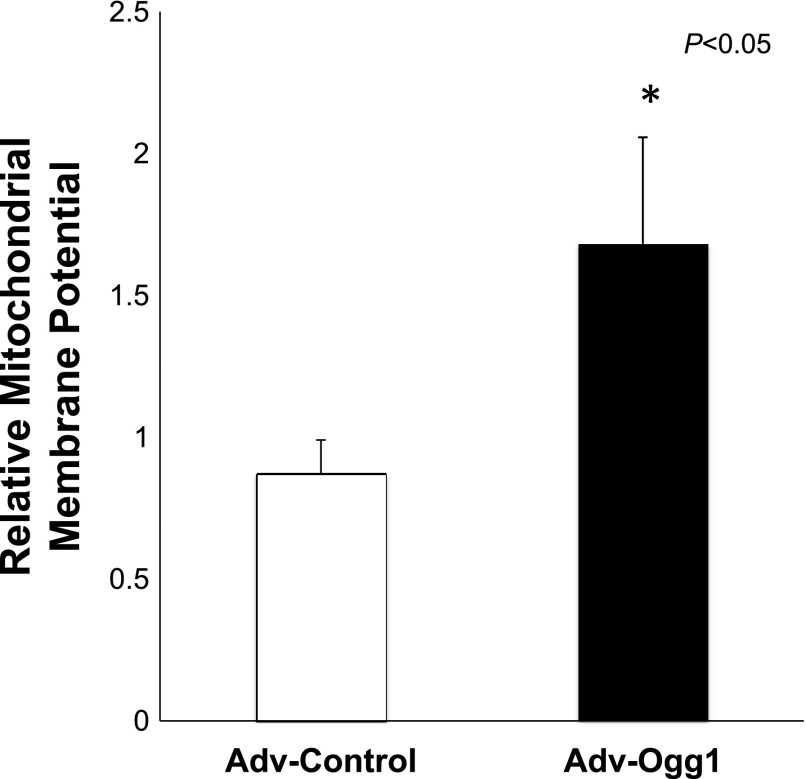
Increased mitochondrial OGG1 protein levels protect against loss of mitochondrial membrane potential under oxidative stress conditions. After menadione treatment cells were loaded with JC-1 for analysis of membrane potential. Graph shows relative mitochondrial membrane potential (red/green fluorescence ratio). n = 30 H9C2, *P < 0.05 vs control. Data are expressed as means ± SE.
Fig. 6.
Fig. 6.
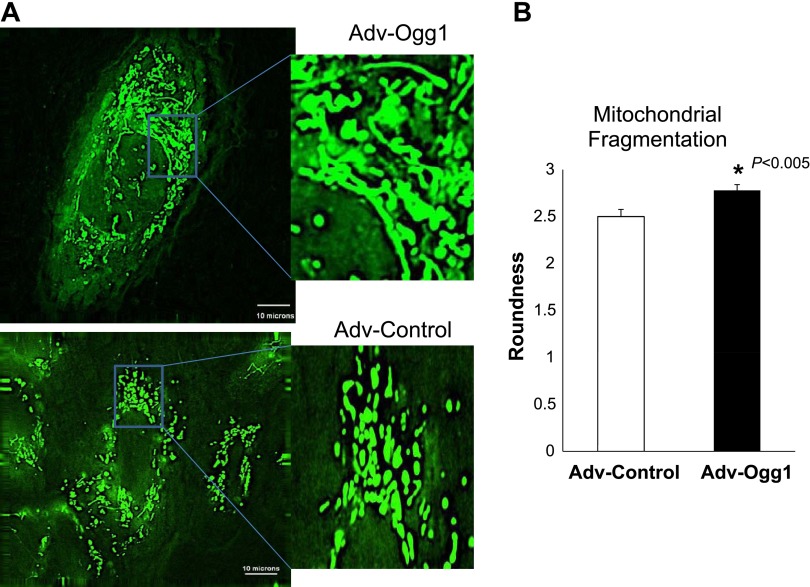
Mitochondrial fragmentation is reduced by mitochondrial Ogg1 overexpression under oxidative stress conditions. After treatment, cells were loaded with Mitotracker Green FM for mitochondria staining. A: representative images of mitochondrial morphology are shown. B: mitochondrial morphological change is analyzed by the mean roundness. n = 15 H9C2 cells, *P < 0.05 vs. control. Data are expressed as means ± SE. The scale bar is 10 μm.
Fig. 7.
Fig. 7.
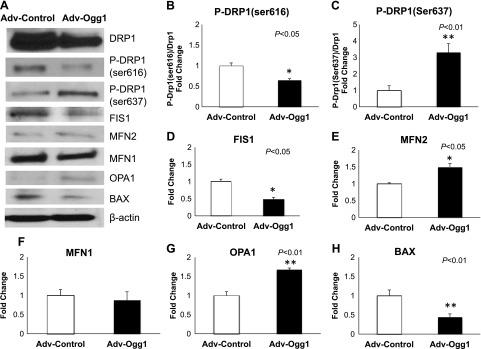
Effects of mitochondrial Ogg1 overexpression on fission and fusion proteins under oxidative stress conditions. A: representative Western blots of fission proteins [DRP1, p-DRP1(ser616), FIS1, and Bax] and fusion proteins [OPA1, MFN1, MFN2, p-DRP1(ser637)]. Immunoblot analysis showed that mitochondrial fission and mitochondrial fusion proteins were reduced and increased, respectively, in Adv-Ogg1 transduced cells. B–H: graphs represent the fold change of protein levels relative to control. Bars indicated means ± SE. Experiments were repeated 3 times, and assays were done in triplicate. *P < 0.05, **P < 0.01.
Fig. 8.
Fig. 8.
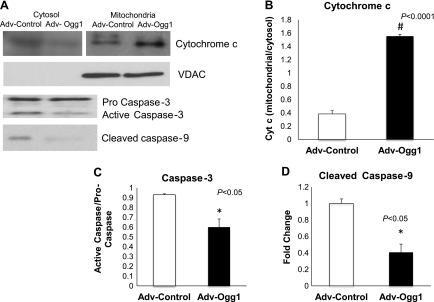
A: representative Western blots showing markers of apoptosis in H9C2 cells after menadione treatment. Ogg1 overexpression prevents cytochrome c release from the mitochondria and leads to decreased protein levels of activated caspases. The scans of cytochrome c levels in mitochondrial and cytosolic fractions are from two separate blots. B–D: graphs represent the fold change of protein levels relative to control. Bars indicated means ± SE. Experiments were repeated 3 times, and assays were done in triplicate.*P < 0.05, #P < 0.0001.

References

    1. Boesch P, Weber LF, Ibrahim N, Tarasenko V, Cosset A, Paulus F, Lightowlers RN, Dietrich A. DNA repair in organelles: pathways, organization, regulation, relevance in disease and aging. Biochim Biophys Acta 1813: 186–200, 2011 - PubMed
    1. Bravard A, Vacher M, Gouget B, Coutant A, de Boisferon FH, Marsin S, Chevillard S, Radicella JP. Redox regulation of human OGG1 activity in response to cellular oxidative stress. Mol Cell Biol 26: 7430–7436, 2006 - PMC - PubMed
    1. Cassano P, Sciancalepore AG, Lezza AM, Leeuwenburgh C, Cantatore P, Gadaleta MN. Tissue-specific effect of age and caloric restriction diet on mitochondrial DNA content. Rejuvenation Res 9: 211–214, 2006 - PubMed
    1. Chan DC. Fusion and fission: interlinked processes critical for mitochondrial health. Annu Rev Genet 46: 265–287, 2012 - PubMed
    1. Chatterjee A, Mambo E, Zhang Y, Deweese T, Sidransky D. Targeting of mutant hogg1 in mammalian mitochondria and nucleus: effect on cellular survival upon oxidative stress. BMC Cancer 6: 235, 2006 - PMC - PubMed

Publication types

MeSH terms

LinkOut - more resources