


Clinical significance of palliative gastrectomy on the survival of patients with incurable advanced gastric cancer: a systematic review and meta-analysis
- PMID: 24304886
- PMCID: PMC4235220
- DOI: 10.1186/1471-2407-13-577
Clinical significance of palliative gastrectomy on the survival of patients with incurable advanced gastric cancer: a systematic review and meta-analysis
Abstract
Background: Palliative gastrectomy for patients with advanced gastric cancer remains controversial. The objective of the present meta-analysis was to analyze survival outcomes and establish a consensus on whether palliative gastrectomy is suitable for patients with incurable advanced gastric cancer and which type of patients should be selected to receive palliative gastrectomy.
Methods: A literature search was conducted in PubMed, EMBASE and the Cochrane Library. The results for overall survival in the meta-analysis are expressed as hazard ratios (HRs) with 95% confidence intervals (CIs).
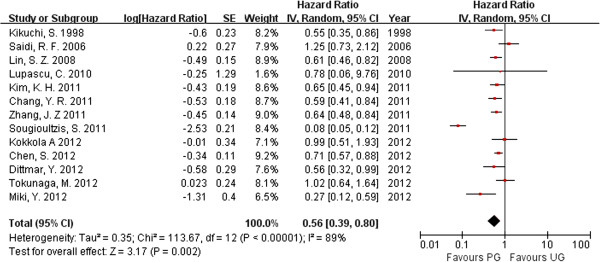
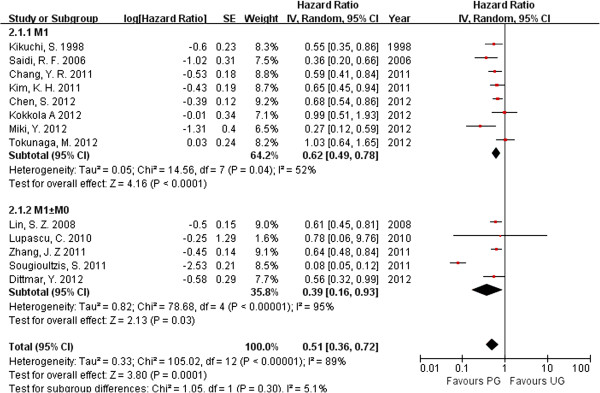
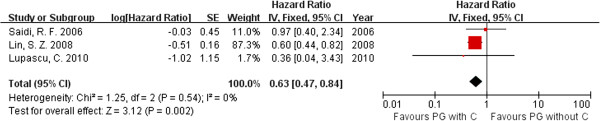
Results: Of 1647 articles and abstracts reviewed, 14 studies with 3003 patients were eligible for the final analysis. The meta-analysis revealed that palliative gastrectomy is associated with a significantly improvement in overall survival (HR 0.56; 95%CI 0.39-0.80; p < 0.002) compared that of patients treated without palliative gastrectomy. An improvement in survival was also observed in patients with stage M1 gastric cancer who received palliative gastrectomy (HR 0.62; 95%CI 0.49-0.78; p < 0.0001), especially those with peritoneal dissemination (HR = 0.76, 95%CI 0.63-0.92), liver metastasis (HR = 0.41, 95%CI 0.30-0.55), or distant lymph-node metastasis (HR = 0.36, 95%CI 0.23-0.59). Combined hepatic resection may be beneficial for patients who under palliative gastrectomy (HR 0.30; 95%CI 0.15-0.61; p = 0.0008). The overall survival of patients who underwent palliative gastrectomy combined with chemotherapy was significantly improved (HR 0.63; 95%CI 0.47-0.84; p = 0.002).
Conclusions: From the results of the meta-analysis, palliative gastrectomy for patients with incurable advanced gastric cancer may be associated with longer survival, especially for patients with stage M1 gastric cancer. Combined hepatic resection for patients with liver metastasis and chemotherapy may be beneficial factors compared to simple palliative gastrectomy.
Figures

References
-
- Shibata A, Parsonnet J. In: Cancer Epidemiology and Prevention. 3. Schottenfeld D, Fraumeni JF, editor. New York: Oxford University Press; 2006. Stomach cancer; pp. 707–720.
-
- Koizumi W, Narahara H, Hara T, Takagane A, Akiya T, Takagi M, Miyashita K, Nishizaki T, Kobayashi O, Takiyama W. et al. S-1 plus cisplatin versus S-1 alone for first-line treatment of advanced gastric cancer (SPIRITS trial): a phase III trial. Lancet Oncol. 2008;9(3):215–221. doi: 10.1016/S1470-2045(08)70035-4. - DOI - PubMed
-
- Glimelius B, Ekstrom K, Hoffman K, Graf W, Sjoden PO, Haglund U, Svensson C, Enander LK, Linne T, Sellstrom H. et al. Randomized comparison between chemotherapy plus best supportive care with best supportive care in advanced gastric cancer. Ann Oncol. 1997;8(2):163–168. doi: 10.1023/A:1008243606668. - DOI - PubMed
-
- Pyrhonen S, Kuitunen T, Nyandoto P, Kouri M. Randomised comparison of fluorouracil, epidoxorubicin and methotrexate (FEMTX) plus supportive care with supportive care alone in patients with non-resectable gastric cancer. Br J Cancer. 1995;71(3):587–591. doi: 10.1038/bjc.1995.114. - DOI - PMC - PubMed
Publication types
MeSH terms
LinkOut - more resources
Full Text Sources
Other Literature Sources
Medical
