Dermal damage promoted by repeated low-level UV-A1 exposure despite tanning response in human skin
- PMID: 24305962
- PMCID: PMC4167395
- DOI: 10.1001/jamadermatol.2013.8417
Dermal damage promoted by repeated low-level UV-A1 exposure despite tanning response in human skin
Abstract
Importance: Solar UV irradiation causes photoaging, characterized by fragmentation and reduced production of type I collagen fibrils that provide strength to skin. Exposure to UV-B irradiation (280-320 nm) causes these changes by inducing matrix metalloproteinase 1 and suppressing type I collagen synthesis. The role of UV-A irradiation (320-400 nm) in promoting similar molecular alterations is less clear yet important to consider because it is 10 to 100 times more abundant in natural sunlight than UV-B irradiation and penetrates deeper into the dermis than UV-B irradiation. Most (approximately 75%) of solar UV-A irradiation is composed of UV-A1 irradiation (340-400 nm), which is also the primary component of tanning beds.
Objective: To evaluate the effects of low levels of UV-A1 irradiation, as might be encountered in daily life, on expression of matrix metalloproteinase 1 and type I procollagen (the precursor of type I collagen).
Design, setting, and participants: In vivo biochemical analyses were conducted after UV-A1 irradiation of normal human skin at an academic referral center. Participants included 22 healthy individuals without skin disease.
Main outcomes and measures: Skin pigmentation was measured by a color meter (chromometer) under the L* variable (luminescence), which ranges from 0 (black) to 100 (white). Gene expression in skin samples was assessed by real-time polymerase chain reaction.
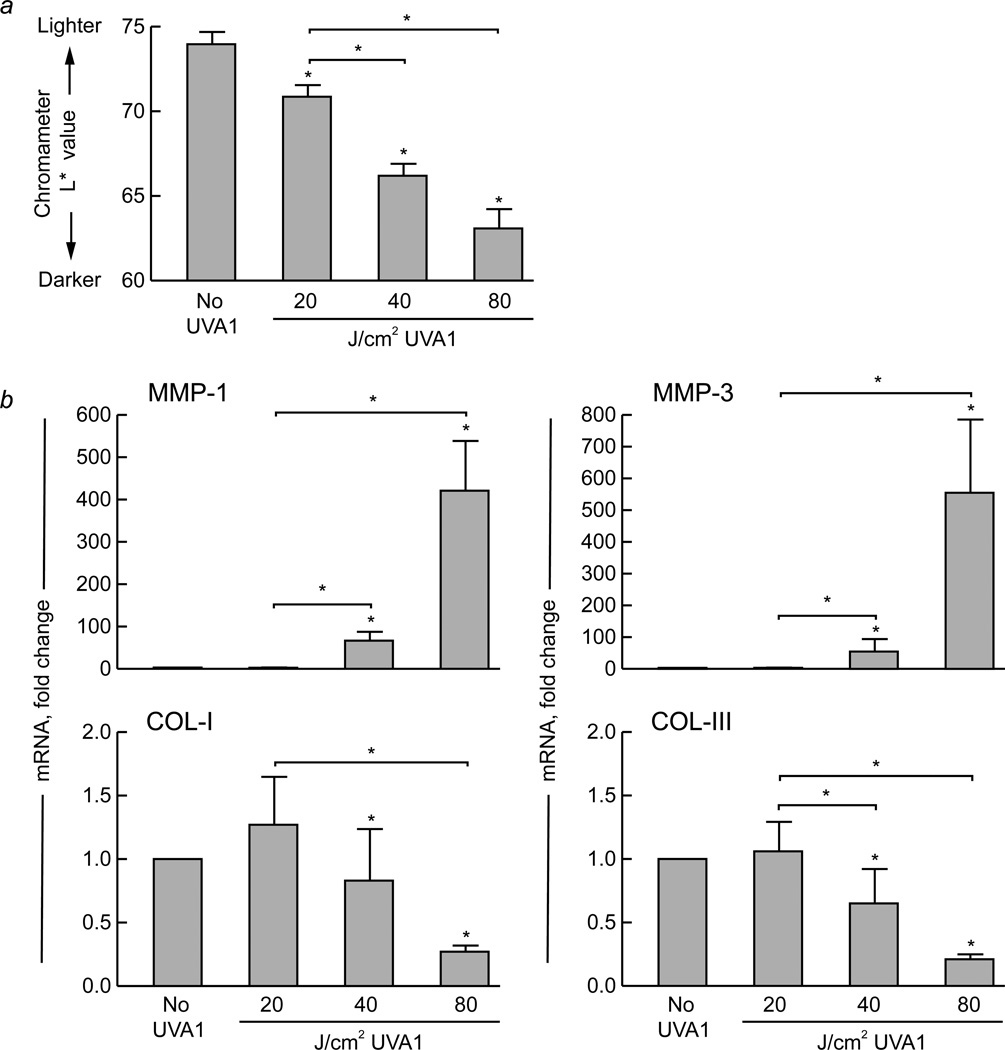
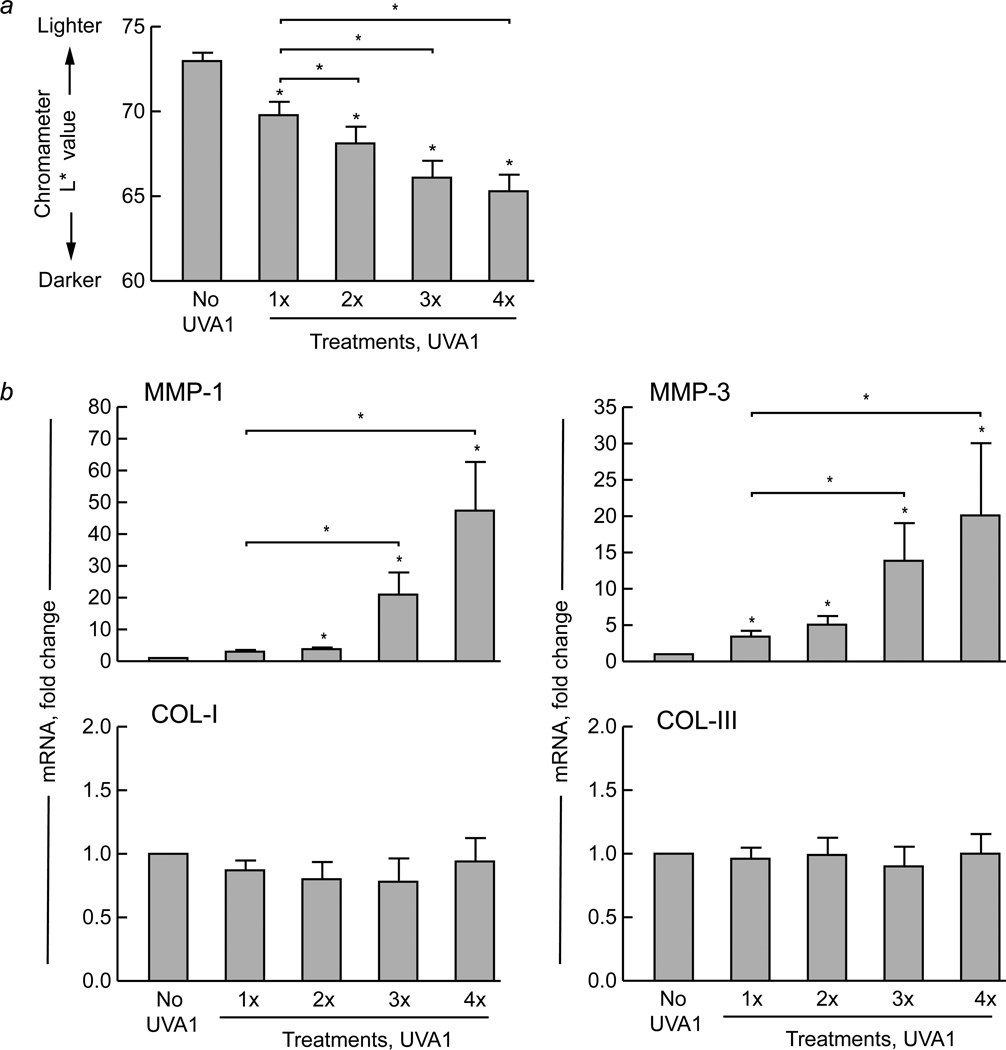
Results: Lightly pigmented human skin (L* >65) was exposed up to 4 times (1 exposure/d) to UV-A1 irradiation at a low dose (20 J/cm2), mimicking UV-A levels from strong sun exposure lasting approximately 2 hours. A single exposure to low-dose UV-A1 irradiation darkened skin slightly and did not alter matrix metalloproteinase 1 or type I procollagen gene expression. With repeated low-dose UV-A1 irradiation, skin darkened incrementally with each exposure. Despite this darkening, 2 or more exposures to low-dose UV-A1 irradiation significantly induced matrix metalloproteinase 1 gene expression, which increased progressively with successive exposures. Repeated UV-A1 exposures did not suppress type I procollagen expression.
Conclusions and relevance: A limited number of low-dose UV-A1 exposures, as commonly experienced in daily life, potentially promotes photoaging by affecting breakdown, rather than synthesis, of collagen. Progressive skin darkening in response to repeated low-dose UV-A1 exposures in lightly pigmented individuals does not prevent UV-A1-induced collagenolytic changes. Therefore, for optimal protection against skin damage, sunscreen formulations should filter all UV wavelengths, including UV-A1 irradiation.
Conflict of interest statement
Figures
References
-
- Fisher GJ, Datta SC, Talwar HS, et al. Molecular basis of sun-induced premature skin ageing and retinoid antagonism. Nature. 1996 Jan 25;379(6563):335–339. - PubMed
-
- Fisher GJ, Wang ZQ, Datta SC, Varani J, Kang S, Voorhees JJ. Pathophysiology of premature skin aging induced by ultraviolet light. N Engl J Med. 1997 Nov 13;337(20):1419–1428. - PubMed
-
- Tewari A, Grage MM, Harrison GI, Sarkany R, Young AR. UVA1 is skin deep: molecular and clinical implications. Photochem Photobiol Sci. 2013 Jan;12(1):95–103. - PubMed
Publication types
MeSH terms
Substances
Grants and funding
LinkOut - more resources
Full Text Sources
Other Literature Sources
Medical